

Published On 5/7/2026
|
Last update: 23:29 (Mecca time)
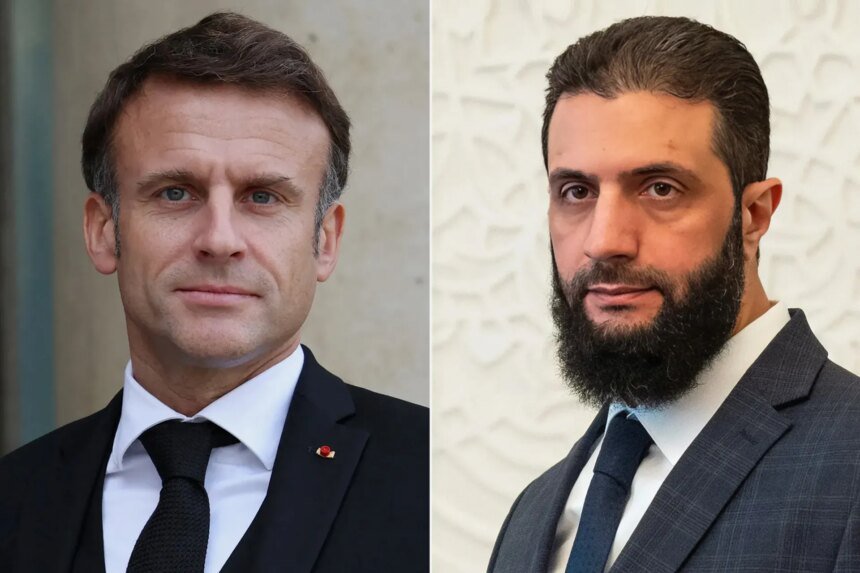
The Syrian presidency’s announcement of French President Emmanuel Macron’s intention to visit Damascus, at an unspecified later date, carries political, economic and strategic implications in a country burdened by post-war wounds, and in a region rife with intense political and security interactions that make approaching it, or coming into contact with it, a dangerous experience.
The international political weight of France gives Macron’s visit great importance as he is the first leader of a country in Western Europe to land in Damascus, and raises questions about the significance of the timing, and about the things that Paris is looking for in the Syrian quiver.
The nature of the delegation accompanying the French President, which includes investors and heads of companies, and the rationale for the French role in normalizing the relationship between the new regime in Damascus and the West, indicate a visit framed by a pair of goals, as Macron initially believes that he is worthy of grabbing a large piece of the “pie” of investments that observers expect to be promising in this Arab country, which is actively seeking to rebuild itself on new economic foundations that are closer to the free market and its requirements.

Strategic foothold
The resident of the Elysee in Damascus is also searching for a strategic foothold in a very important geographical node in the eastern Mediterranean, in continuation of Paris’s ambition, which cannot be mistaken by an observer, to revive French foreign glory, benefiting from the psychological momentum provided by the general French feeling that Paris was one of the first to sever its ties with the deposed regime, and closed its embassy, in protest against the systematic campaign of repression practiced by the deposed regime of Bashar al-Assad.
According to observers, the dialogue sessions between Macron and his Syrian counterpart, Ahmed Al-Sharaa, are expected to be dominated by topics of strengthening political relations between the two countries, expanding economic and investment cooperation, and also discussing developments in the region and the world, as well as supporting efforts to rebuild Syria, whose infrastructure was thrown to the ground, and whose shoulders bowed under the weight of air and ground bombardment carried out by the armed forces and military arms of the ousted regime over a period of about 14 years.
Syrian repositioning
Macron’s visit to Damascus comes at a time when the Syrian capital is repositioning itself politically towards the west, after many decades of falling into the arms of the socialist camp formed and led by the former Soviet Union, and coinciding with President Al-Sharaa’s attempt to rebuild the state in a way that enables it to regain its important role in the region.

Macron’s expected presence in Damascus cannot be read in isolation from the Western openness to the new Syrian leadership, which was represented in the form of lifting sanctions that had been troubling the Syrian economy, and visits by President Al-Shara to a number of Western capitals, including Paris and London, as well as his going to New York last year to participate in the 80th session of the United Nations General Assembly meetings, a visit that was considered, on a wide international scale, as an exceptional event, and an indication of a major and profound shift in Syria’s path.
But the “pie” of investments, or the share that Paris is looking for in this visit, may not be an easy one, as it may collide with an imperfect Syrian mood after a “series of mistakes” committed by the French in approaching the Kurdish problem, represented by supporting the autonomy sought by Syrian Kurdish elites through what is known as the “Syrian Democratic Forces” (SDF), taking advantage of the revolutionary forces’ preoccupation with combating the Assad regime and its Russian and Iranian allies in the country.
The visit may also be disturbed by Paris’s reception last month of Mazloum Abdi, Commander-in-Chief of the Syrian Democratic Forces, which Damascus sees as a French attempt to interfere in Syrian internal affairs by receiving Syrian figures who do not hold an official position.

Historical data
If the French President’s visit to Syria takes place, and there is no obstacle to it, and Macron puts his feet on the riches of Damascus as the first French president to visit since Nicolas Sarkozy in 2009, he will find himself facing a heritage crowded with historical and current data alike, some of which constitute a challenge, most important of which is the sensitivity of the historical experience between Paris, which is looking to expand its external influence by including the largest possible number of countries that it occupied in the 19th and 20th centuries within the Francophone “cloak”, Likewise, the new political regime in Syria was brought to power by a revolution that rejects dependency and promotes independence.
But whatever the outcome of the anticipated visit, and regardless of the nature and size of the French gains behind it, the new Syrian leadership will gain new political momentum through these discussions, as Macron will be the fourth leader of a state or regional body received by Syria after the Emir of the State of Qatar, Sheikh Tamim bin Hamad Al Thani, who arrived in Damascus late last year, followed by the President of the European Commission, Ursula von der Leyen last January, and then Ukrainian President Volodymyr. Zelensky in April of this year.
The arrival of the French President to Damascus, with the political role that Paris plays today in the international scene, specifically on the level of the European continent, will enable Syria to penetrate deeper into the map of political normalization with the West, which will help it face economic and security burdens that are not expected to leave Damascus with a sigh of relief before it completes the conditions for building the new state, including political stability within a calm and stable regional and international horizon.