

Published On 4/7/2026
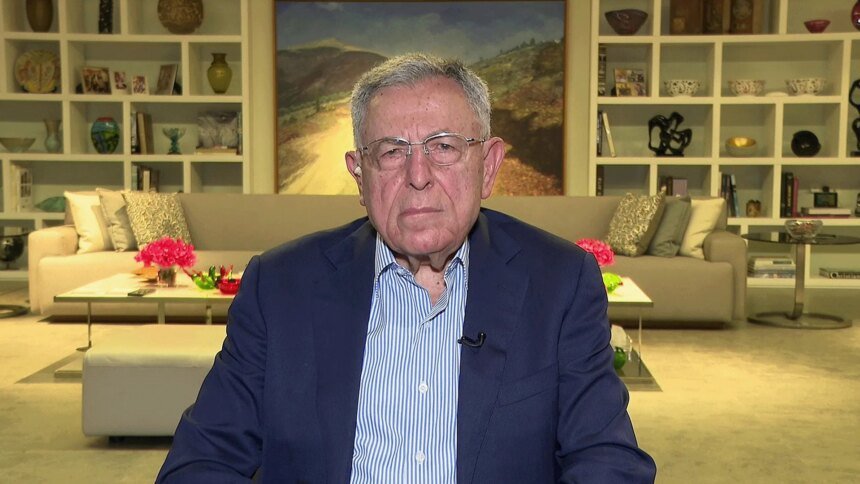
Former Lebanese Prime Minister Fouad Siniora presented an expanded political reading of the framework agreement proposed between Lebanon and Israel, in light of widespread internal controversy and sharp division around it, between those who see it as a necessary negotiating step, and those who consider it an ambiguous formula that may be used to justify political and security facts on the ground.
Siniora said in an interview with Al Jazeera from Mount Lebanon that the reality that Lebanon has reached came as a result of a series of developments related to Hezbollah’s movements that took place – as he put it – without consulting the Lebanese state and contrary to its will, which put the country in an extremely difficult situation and pushed it to the option of direct negotiations.
He stated that Lebanon had previously entered into indirect negotiations in 2022 to demarcate the exclusive economic zone, as well as in ceasefire negotiations on November 27, 2024, which shows – according to his opinion – that the negotiating path is not new to the Lebanese state.
He explained that the proposed framework agreement, which is being circulated under American sponsorship, is based on a contractual formula between Lebanon and Israel, and links several files, most notably the withdrawal of Hezbollah’s weapons, in exchange for an Israeli withdrawal, in addition to support for the Lebanese army and reconstruction. But he considered that this formula “hides great complications,” especially in light of Hezbollah’s rejection of the agreement, as well as the objection of regional parties to the direct negotiation process.
Siniora referred to what he described as “serving interests” between Israel and Hezbollah, saying that each of them has begun to benefit from the continued presence of the other to justify its position and role, which complicates any final settlement. He added that the theoretical goal of the framework is to reach a Lebanon free of weapons outside the country, but he criticized the absence of some essential provisions, most notably the explicit text on Israel’s withdrawal, as the term redeployment was used instead, in addition to not clearly including a ceasefire, and relying on good intentions on sensitive issues.
Lebanon’s right to sue Israel
He also pointed out that the article related to Lebanon’s right to sue Israel, as well as some provisions related to stopping the procedures, need greater legal scrutiny, warning that historical experiences with international agreements have shown the seriousness of the gaps and ambiguity in the wordings.
Regarding the position of the Lebanese state, Siniora said that launching the path of direct negotiations by President Joseph Aoun and Prime Minister Nawaf Salam was a step worthy of support, because it gives Lebanon an opportunity to advance on a path that leads to:
- cease-fire.
- Withdrawal of forces.
- Return of prisoners.
- Return of displaced people.
- Launching the reconstruction process.
But at the same time, he stressed that the Lebanese negotiating balance is no longer as strong as a result of developments on the ground, which requires – in his opinion – strengthening the negotiating team with legal and international expertise, especially those with experience in the United Nations and the Security Council, with the aim of filling the gaps in any final agreement.
Speaking about the regional context, he pointed out that the two negotiating tracks in Lebanon and Islamabad are intertwined, according to what he described as the “theory of bisecting vessels,” with each track affecting the other. He considered that there are mutual attempts by different parties to gain time, whether for political or electoral reasons, whether inside Israel or in the United States.
He also talked about considerations related to linking Lebanon’s files to broader tracks that include Iran and the United States, considering that the success of any agreement requires a careful balance between these intertwined interests, otherwise it will remain vulnerable to faltering.
Regarding passing the agreement inside Lebanon, Siniora stressed the need to take into account the Charter and the internal division, warning that any agreement that does not enjoy broad national consensus will be fragile in implementation.
He pointed out that the Lebanese government is adopting a clear trilogy to manage this stage:
- Firmness in implementing sovereign decisions, especially the exclusivity of weapons and the decision to war and peace.
- Wisdom in communicating with all parties to reduce tension.
- Cleverness in managing what is politically possible, through the principle of “what is not fully realized, most of it is not left behind.”
He considered that the opportunity still exists despite the difficult and complex circumstances.