

Celebrated author turns 100 years old
The Austrian one the author Ingeborg Bachmann (1926–1973) was active after modernism but before social media. A challenging time for a writer. When she proclaimed “Eliminate the phrases” from a podium in Frankfurt, in the 1950s and 1960s, she expressed a strict view of what the writer and literature should accomplish.
Fixed linguistic phrases inhabit our everyday way of small talk and consumption, and when this language is not challenged, it prevents us from perceiving and understanding. It keeps us from both visions and realities. Cold talk and advertising protect us from thinking about anxiety and conditions of production, protect us from thinking about past and ongoing wars.
Literature should, with the help of language, plow up what lies beneath the surface. Show the justified violence and lies. “Man must cope with the truth”, thought Bachmann. I am preparing a trip to Vienna and see that it is not terribly far between her old apartment and the Freud Museum.
Bachmann would have would have turned one hundred this year if she hadn’t died in a fire accident. She was a literary superstar of her time. Above all, she was celebrated as a poet during the 1950s, before turning to writing gracefully heated and heavily musical prose in the 60s. She exchanged letters and had a relationship with the poet Paul Celan. Lived for a few years together with the author Max Frisch.
She was praised, read and significant for other contemporary writers. For example, for the highly literate Günter Grasswho also wrote about her in the memoir “When you peel onions”. As for the great silly sadist of 20th century European literature Thomas Bernardwho portrayed her in the novel “Utpåning.”
And you see similarities to her in the one twenty years younger Elfriede Jelinek: Massively, pitch-dark and with an elusive ironic tone, the lies in the veneer of the Austrian bourgeoisie are attacked.
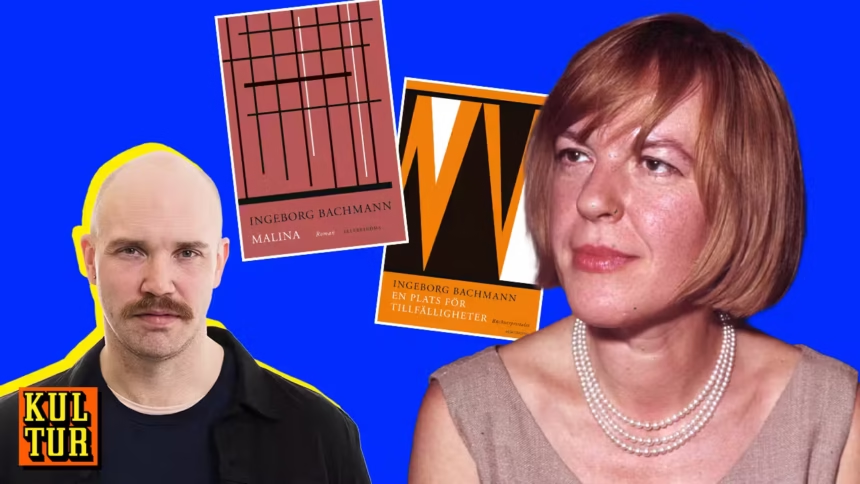
In Sweden is celebrated The Bachmann jubilee, among other things, by the publishing house Ellerströms reissuing the acclaimed novel “Malina” (1971). In addition, the shimmeringly beautiful Büchner prize, “A place for coincidences” (1965) is published for the first time in Swedish. Both are eminently translated into Swedish by Linda Ostergaard.
In his books, Bachmann obliterates the phrases in slightly different ways. In the almost hysterically difficult to summarize love novel “Malina”, the recognizable phrases are not avoided, but they are shone through so hard that they break. Turns into both despair and jokes. For example, she begins by explaining how the free time marker “Today” should be reserved for suicide: for everyone else, the word is simply meaningless.
Here is a fairly simple frame story. The female protagonist lives together with two orderly men, Ivan and Malina, on Ungargasse in Vienna. She works as a writer. She tries to stage a happy life by servilely waiting for the fugitive Ivan who lives across the street. She tries to come to terms with the apartment she shares with Malina and his critically demanding questions.
She has named their home “Ungargasseland”. Perhaps the tiny nation-building is a defense against a threateningly silent Austria. The Cold War is a fever under the novel’s restlessly reproduced street names. A Nazi father figure emerges as the most graphic wound.

The novel is packed of aborted contact attempts – half-written letters and hacked dialogues. And the communication that actually takes place is never intimate. The main character sorts what is said between her and Ivan into different “sentence types”. The relationship is theater. It’s not about what the self needs or wants from the not-quite-soft dude Ivan, she just reaches for him. It is as if desire itself becomes a place as well barricaded as the apartment.
She is, to put it simply, a piece of shit, this narrator. Desperate and clingy. Princess-like and traumatized. Somehow doomed to love. I think that Bachmann through her went as far as possible in terms of using language to portray subjective, human pain. It is clear that the form is blown up by such a measure. Of course someone has to die in the end.
In comparison with “Malina” is “A place for coincidences” a quiet and melancholic piece of writing, even though it moves considerably more in time and space. Here the Cold War is really frozen and the city is Berlin. When Bachmann was awarded the German-speaking world’s finest literary prize in 1964, she disguised a prose-lyrical meditation as the obligatory acceptance speech. The planes fly in low through the West German air corridors. War memories glow in the names of the places; Wannsee, Potsdam. Frothed beer and secrets spill from the corners of the mouths of the night blurs of the divided city.
To read “A place for coincidences” is to follow a mercilessly sharp spotlight cone as it sweeps over a subdued and debt-laden Berlin, where peace is a restless illness. It is a short text that I read hungrily, several times. I want to return to its dark, precise images.
In my head talks “A place for coincidences” with this year’s most attention-grabbing depiction of Berlin: “Perfection” by Vincenzo Latronicowhich was translated into Swedish by Johanna Hedenberg. Also the kind of sweep of compressed scenes. Digital creators Anna and Tom try to live up to the carefully edited images they post on social media. By the time the existential crisis hits, the novel has already locked them into a super slick summative narrative. There is no way out of superficiality.
At Bachmann! “Perfection” is a neat, tragicomic display that changes nothing in the reader. It captures a specific lifestyle aesthetic to the point, or at least cross-certainly. And it is a book based entirely on intact phrases.
I understand. To reading “Perfection” should feel claustrophobic and high-gloss like the stiff plastic you pry off a recently purchased Air pod box. But so sad to see this blankness mirrored.
Annihilation of phrases versus prose perfection, 1-0, this WC summer, if I may judge. When I parallelly dwell in Bachmann’s maddened mind, Latronico comes across as both flattering and flat.
Bachmann is a source of linguistic energy, full of life, long after she stopped writing about death.
Kristofer Folkhammar is a writer and literary critic.