

Published On 1/7/2026
|
Last update: 22:18 (Mecca time)
Amateurs and astronomy professionals around the world are in a state of comprehensive alert with the observation of two great sunspots bearing the numbers 4478 and 4479, which can be seen with the naked eye in a rare event that brings to mind the history of the discovery of solar cycles, which was begun by the German astronomer Heinrich Schwab in 1843.

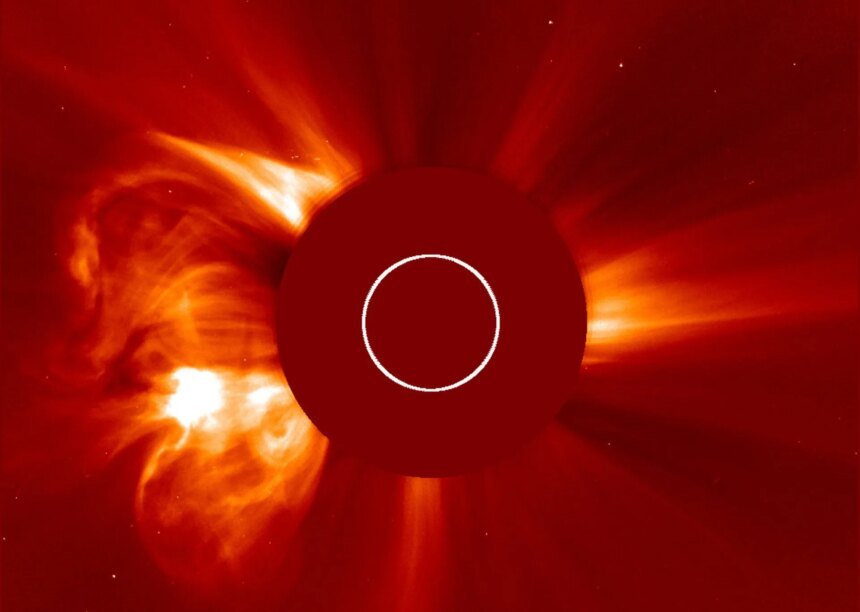
Current data issued by NASA’s Solar Dynamics Observatory prove that our closest star is experiencing an exceptional and unexpected peak of activity during its twenty-fifth cycle. Giant Spot 4479 exploded on the 30th of last month, releasing a massive super-class solar flare, which led to ionization of the Earth’s upper atmosphere and an immediate interruption of short-wave radio communications over North America and the Pacific Ocean.
The upcoming storm and the timing of the retreating spots
The matter did not stop at the immediate flash, but the Sun ejected a huge coronal mass ejection heading directly towards our planet, and simulation models issued by the National Oceanic and Atmospheric Administration indicate that this magnetic storm will arrive between the first and second of July, threatening the occurrence of geomagnetic disturbances of the second or third degree.
Read also
list of 2 itemsend of list
Regarding the nature of this threat and its technical impact, Ibrahim Al Jarwan, President of the Sharjah Astronomical Society, answers, saying: “These magnetic storms, despite the beauty of the aurora borealis they create, put energy networks, space communications, maritime and air navigation, and wireless communications under real pressure and danger.”

In response to readers’ questions about how long these spots will remain on the sun’s disk, Al-Jarwan explains: “This majestic scene will not last long, as due to the sun’s natural rotation around itself, which usually takes about 27 days, these two giant spots will be hidden from the eyes of the inhabitants of the Earth within a week, making the coming hours a golden window for observation.”
The safe triple guide to spotting the wrath of the sun
In the face of this exciting astronomical challenge, amateur astronomers and photographers are scrambling to document the event, but caution remains necessary to protect eyesight. The most appropriate and completely safe time to look at the sun without special devices, as some experts say, is the moment of sunset, when the light passes through the thick layers of the atmosphere, so that the sun appears as a clear disc filtered from the rays. During the rest of the day, approved eclipse glasses must be used to protect the retina from immediate damage.

Regarding how to protect while using optical devices, Professor Ibrahim Al-Jarwan concludes with a warning: “Looking at the sun through a telescope without a front filter is complete optical suicide, as it can cause complete blindness. Therefore, amateurs must use the safe method of projection onto a white sheet of paper behind the lens, or install a special solar filter that completely covers the front of the telescope to reduce light and heat by more than 99% before it enters the tube, which is the safest and most professional method.”