


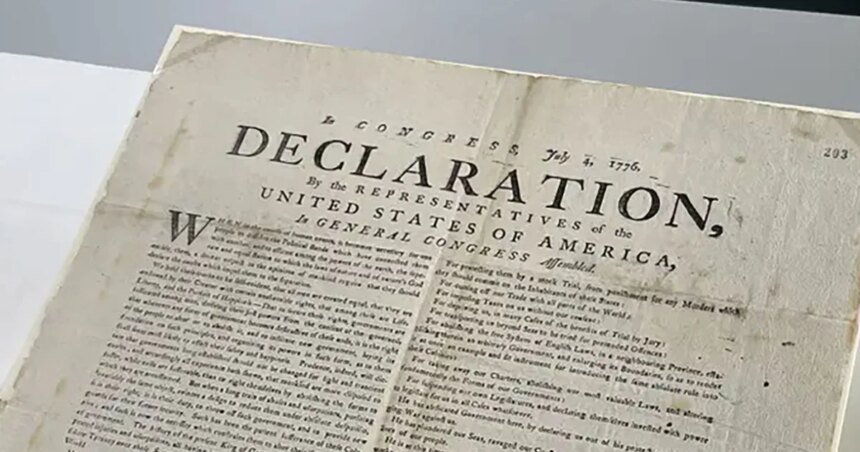
LONDON — A rare copy of the Declaration of Independence lost for 250 years has been discovered in London, where it is now the only known example of its kind outside the United States.
Limited time: Save 25% on NBC News subscription
Get exclusive reporting, live Q&As and ad-free reading.

Printed in Exeter, New Hampshire, just days after the Declaration was adopted on July 4, 1776, the document was intended to spread news of American independence throughout the American colonies.
The early copy remained tucked away in Britain’s National Archives until a volunteer cataloging records from the American Revolutionary War came across it in May this year among the papers of Royal Navy captains.
Only 11 copies of the so-called Exeter printing are known to survive, and until this discovery, none had been found outside the United States, Britain’s National Archives said in a press release Thursday.

The Declaration was among a collection of papers seized by the Royal Navy in December 1776, after it captured the American privateer vessel the Dalton, it said.
“It was an amazing addition to the story of the Dalton and the many other privateers that fought the British at sea,” Amanda Bevan, who leads the National Archives’ project cataloging Royal Navy correspondence from the American Revolution, told NBC News in an email Friday.
Privateers were privately owned ships authorized by the Continental Congress to attack British merchant vessels, disrupting trade and military supply lines during the Revolutionary War.
“But the presence of the Declaration on the Dalton made it clear that they were doing this in the service of an ideal,” Bevan said.
The seized papers also included the Dalton’s commission, which granted the ship permission from Continental Congress to attack British vessels, and other official orders explaining the rules of warfare for privateers.
Bevan said it was common for such documents to be read aloud to crews to reinforce discipline.

“But I like to think that if Captain Johnson read the orders and the commission to his crew, he also read the Declaration to them,” she added. “It would have made clear what they were fighting for and involved all of them in that hope for a better world.”
The Dalton’s mission, however, ended in defeat.
On Christmas Eve 1776, the 18-gun vessel commanded by Eleazer Johnson was pursued for seven hours by the 64-gun HMS Raisonnable, commanded by Capt. Thomas Fitzherbert of the Royal Navy, before being captured off the coast of Portugal. Johnson and his crew of about 120 men were later imprisoned in Plymouth, England.
The seized Declaration, listed simply as “another paper” in the Royal Navy inventory, remained buried in British archives for centuries. It was eventually uncovered by Michael Scurr, a retired insurance executive who has volunteered at Britain’s National Archives for the past 11 years.
While carrying out routine cataloging work designed to make the archives more accessible for future researchers, Scurr opened a report on the Dalton’s capture and immediately realized he had found something extraordinary.

“I thought, oh, right, this is definitely a Declaration of Independence,” Scurr told The Associated Press. “How exciting is this?”
To explain why the document went unnoticed for more than 250 years after it was seized by the British, historians say it is important to remember that its historical significance was not obvious when it was issued.
After the Dalton was seized, the Declaration “might not have had the same significance and status for someone in the Royal Navy then that it would have subsequently,” said Nicholas Guyatt, a professor of North American history at the University of Cambridge.
“From the British perspective, it was simply another document seized among many others,” he said. “It was filed away, sent back to London and ultimately disappeared into the archives.”
Guyatt added that the discovery serves as a reminder that physical archives continue to yield important historical finds.
“It reminds us that it still takes someone working through physical collections to uncover an object that can reshape our understanding of an event or provide entirely new historical context,” he said.