Culture
Of:
Mustafa Can
This is a cultural article which is part of Aftonbladet’s opinion journalism.
In the 1970s had we a recreational leader who darkened the room and rolled out old films from Brazil’s World Cup in 1958. The projector stuttered, the picture flickered, the world came to us in scratchy colors. There it came Didi, Wow, Pele and Garrinchathe poor boys who played as if the world had misunderstood their place.
The ball came alive for us refugee children and working-class children at Rydskolan, in Skövde. Garrincha opened the world from his right wing. In the final against Sweden, Pelé lifted the ball over his keeper and turned the world’s biggest game into a backyard in Brazil. Later came Rivelino, Jairzinho, Tostao, Zico, Honorable, Socrates and Falcon.
In the yards between the concrete blocks, we took their names.
We had the ball, the gravel, the concrete, the municipality’s cut grass and the snow when it was hard enough to become flat.
In the movies there were the misery, the barefoot play and the streets where the boys learned to conjure. In the dark we grasped with our legs. Class trip, colonial shadow, global south, exploitation and commodity chain came later. A ball was cheap. An empty surface could be anywhere. No one required a sailing club, boots, lift pass or mountain cabin.
Brazil played as if technology was the nobility of the poor. Every dribble carried something of the backstreet, the boy who refused to let go of the ball before the world learned his name.
The author Eduardo Galeano later gave words to what we suspected, the party in the body and the predatory drive behind it, how poor neighborhood clubs raise boys that others turn into goods. We saw the feet that carried the family on. Europe saw the contracts, the agents, the television rights, the body from poverty packaged and re-exported as a brand.
When Brazil met Italy in the WC 1982 I was so deep in the yellow shirt that a loss could upset existence. Brazil just needed a draw. Yet they continued to attack, as if caution were a shame. At 1–1 struck Cerezo a too loose fit and Paolo Rossi scored 2–1. When Brazil recovered to 2–2, the next carelessness came in the penalty area: Rossi again, 3–2.
For months I woke up with the loss. I ate with it, went to school with it, played with it, slept with it. For many years, Italy was a word the body hated before the thought.

Flamengo’s number ten had lost, the poor boy Zico from Quintino who formed a players’ union and turned technology into the counterforce of the working class. Sócrates had lost, the doctor, the smoker, the team captain who, in Corinthians, let the players vote on the club’s everyday life and turned football into an exercise in democracy in the midst of the military dictatorship. A team that carried direct election, disobedience and beauty in the same movement had been knocked out by a team that waited for freedom to strike a misstep.
The 1982 team was a political temperament that did not bow to generals. Italy knocked out the version of the world I wanted to believe in.
From that summer, Italy carried a debt that no national team has been able to pay off. Whoever they faced, I hoped for the opponents.
The Brazilian coach Tele Santana said that some defeats preserve a man better than victories. Some teams win a trophy. Others lose and take over the memory.
In Mexico four years later Brazil would take back the world. France awaited in the quarter-finals. Zico missed a penalty, Sócrates missed in the shootout, Julius Caesar hit the post. Michel Platini smiled his thin smile and Brazil had to pack away its beauty.
Afterwards I went to Rydskolan’s gymnasium and smashed windows worth thousands of kroner. Then I had no other form for what was going on in my body. I now despised two countries in world football.
In 1998, France forced the child in me to respect, but not forgiveness. Zidane from Marseille, son of Algerian parents. Thuram from Guadeloupe. The France of colonies and migration in blue shirts. When Zidane scored his goals in the final against Brazil, there was something of the promise of the old Brazilian teams; the body from the periphery steps into the center and makes the nation call its name.
But Algeria, Guadeloupe and the banlieues only got places when they won; after the party the suburbs awaited again.

When Brazil won WC 1994 had less of the elegance of 1982 but still enough of the old street and irreverence. In 2002 I watched the matches alone. It was not possible to have people in the room. I screamed, swore, got up and threw things at the wall and cried. When Ronaldo scored his goals in the final against Germany, it was as if the yellow story regained something that had been torn from it twenty years earlier.
Then something started to break.
It went slowly, like when a color fades but you keep calling it by its old name. The best players were shaped by European clubs, systems and discipline. The beauty remained, but the audacity was ground down in academies, contracts and systems.
The World Cup on home soil in 2014 did something to me that I initially pushed away. Not just the 1-7 loss against Germany. It was God involved in a game-like collapse, the hands to the sky, the prayers, the faces heading into a revival meeting rather than onto the pitch. Players fell to their knees and thanked the Lord, wept and offered the piety as a sponsored gesture in a game where almost everything was sold.
I myself sat in front of the television and longed for Garrincha’s crooked legs, Rivelino’s mustache and Sócrates who could turn a heel pass into a no to the generals.
I wanted to have back the ball from the pulpit. The Brazilian football I loved carried dictatorships, inequality, corruption, racism, exploitation of poor bodies. But on the field it had long had a sensuality that refused to be obedient. When it started to look like everything else, carrying the same gestures and fear of the unexpected, the sweater was still there but the fire was getting less oxygen.
But you don’t leave your first football country because the game has gotten worse. You stay with the leisure leader, the pitch in the suburb of Skövde, the summer of 1982, the glass in Rydskolan’s gymnastics hall, Ronaldo in 2002 and everything that taught you that poverty could have its own language.
Then came Spain.
I had no relation to Spain or its national team. The fact that my wife is half Spanish doesn’t explain anything – even if she wants to believe it.

Xavis, Iniestas and Puyols Spain wore elegance without Brazilian skin but with the same respect for the game: passes that cut through the defense, movements small enough to be missed by the goal-scorer.
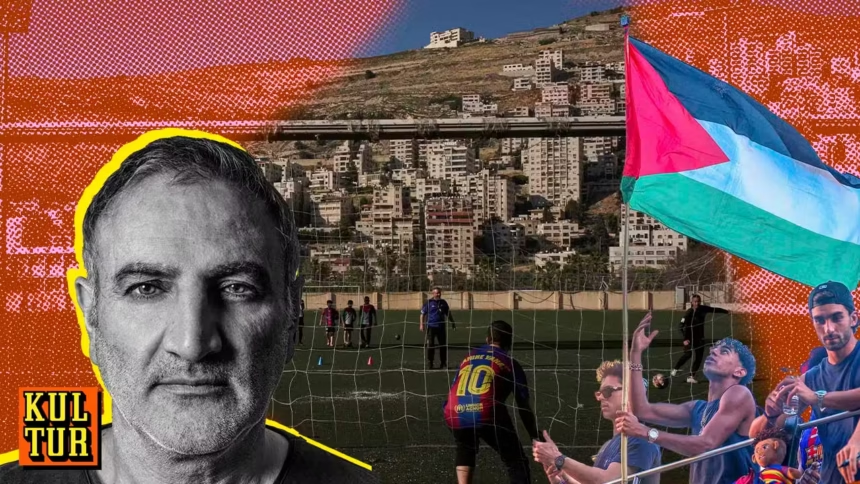
With Lamine Yamal came the movement back. He is from the working-class suburb of Rocafonda in Mataró, with a Moroccan father and mother from Equatorial Guinea, their flags on his shoes and Spain’s shirt on his back. During Barcelona’s league celebrations, he waved a Palestinian flag.
Israeli representatives called the flag a provocation. Prime Minister of Spain Pedro Sanchez wrote on X that those who see Yamal’s Palestinian flag as incitement to hate have either lost their judgment or been blinded by their own shame.
A seventeen year old held raise a flag from a people bombed, starved and driven away while Europe is silent. The genocide continues. Ethnic cleansing in the West Bank is accelerating. Gaza has been made a place where the world can no longer say it does not see. Sánchez’s government has long called the slaughter of civilians by its rightful name, speaking of international law, while European leaders have drawn the curtain over the mass graves and called it the right of self-defense.
Spain became a crack in Europe’s cowardice and complicity. Javier Bardem speaking up when silence is more career-friendly. Spain’s public service company RTVE marked against Israel’s participation in Eurovision, drawing a line in a European public accustomed to weighing dead Palestinian children against broadcast tables, sponsors and diplomatic courtesy. Gaza remains closed to reporters; those who are there are killed on a scale that has made the place the largest mass grave in the history of journalism. At the same time Israeli bulldozers do two thirds of pre-war Gaza to military roads, fortifications and empty zones where Palestinian life is supposed to have no place.
On the West Bank and in the ash landscape of the Gaza Strip, Palestinians hold on to Spain. I recognize the movement from the leisure park in Skövde: sometimes you choose a team far away to open a door in the confinement.
Bangladeshis have loved Argentina and Brazil because the teams held a different promise than Europe’s colonial masters. Maradona’s hand and his second goal against England in 1986 became a response from the humiliated to those who demanded clean hands from the poor while they themselves redrawn world maps.

The Neapolitans loved Maradona because he made a despised city dangerous. The once poor child made Italy’s scorned south stare back at the money, clubs and contempt of the north.
Children in French suburbs could see Zidane and understand that the face of the Republic could also bear their surnames, their silences, their parents’ hands. Children in Palestine can see Yamal with the flag and understand that sometimes a team becomes a crack in the world’s indifference.
Football loyalties rarely follow the passport. They follow the class memory, the colonial injury, the old humiliation. You don’t always cheer for a country, but for a possible answer.
Therefore, my Spain is something other than tapas, in-laws and holiday lights. It’s Yamal with the flag, the coach Pep Guardiola who use their position for more than tactical boards, Sánchez’s government stopping arms flows and dock workers in Barcelona who refuse to load military equipment to Israel.
It is Spain in spite of Spain. An old empire with colonial traces, racism and borders against Africa’s poor, but now also a country that has dragged Palestine into the European rooms where the entertainment should preferably go on undisturbed.
After fifty years out of religious allegiance to Brazil, I want Spain to win the World Cup. A child does not leave Garrincha, Pelé, Zico and Sócrates without something happening to the world. Maybe I’ve just followed the same trail; from the poor boys of Brazil to Maradona in Villa Fiorito, Zidane in Marseille, Yamal in Rocafonda, from the pitch below the concrete lines to Ramallah’s television screens.
I follow the ball away from those who made it obedient, to the place where it is right now saying something true about the world.