The Tunisian team was the first to achieve the first Arab and African victories in the World Cup competitions, when it won the 1978 World Cup over the Mexican team with a hat-trick that shook the world, as the International Federation of Association Football (FIFA) then increased the number of African football representatives in the next World Cup to three teams.
However, this achievement was not matched by an improvement in the level of results and returns, as evidenced by the numerous participations of the “Eagles of Carthage” in the finals, reaching 7 participations, which placed the Tunisian team in the category of the most prominent African teams in the World Cup, but despite that, it was unable to cross the threshold of the first round, even on one occasion.
Read also
list of 2 itemsend of list
In this edition, during which the number of participants doubled to 48 teams, there were greater opportunities to reach the second round, since finishing the first round in third place in the group competitions may allow for qualification, but the Tunisian team disappointed, and was the only African team out of 9 teams that failed to reach the second round.
However, the modesty of Tunisian participation in this World Cup is not only evident in its mere lag behind the rest of its neighbors from the African continent, but also extends to the results recorded and the performances presented, making the seventh attendance of the “Eagles of Carthage” in the World Cup the worst and weakest ever.
The modesty of Tunisian participation in this World Cup is not only evident in its mere lag behind the rest of its neighbors from the African continent, but also extends to the results recorded and the performance that was presented.
For the first time in the history of its participation, the Tunisian team failed to score any point after 3 defeats against Sweden, Japan and the Netherlands, ranking in 47th place, penultimate in the standings, after conceding 12 times.
The Tunisia national team opened its participation in this World Cup with a shocking and humiliating loss against the Swedish national team, which is not considered one of the strong teams currently since it qualified with difficulty through the European playoff.
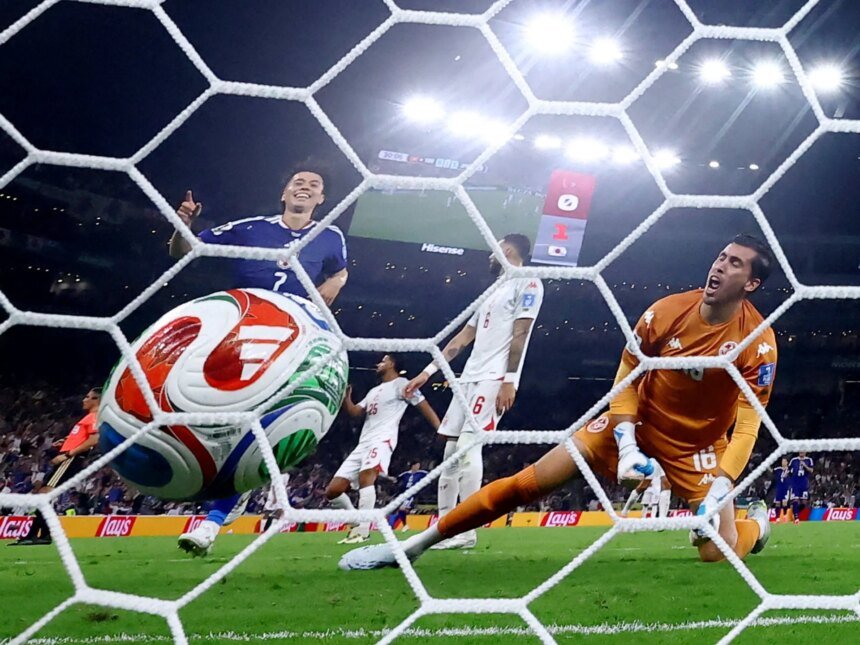
Before getting over the remnants of the shock of the first match, the Tunisian team suffered its second defeat in the tournament against the Japanese team, which exposed all the faults and shortcomings of the Tunisia team, and rained down four goals without a response. This defeat was enough for the “Eagles” to bid farewell to the World Cup from the first round, ending the shameful participation with a new defeat against the Netherlands team, which settled the confrontation with three goals with mercy.
In exchange for conceding 12 goals, the Tunisian team was content with scoring only two goals, which revealed a clear weakness at the offensive level and a complete absence of solutions, despite the many names that were invited to register their presence in a disastrous participation that caused the Tunisian team to lose its prestige.
It is clear that the Tunisian national team stormed into the tournament without good preparation, and this matter is the responsibility of the Tunisian Football Federation, as well as the technical staff led by Sabri Lamouchi, who took over the technical reins immediately after the last edition of the African Cup, where national coach Sami Trabelsi was dismissed and replaced by Frenchman of Tunisian origins, Sabri Lamouchi, who completely failed to prepare the team in a good way.
This weakness in preparation and preparing was embodied in the clear failure to determine the list of players participating in the tournament, as modest players were invited in exchange for the exclusion of veteran and experienced elements who are familiar with the value of World Cup confrontations, such as Ferjani Sassi and Issa Al-Aidouni, who are currently active in the Qatari League, Ali Maaloul, the former star of Al-Ahly of Egypt, Yassine Meriah, captain of Tunisian Esperance, and Issam El-Gebali, who is brilliant in the Japanese League.
It is clear that the Tunisian national team entered the tournament without good preparation, and this matter is the responsibility of the Tunisian Football Federation, as well as the technical staff led by Sabri Lamouchi.
In the absence of these players who shone in the 2022 Qatar World Cup and contributed to achieving a historic victory over the French team, the Tunisian team lacked balance and strength of character, especially since most of the players who were invited to represent Tunisia in this tournament lack experience, mental and physical toughness, and most importantly, talent, since most of them lack individual and technical skills and lack the football savvy that distinguished the Tunisian national teams and teams.
The features of failure emerged a few days before the start of the tournament, as the Tunisian team played a friendly match against its Belgian counterpart and ended with a five-point defeat. In that confrontation, the “Eagles of Carthage” were completely lost and without any spirit, as there was no rush or cohesion, and it became clear that the technical staff was completely incapable of making the necessary adjustments and necessary reforms.
Indicators of great weakness emerged at the level of mental, physical and technical preparation since the first match, as the team was unable to keep up with the style of its Swedish competitor, and there were no clearly defined technical and tactical components that would provide a single piece of evidence that the technical staff succeeded in developing plans and playing methods that are in line with the value of this event and take into account the strengths of Tunisian football.
What confirms the modest abilities of coach Sabri Lamouchi is that the Tunisian team, which succeeded, thanks to its defensive solidity, in securing its seventh appearance in the World Cup, where it did not concede a single goal throughout the qualifying stages, conceded 12 goals in three matches during the finals.
Going back a little, the Tunisian national team only conceded one goal during the Qatar 2022 World Cup, even though it was in a strong group that included the French national team, which reached the final round, and the Danish and Australian national teams.
Signs of failure emerged a few days before the start of the tournament, as the Tunisian team played a friendly match against its Belgian counterpart and ended with a five-point defeat.
During the beginning of the World Cup, the technical staff bet on mobilizing the defense by fielding an additional player in the center, in exchange for relying on two full-backs and three players in the midfield in order to tighten the defensive coverage, but Lamouchi’s reading was wrong since the Tunisian team conceded two goals early as a result of the wrong positioning of a number of players who played in positions other than their positions, as well as because of physical and mental fragility.
The first test in the tournament ruled that Lamouchi should leave after one match, as he was dismissed with record speed by a decision from the Tunisian Federation, which implicitly acknowledged its mistake in choosing him as coach of the Tunisian national team, before an agreement was quickly reached with his compatriot Hervé Renard to succeed him within an “emergency” plan aimed at reducing losses and limiting damage.
However, the situation did not change, as the “Eagles of Carthage” continued to fall from their heights and reached rock bottom in this World Cup after providing a modest and disappointing result over the course of 3 matches played by the Tunisian team without clear technical plans, and without ideas and alternative solutions that could change the difficult reality.
This is due to the state of despair and frustration that has afflicted the players since the friendly loss against the Belgian national team, the poor psychological preparation, and most importantly the ill-considered choices of the list of players participating in this tournament.
That fatal blow that occurred in the first match led to a complete collapse of morale, causing doubt among the players, who were like “ghosts” on the field.
A state of confusion, loss, and lack of tactical discipline prevailed in light of the inability of Renard, the “emergency coach,” to overcome the barrier of exaggerated fear and limit the effects of the sharp decline in the level of the defensive system, which lost all its constants despite the insistence on installing 3 players in the defense axis, as well as changing the main goalkeeper, Mohib Al-Shamekh, and giving the opportunity to his colleague Ayman Dahman.
This exaggerated fear led to a repetition of the scenario of the first match in the following two matches, as the goal was conceded twice early against the Japanese team, and the same thing happened against the Dutch team, which did not need more than 7 minutes to advance with a double.
A state of confusion, loss, and lack of tactical discipline prevailed in light of the inability of Renard, the “emergency coach,” to overcome the barrier of exaggerated fear and limit the effects of the sharp decline at the level of the defense system, which has lost all its constants.
Repair is possible
Yes, the “Eagles” have fallen from their perches, their claws were trimmed, their wings were cut off, and their eyesight was impaired, but despite that, reform is still possible, and recovery from the repercussions of the World Cup zero scandal remains very likely.
But it requires a lot of wisdom, insight, and taking bold and revolutionary decisions in all fields in order to truly advance the reality of Tunisian football, which is living under the impact of severe problems, some of which are linked to the lack of continuity at the level of the technical staff, and others are related to the low level of the local league, and the complete absence of projects that improve stadiums and sports facilities.
In the first aspect of the urgent reforms, in order for a comprehensive football renaissance to occur and the Tunisian national team is able to shine in the World Cup and compete strongly in the African Cup, it is necessary to select the first coach for the Tunisian national team accurately, according to precise rules, while giving him sufficient time, meaning at least 4 years (which is the period of time separating two World Cup sessions).
This is in order to embody his sporting project and reap the fruits of his work, as the lack of stability at the level of the technical staff greatly affected the stability of the Tunisian national team and caused its results to deteriorate.
In this regard, the Tunisian national team achieved a negative number in the number of technicians who trained it from the 2022 World Cup until the current World Cup, as their number reached exactly 7 coaches in a period of time not exceeding 4 years, that is, an average of approximately two coaches every year.
They are Jalal Al-Qadiri, Montaser Al-Wahshi, Fawzi Benzarti, Qais Al-Yaqoubi, Sami Trabelsi, then Sabri, Al-Lamouchi and finally Hervé Renard.
Yes, the “Eagles” have fallen from their perches, their claws were trimmed, their wings were cut off, and their eyesight was impaired, but despite that, reform is still possible, and recovery from the repercussions of the World Cup zero scandal remains very likely.
Local league
As for the second factor that must be present in order for Tunisian football to see the desired improvement and for the “Eagles of Carthage” team, which was satisfied with a single continental title achieved 22 years ago, to be able to shine continentally and globally, it is linked to the inevitability of raising the level of the local league, and improving the capabilities of the Tunisian teams, which are considered the main reservoir of funding for the Tunisian team, but most of them live under the impact of stifling financial problems.
With the exception of Esperance of Tunisia, which maintained its financial balance and succeeded in achieving the African Champions League title five times thanks to its administrative stability and continued support from the club’s president, the wealthy businessman Hamdi Medab, the rest of the Tunisian teams are complaining of deep financial crises. Due to weak resources and lack of financial independence.
This directly contributed to its distance from continental competition for many years, and the evidence for this is that the last Tunisian title in the Champions League was achieved thanks to a team other than Esperance Sportive, which was won by Etoile du Sahel 19 years ago.
It is certain that the time has come to change the laws and legislation that besiege Tunisian teams and restrict them financially. The currently approved law requires that these clubs not be given a commercial character, and therefore they cannot turn into “companies” that can generate profits and revenues that help them develop and respond to successive changes in the world of football.
Tunisia, which previously organized three African Cups – in 1965, 1994 and 2004 – today suffers from great poverty in terms of sports stadiums.
Infrastructure
The third factor is related to the corrosion of sports structures and facilities and their failure to undertake the necessary maintenance and development, which is highlighted by the decline in the number of stadiums qualified to host matches.
Tunisia, which previously organized three African Cup tournaments in 1965, 1994 and 2004, today suffers from great poverty at the level of sports stadiums, which has caused increasing suffering for Tunisian national teams, as they are forced to host their competitors in continental competitions at Radès Stadium, which is considered hardly the only stadium in Tunisia that has been approved by the Confederation of African Football to host international matches.
In parallel, other stadiums that had previously hosted major international matches, especially in the African Cup tournaments, have become out of service due to the lack of will to renovate them, and the presence of suspicions of corruption that have hampered their development projects, similar to the file of El Menzah Stadium, for which nearly 7 years ago the necessary financial funds were allocated for its reconstruction, but to this day it is still far from being fully prepared.
The disappointing participation exposed all the facts, and revealed the inability of Tunisian football supervisors to make the right decisions, as it became clear that the decision to dismiss Sami Trabelsi was not correct, but rather introduced a state of confusion and imbalance within the Tunisian national team.
What is certain is that betting on the local coach, as most Arab teams from North African countries have done, would be desirable and very beneficial.
The opinions expressed in the article do not necessarily reflect the editorial position of Al Jazeera Network.