


Published on 6/29/2026
For many years, the golden advice for those who want to protect their heart has been to reduce fat as much as possible. But recent research has redrawn the picture: not all fats are the same. Rather, some foods rich in fats can be an ally for heart health, if we know which fats to choose and how to incorporate them into a balanced dietary pattern.
A report published by the American “Time” magazine indicates that foods containing unsaturated fats can reduce the risk of some chronic diseases, when they replace saturated fats and are eaten as part of a diet rich in fiber and vegetables.
Read also
list of 2 itemsend of list
From the “obsession” with criminalizing fat to understanding its type
In the 1980s, many dietary guidelines focused on a general idea: “Reduce fat.” With the food industry’s messages, a simplistic equation has become entrenched in people’s minds: all fat is bad, and all low-fat food is good.
But today’s nutrition experts differentiate between:
- Saturated fat: It is found in abundance in fatty meats, butter, margarine, and some industrial baked goods, and excessive amounts of it are linked to high harmful cholesterol (LDL) and an increased risk of heart disease.
- Unsaturated fats: Found in fatty fish, nuts, seeds, some oils, and plant foods such as avocados and soy, studies have shown that they improve blood lipid profile and support heart health.
“It’s not the fat itself that’s the problem, it’s the type and amount of fat,” explains Christina Petersen, an assistant professor of nutritional sciences at Penn State University, who adds that swapping out some of the saturated fat for unsaturated fat is a clear step in the direction of better heart health. But even with healthy fats, high-fat foods should be “balanced with good sources of fiber and protein,” says Maya Vadivelo, an assistant professor of nutrition and food science at the University of Rhode Island.
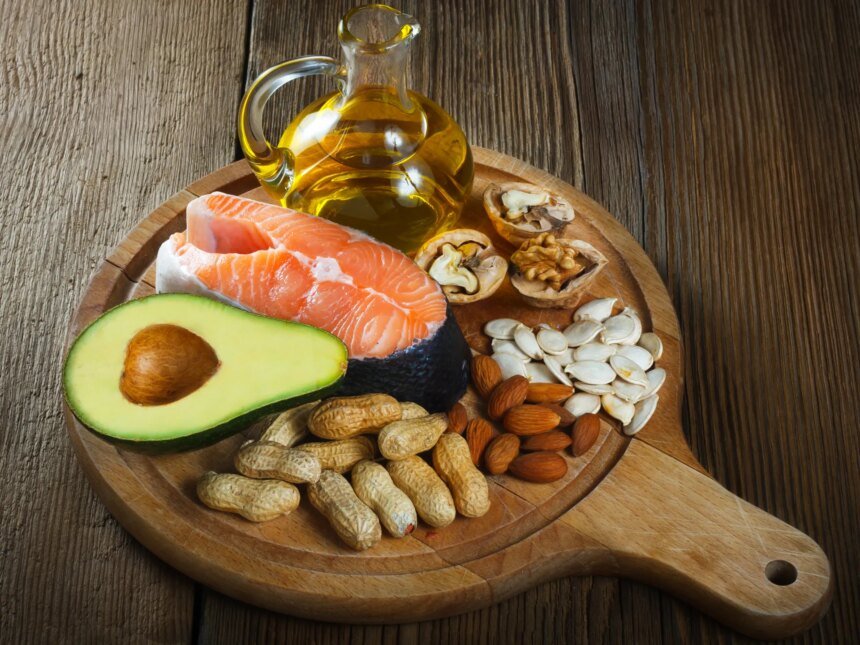
Below are 5 foods that provide several types of unsaturated fats that have been proven to promote health, in addition to containing other important nutrients.
1. Fatty fish
Salmon, sardines, mackerel, and anchovies are among the most popular fatty fish, meaning those that contain large amounts of oils in their flesh. These oils are rich in omega-3 fatty acids, which the body uses as “building blocks” for cell membranes and chemical messengers that reduce inflammation and support heart health.

“It’s one of the best sources of healthy fats, and it also provides protein and vitamins,” says Matti Marklund, a public health researcher at Johns Hopkins University. Studies have shown that people with higher levels of omega-3 in the blood have a lower risk of premature death and heart disease. Eating fatty fish is also associated with improved blood triglycerides, a slight decrease in blood pressure, and possibly support for some cognitive functions.
In practice, many experts recommend eating fatty fish twice a week, preferably grilled or cooked in ways with low added fat, with a plate of vegetables or whole grains.
2. Nuts and seeds
Nuts – such as almonds, walnuts, pistachios, and pecans – and seeds – such as sunflower seeds and flax seeds – are rich in unsaturated fats, especially linoleic acid from the “omega-6” family. Marklund says that this acid has been linked in studies to lowering harmful cholesterol, improving some indicators of heart health, and possibly lowering the risk of developing type 2 diabetes through improving glucose metabolism.
Christina Petersen found that people who switched to eating pecans as a snack for 12 weeks improved their heart health. She points out that in addition to eating whole nuts, you can get linoleic acid from nut butter, while being careful of the sugar and sodium contained in them.
Christina adds that eating a mixture of nuts is a great thing, because each type provides one of the fatty acids. Walnuts contain a version of “omega-3,” called alpha-linolenic acid, which is found abundantly in fatty fish. She says that people who do not eat fish can get “omega-3” from walnuts.

3. A variety of healthy oils
Seed oils are another source of linoleic acid and alpha-linolenic acid. Like nuts, these oils contain much more unsaturated fats than saturated fats. Soybean oil and canola oil provide polyunsaturated fats that are beneficial for heart health.
Olive oil is also an excellent source of another type of unsaturated fat, which is monounsaturated fat, and Marklund explains that cold-pressed extra virgin olive oil is rich in antioxidants and phenolic compounds. “There is a benefit to diversifying oils,” says Maya Vadivelu.
But oils remain very concentrated in calories, as one tablespoon provides about 120 calories. Therefore, experts recommend using them consciously: a teaspoon to a tablespoon for cooking vegetables or meat, a teaspoon of olive oil on salads instead of ready-made sauces rich in saturated fats or sugar, avoid “drinking” the oil or excessively adding it to dishes.

4. Soy foods
Soy-based foods are often overlooked by people as a source of healthy fats. These foods, including soybeans and tofu, are good choices because, in addition to their unsaturated fats, they provide protein and fiber. It also contains soy isoflavones, which are plant compounds that can interact with receptors in the body for the female hormone estrogen, says Maya Vadivelo.
Studies have linked diets rich in soy foods, especially when they replace less healthy foods, to reduced risks of breast cancer.
Soy can be introduced into the diet by: using tofu as a partial meat substitute in some dishes, adding green soybeans to salads, trying “tempeh” for those who love fermented foods, as part of grilled or stewed dishes.
5. Avocado and chia seeds
Avocados contain a variety of healthy unsaturated fats, especially monounsaturated fats, the same type found in olive oil, with a very small amount of saturated fats. Avocados are also rich in nutrients with a combination of fiber, vitamins and minerals, such as potassium, which may lower blood pressure.

Chia seeds are rich in a mixture of unsaturated fats, soluble fiber, and protein. Adding a spoon or two of chia to milk, yogurt, smoothies, or oatmeal can contribute to increasing the feeling of fullness and improving intestinal health.
It is noteworthy that the average consumption of fiber for many people is less than the recommended amounts, which makes foods rich in healthy fats and fiber – such as avocados, chia seeds, and nuts – a beneficial addition.
How do we balance quantity?
Despite the benefits of these foods, the quantity factor remains important. Fat provides more than twice the calories per gram of protein or carbohydrates.
Therefore, scientific bodies advise that the total fat in the diet constitute about 20 to 35% of daily calories, while reducing saturated fats to less than 10%, and focusing on replacing them with unsaturated fats found in whole natural foods.
The dividing line is simple: we don’t need a “no fat diet”, but rather the right kind of fat, in the right amounts. Introducing these five foods can turn fat from an “enemy” into a staple of a heart-friendly diet, if we stick to moderation and variety.