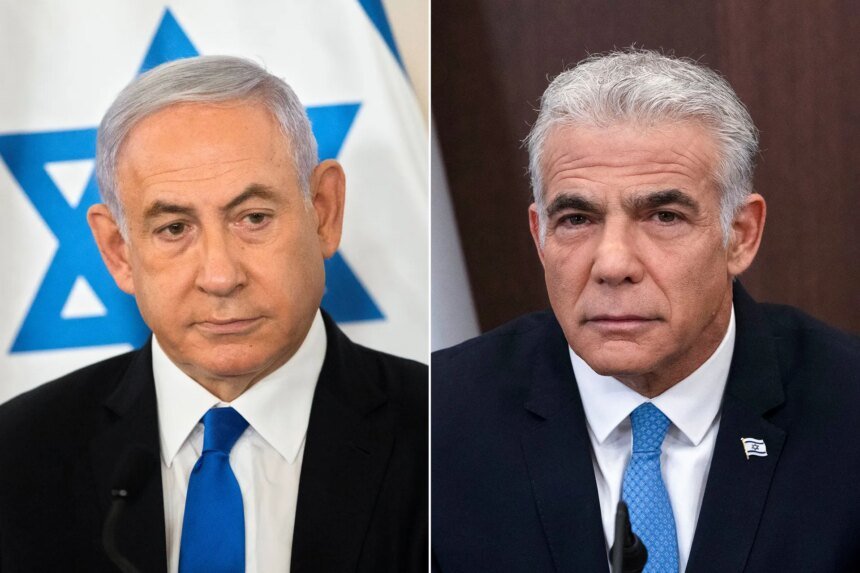
On an afternoon burdened by the files of Iran and Lebanon, Israeli Prime Minister Benjamin Netanyahu and Israeli opposition leader Yair Lapid sat for 45 minutes in a security meeting attended by the new military secretary to the Prime Minister, Major General Guy Marquisano.
The details published by Yedioth Ahronoth seemed brief, but they came after a long gap, as two and a half months had passed without a security briefing between the Prime Minister and the Leader of the Opposition, at a stage in which Israel is moving between a framework agreement with Lebanon, American arrangements with Iran, and elections that are close to turning every institutional measure into a political material.
Read also
list of 2 itemsend of list
And it opened Political affairs correspondent for Yedioth Ahronoth Itamar Eichner reported the news from the perspective of time, explaining that the meeting he The first was about two and a half months ago, and was 45 minutes long, in the presence of the new military secretary.
Two weeks earlier, in the same newspaper, Morane Azoulay placed this delay in its legal and political context, when she wrote that the last security update Lapid received was on April 15, and that Israeli law requires the prime minister to brief the opposition leader at least once a month.
This background gives the meeting a special meaning, as it is a duty stipulated in the Knesset law since 2000, not a personal initiative by Netanyahu, and it comes at a time when the delay itself has turned into news, as Yedioth states that Lapid’s office went more than once to Netanyahu’s office because of the crystallized US-Iranian agreement, without setting a quick date for it.

Here, Lapid’s position on the scene stands out. He is not only the leader of an opposition party, but also a former prime minister and the official head of the opposition due to the Leader of the Opposition Law that was approved in the Knesset in 2000. He is supposed to see the raw security material that the Israeli press calls “the black material.” Therefore, the question is not related to Lapid’s right to be briefed, but rather to the reason that made it return at this specific time.
Memory of briefings
The memory of the meetings between the two men reveals that these security briefings were routine in law, but they were often linked to severe security stations. In August 2022, when Lapid was prime minister and Netanyahu was leader of the opposition, Netanyahu left a briefing on the Iranian nuclear file, saying that he “came out more worried,” and accused Lapid and Gantz of “falling asleep during the guard shift” in front of the nuclear agreement. Lapid responded at the time with a remarkable sentence, “On national security issues, politics must not allow the Israeli position to be sabotaged.” United towards Iran.
After Netanyahu returned to power, the roles were reversed and the language remained almost the same. In April 2023, and in light of an escalation that extended to Lebanon, Gaza, and the West Bank, Lapid left a briefing at the Ministry of Defense by saying that he “entered anxious and left more anxious,” adding that he would support any step recommended by the security services, but he believed that Netanyahu’s government was not qualified to manage the moment.

The picture expands after October 7, as the Israeli Broadcasting Corporation documented Netanyahu’s meeting with Lapid and Gantz on the day of the attack, when Netanyahu proposed a broad emergency government, andHe agreed Lapid was on principle, but he stipulated a “professional” government that would not keep the composition of Itamar Ben Gvir and Bezalel Smotrich as it is. At that moment, the line that remained present later appeared, which was a limited security consensus and a deep political disagreement.
Yedioth Ahronoth and Channel 13 monitoring agree that Lapid used his statements after the briefings to confirm this line, in May 2025, when he came out of a security update to say that the prisoner deal required “a single cabinet decision,” and offered Netanyahu a political safety net.
In August of the same year, after a meeting that lasted about 40 minutes, Lapid said that “occupying Gaza is a very bad idea” operationally, morally, and economically. However, in February 2026, with the Iran issue heating up, he chose a different tone, when he said that “all of Israel is united before Iran.” Thus, the briefing became a small window into the way Lapid is trying to combine a security responsibility that he does not want to abandon, and a political opposition that he does not want to dilute.
Iran and Lebanon
In today’s meeting, the separation between Iran and Lebanon does not seem possible, and Yedioth Ahronoth had linked Lapid’s previous requests to the US-Iranian agreement, and to what Israeli sources described as major damage to Israeli security interests. On the other hand, the briefing came after Netanyahu’s conference on the framework agreement with Lebanon, where he presented the American and Lebanese recognition of Israel remaining in the “security belt” as a major achievement.
Here, the readings of the Israeli media intersect, as Kan 11 reported Netanyahu’s account of the agreement as a confirmation of Israel’s right to remain and work as long as the threat persists. On the other hand, Israel Hayom highlighted responses from the right and left questioning the agreement, as Ben Gvir described it as a big mistake, while Lapid accused Netanyahu of agreeing to a withdrawal without a clear return.

In this sense, the two files meet in one question. Was the briefing due to Iran or Lebanon? The more accurate formulation is that Iran gave the meeting its security necessity, and Lebanon gave it its political timing. The agreement with Beirut requires internal cover, or at least an institutional image that says that the prime minister informs the opposition of the sensitive moment. As for Iran, it is the file that allows Netanyahu and Lapid to repeat the language of “unity” without paying the price of actual political unity.
Impossible unity
The meeting coincided with Netanyahu’s new campaign for a “broad national government,” and here the Israeli media does not read the event as a security measure separate from the elections. On Channel 12, Amit Segal and Ben Caspit agree that Netanyahu is using unity rhetoric as part of managing his upcoming electoral battle, but they differ in interpreting the purpose.
Segal believes that Netanyahu is trying to improve his position before voters fed up with division, and is not proposing complete unity as much as he is offering others to join a government based on his base, while Summarizes Ben Caspit said that Netanyahu is putting “one foot in unity and one foot in division,” and the goal is ultimately to form a government at any cost.

Haaretz gave the reading a more intense character – according to Jonathan Lees – because Netanyahu’s announcement of a broad government – according to his analysis – lacks real political viability, and comes in light of Lebanon’s faltering and American pressure. As for Israel Hayom, it reveals that the doubt did not come only from the opposition, but from within the right as well, as Ben Gvir’s circles fear that Netanyahu is preparing for a political turn that will remove him from the next government.
In this climate, Lapid was keen to block any unilateral interpretation of the meeting after the briefing. He attacked Netanyahu’s talk about a broad government – according to Channel 13 – and said that Yesh Atid would not sit with him, warning of “parties affiliated with Netanyahu” that he would serve his return if he was unable to win the upcoming elections alone or with his far-right allies. Thus, the briefing remained in its narrow place, as it is a necessary security channel, not a political bridge.
In conclusion, the meetings between Netanyahu and Lapid revealed that the security briefing in Israel is a routine procedure that turns, in times of war and elections, into a mirror of the political crisis.
Although today’s meeting brought together Iran and Lebanon in one room, it also carried an image that Netanyahu wanted of a prime minister who shared the “security destiny” with the opposition. Lapid accepted to sit at the security table, then quickly left politically, leaving the question open: Was the briefing a legal duty, or a calculated shot in Netanyahu’s new campaign?