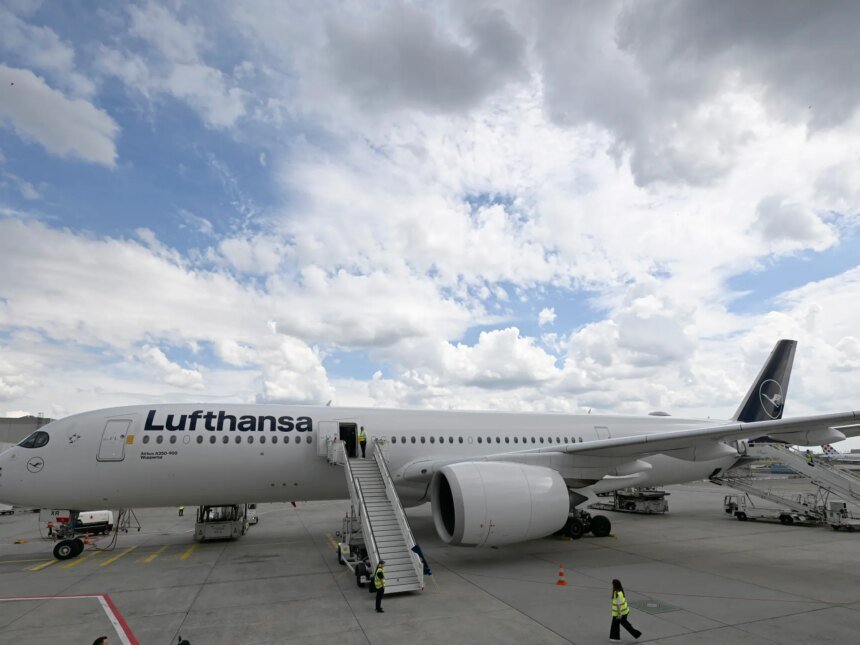
Published on 6/30/2026
|
Last update: 7/1/2026 00:39 (Mecca time)
CEO of the German cargo company Lufthansa, Ashwin Bhatt, said that Gulf airlines have returned to competition in the air cargo sector with the end of the war in the Middle East.
Bhatt added, according to Bloomberg, that the war disrupted the operations of competing companies in the Gulf, which led to an increase in demand for Lufthansa Cargo services.
Read also
list of 4 itemsend of list
However, this was “a temporary phase due to the conflict in the Middle East,” according to Bhatt’s description, adding that competition in the air cargo market has now begun to return, and that some competitors have regained about 95% of the operational capacity before the war, without mentioning their names.
Bhatt confirmed that the demand for Lufthansa Cargo remains stable, and the company has not been forced to make a significant reduction in its fees, which is a “surprising” matter, as he described it, because demand for freight services is usually weak in June.
Bloomberg reported that Lufthansa Cargo achieved operating profits amounting to 324 million euros (about 369 million dollars) last year, which is equivalent to about 17% of the total profits of the Lufthansa Group, which owns it.
European Union pressure
Lufthansa Cargo suffers from high duties imposed by the European Union on activities related to the aviation sector, which affects its opportunities to achieve profits.
In early July, the European Union will begin imposing customs duties of 3 euros on each item of imports made via e-commerce from outside the Union.
The goods sold through websites, and transported by Lufthansa Cargo, constitute about 20% of the company’s business, which explains the impact of the European Union’s decision on its activity.

The impact of the war on the aviation sector
Since the outbreak of the Iran war, the aviation sector has been suffering from high aviation fuel prices, with prices exceeding $100 per barrel.
Fuel represents one of the largest components of operating costs, according to the International Aviation Association (IATA), which had previously warned of a decline in aviation sector profits as a result of the high cost of fuel and the disruption of air traffic during the war.
According to IATA data, the economic effects of the war on the aviation sector are as follows:
- Airlines are expected to generate net profits of $23 billion in 2026, which is roughly half of the $41 billion previously expected and about half of the 2025 net profit estimate of $45 billion.
- Operating profit in 2026 is expected to reach $48 billion, compared to $76.4 billion in 2025, representing an operating profit margin of 4.1%, compared to 7.2% in 2025.