Published on 6/29/2026
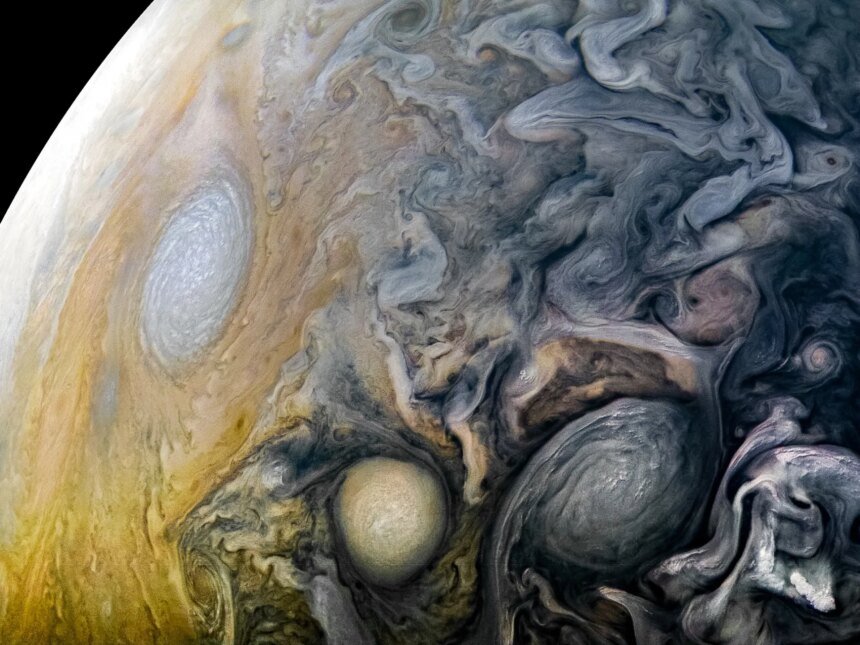
A recent scientific study published in The Planetary Science Journal showed that Jupiter, the largest planet in our solar system, contains in its depths quantities of oxygen approximately one and a half times greater than the sun.
Jupiter has been the focus of attention of astronomers for centuries. Since it was observed with the first telescopes and contemplated its violent storms, such as the “Great Red Spot,” until the “Juno” probe of the American Space Agency (NASA), which accurately mapped its gravity, the question about the components of its deep atmosphere has remained a mystery that has haunted researchers.

This exploratory journey began with diligent attempts to understand whether the planet originated gaseous or icy, but the inability to look directly under the dense clouds prevented this, as oxygen hides and is trapped inside water molecules in deep depths that condense under thousands of kilometers of visible peaks, which necessitated the search for new technological means to probe these cosmic depths and their history.
Read also
list of 2 itemsend of list
The digital simulation revolution reveals the hidden
To overcome the dilemma of visual observation, a joint research team from the University of Chicago and NASA’s Jet Propulsion Laboratory succeeded in developing a computer simulation model that is considered the most complex and accurate to date for Jupiter’s inner atmosphere.
Instead of studying wind movement and chemical reactions separately as was the case in the past, the new models combined the two processes into a single dynamical system that precisely follows how gases and clouds evolve chemically as materials slowly circulate between the planet’s scorching depths and its cold upper layers.

This integrated scientific method provided a consistent and highly reliable picture that enabled scientists to estimate hidden amounts of oxygen with unprecedented accuracy, putting an end to decades-old assumptions about the nature of gas giant planets and their puzzling chemical composition.
Cosmic ice behind the birth of the gas giant
These new results reinforce the scientific hypothesis that Jupiter was not born from pure gases only, but was formed through the accumulation of huge quantities of ice-rich materials in the very early stages of the life of the solar system.
According to astronomical models, Jupiter has grown and increased in size behind what is known as the “Snow Line”, which is the cold region of the emerging solar system that allows water to freeze. In that harsh environment, huge blocks of ice were embedded in the body of the developing planet, causing it to be richer in oxygen than the Sun.
In this context, the study’s lead researcher, Jihyun Yang, a postdoctoral researcher at the University of Chicago, said: “This discovery really shows how much we still don’t know about planets, even those in our solar system.”

Along with the oxygen puzzle, the simulation reshaped our understanding of how Jupiter’s atmosphere moves; It has proven that the movement of gases between depths and high altitudes takes many weeks, contrary to the previous belief that it is a quick journey that takes place in a few hours.
This slowness fundamentally affects the distribution of heat, cloud growth, and the evolution of chemical compounds, which will help in reading cosmic data collected by future probes. The importance of this study does not stop at the buyer’s borders; Each planet represents a time capsule that preserves the chemistry of the environment in which it originated.
By decoding this mystery, scientists today have new keys to understanding thousands of large and distant planets orbiting other stars in our galaxy, and how to redraw historical scenarios for the birth of worlds outside the boundaries of our local system.
Science as a bridge between the present and the distant universe
This discovery reminds us that science is not just numbers and equations, but rather a window through which humanity overlooks the secrets of existence, and a noble attempt to understand our place in this vast universe. Continuous research and exploration into the depths of the planets – despite the vast distances – demonstrates man’s eternal passion for knowledge and the challenge of the unknown.
Every secret that technology reveals behind the distant clouds reinforces our belief in the value of exploration, and confirms that the pursuit of scientific truth is the highest philosophical influence that connects our present minds to the distant beginnings of the universe, reconciling our human curiosity with the great mystery of existence.