The creative critic has always been the most free critic in raising the most funny and daring issues, because he moves in two seemingly disparate fields: creativity and criticism. In creativity, he is free from controls, experimentation gives him a wide range of freedom, and in criticism, he is free from the constraints of academic research.
Within every creative critic is a critic who guides him and struggles with him on the journey of writing and editing, and inside every creative critic seeks to be his eye through which he spies on the creative process that produced the text, the text that he undertakes to criticize.
From this logic, we can understand the contributions of Milan Kundera, Colin Wilson, Henry James, Jean-Paul Sartre, and Anais Nin, and in the Arab world we can understand Abdel Fattah Kilito and Nabil Suleiman, and even those belonging to the academic field such as Muhammad Barrada, Salah al-Din Boujah, Walid al-Khashab, and Muhammad Ubaidullah. There are writers whose critical vision we read in their testimonies or dialogues, such as Ernest Hemingway, Paul Auster, Ernesto Sabato, Jose Saramago, and Mohamed Shukri.
The critic’s voice also appears in some of them in their diaries, such as John Steinbeck and André Gide; There is no true creator who does not think critically.
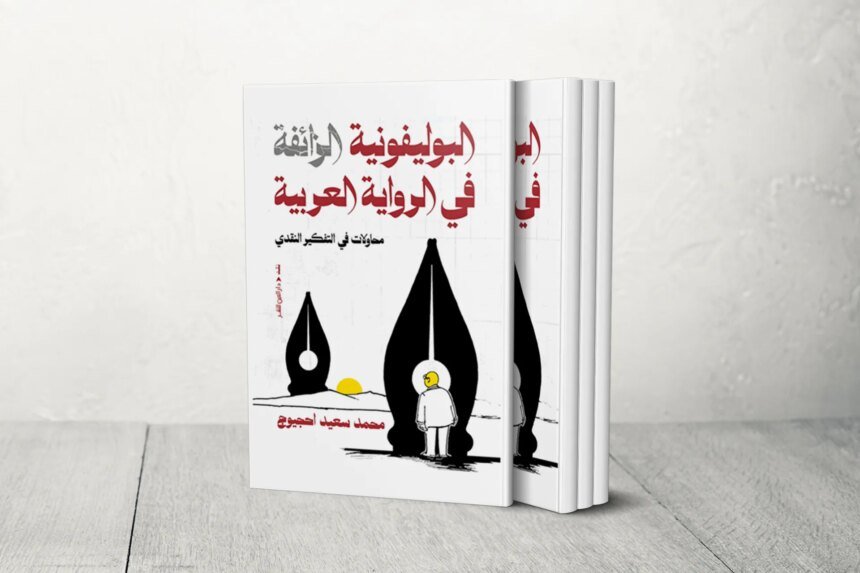
From this window we can read the book of the Moroccan novelist Mohamed Said Ahjiyouj, “The False Polyphony in the Arabic Novel: Attempts at Critical Thinking,” published by Dar Al Ain. In it, the writer reveals his critical face and clashes with the Arab novelist achievement when he puts it to the test of one of the most important and most hesitant achievements of Western novelist theorizing, which is polyphony.
Literary criticism borrowed this word from the dictionary of music, and it means polyphony, as opposed to monophony, i.e. one tone. Perhaps the first creative person to transfer it to the world of literature was Milan Kundera in his book “The Art of the Novel.” As for the one who looked at it linguistically, he was the Russian linguist Mikhail Bakhtin in his research on Fyodor Dostoyevsky, when he used a word synonymous with it, which is “dialogical.”
What is polyphony?
Literary criticism borrowed this word from the dictionary of music, and it means polyphony, as opposed to monophony, i.e. one tone. Perhaps the first creative person to transfer it to the world of literature was Milan Kundera in his book “The Art of the Novel.” As for the one who looked at it linguistically, it was the Russian linguist Mikhail Bakhtin in his research on Fyodor Dostoyevsky, when he used a synonymous word for it, which is “dialogic.” With this dialogue, he distinguished the narrative discourse from the poetic one. It is required in the novel and usually absent from poetry. This is because, in his opinion, the speech of the novel is the speech of the characters, while the speech of poetry is the speech of the poet himself, as the voice in it is his own and no one else’s.
Since the appearance of Kundera’s book and the translation of Bakhtin’s books, the phrases “polyphony,” “dialogic,” and “polyphony” have become frequently used in Arab critical works, to the point that for some they have turned into a refrain that they repeat without real awareness of it. On the other hand, since the arrival of the translation of William Faulkner’s novel The Sound and the Fury, the Arab novelist has been trying to find a place for this technique in his experience. This is the test that Ahjuyouj set for the accomplished Arab novelist, as he questioned him according to his laws.
Is there really polyphony in Arabic novels, which on the surface appear to rely on multiple voices? Or are they just monophonic narratives in disguise?
Pseudopolyphony
In eight chapters, an introduction and a conclusion, collected in a 190-page book, Hajjuj demolishes the polyphony in Arabic novelist discourse, describing it as false polyphony. The titles of its chapters indicate its purpose, including “An Attempt to Define Pseudo-Polyphony,” “The Problems of the Narrator and the Narrated in Naguib Mahfouz’s Karnak Novel,” “Shadows of the Qur’an and the Legacy of Orality,” “Lazy Reading,” “The Authority of the Story,” “The Sacred Language in the Arabic Novel,” and “The Journey in Search of Immortality.”
In presenting his problem, Ahjuj begins by comparing the critic while examining books and the critic examining money. Linguistically, the currency of dirhams distinguishes between the fake and the authentic. Is it the critic’s job to separate good literature from bad? Who actually has the quality standard? Is it taste, the market, history, or theory?
This first question opens the door to dozens of questions about criticism and the critic, its relationship to interpretation and interpretation, transformations in reception, and the feasibility of reading and circulating literature in a world that has become governed by everything that is false, ambiguous, and vulgar.
The critic believes that we have moved from the time of the authentic novelist to the time of the “mediocre” or false novelist, due to the flood of production that finds no one to evaluate it and distinguish its wheat from its wheat.
The critic believes that we have moved from the time of the authentic novelist to the time of the “mediocre” or false novelist, due to the flood of production that finds no one to evaluate it and distinguish its wheat from its wheat.
He believes that the basic problem is deeper than mere quantitative accumulation; It strikes at the sorting mechanisms themselves. He accuses a class of novelists who are good at reading the cultural market and its requirements, of being so preoccupied with mastering its tools that they neglected the identity of the novelist and the novel together, so he says:
“With pure business intelligence, this novelist understands the nature of the cultural market and its requirements, knows precisely what critics and publishing journalists want, what award committees look for in their selections, and what readers expect from the works they accept.
But he forgets, ignores, or is even ignorant that the true novel is not a tradeable commodity, but rather a deep and complex existential discovery that requires exceptional audacity, absolute honesty, and a complete willingness to pay the high price for this discovery. And here we reach the heart of the painful irony: while this pseudo-novelist claims to be writing “literary fiction,” we find him in fact producing a compelling form of consumer literature, cloaked in a thin layer of superficial complexity and aesthetics.
The critic believes that this false novelist is a technocratic intellectual who knows where the shoulder comes from, but he neglects the concept that Milan Kundera gave to the novel and its main roles when he wrote that “the only justification for the existence of the novel is to say what the novel alone can say.”
Ahjiyouj believes that the false polyphony in the Arabic novel, that is, the claim of multiple voices while only the writer’s voice is repeated in the text, is only an example of a broader falsehood that affects all claims of “pluralism” and “modernity,” and a small example of the disintegration of the entire cultural scene.
Ahjiyouj believes that the false polyphony in the Arabic novel, that is, the claim of multiple voices while only the writer’s voice is repeated in the text, is only an example of a broader falsehood that affects all claims of “pluralism” and “modernity,” and a small example of the disintegration of the entire cultural scene.
Perhaps this book, with what it says between its lines, is one of the rare critical books that linked the Arab social, political and cultural reality with the reality of its literature. It reminds us of the books “Culture and Imperialism” by Edward Said, and “Contemporary Arab Ideology” by Abdullah Al-Aroui.
The writer here stands thinking about writing, neither recounting it nor recalling its discourse. He tries to confront himself as a novelist before he confronts others. He is at the heart of the market that he criticizes, is involved in the modernist discourse of the Arabic novel, and participates in the awards of the cultural scene that he criticizes.
We do not see this as a contradiction, but rather a necessary moment that every true writer needs when he rethinks the world around him and his achievement and path, even if he is convinced by the texts of others, to review himself and remind her that there is a vast gap between what we know and what we claim, and what we practice and what we produce.
This cruelty practiced by Ahjiyouj, and which necessarily affects him, acts in the cultural scene as the jolt that every Arab novelist needs to return his feet to the ground, no matter what his experience or no matter how much Arab success he has achieved. The production of novels in our Arab world, with the absence of professional literary editors and publishing houses that match international standards, a real critical scene and specialized cultural media, can only be a production of limited value and “full of holes,” as the title of the novel “The Abominable Living or A Life Full of Holes” by the Moroccan Arab Al-Ayashi says.
This is what raises the value of the book, as it is a controversial work that opens a real intellectual discussion about the reality of the Arabic novel today.
The writer takes a humble stance regarding his thoughts. Although it is harsh, it is accompanied by an acknowledgment of the principle of relativity. Criticism, in essence, is an attempt and an approach, not an act of appropriation, a journey of discovery, not a declaration of victory and certainty.
Destruction of sanctities
Since the beginning of the twentieth century, the Arab cultural scene has been living in a state resembling a second ignorance. His rulers erected a huge temple, and every year they built a new statue of an infallible Lord in it, which they placed for people who believed in Him to visit, rejecting any doubt about it.
Perhaps what best embodies this scene is the program in which Laila Rustom hosted Taha Hussein, to confront the questions of a large number of Egyptian intellectuals and creatives. The dialogue was surreal; Taha Hussein, known as the “Dean of Arabic Literature,” began answering with some contempt and ridicule every question posed to him by his guests, including Youssef Al-Sibai, Tharwat Abaza, Amin Youssef Ghorab, Abdul Rahman Al-Sharqawi, Naguib Mahfouz, Mahmoud Amin Al-Alam, Anis Mansour, Kamel Zuhairi, Abdul Rahman Sidqi, and Abdul Rahman Badawi.
This legacy made the Arab literary scene educated to accept everything. What the institution dedicates, we must embrace and believe in, and refuse to touch it, discuss its works, or put it into critical question. This applies to every Arab writer who was devoted to his country, from Taha Hussein and Naguib Mahfouz in Egypt, to Mahmoud Al-Masadi in Tunisia, Ghazi Al-Gosaibi in Saudi Arabia, Muhammad Mahdi Al-Jawahiri in Iraq, Abdullah Al-Bardouni in Yemen, Mahmoud Darwish in Palestine, Michael Naima in Lebanon, Muhammad Zafzaf in Morocco, Abdel Hamid bin Hadouqa in Algeria, and Ismail Fahd Ismail in Kuwait.
This book comes to free itself from all of that, and puts one of Naguib Mahfouz’s novels into critical questioning regarding its basic topic, which is polyphony.
Naguib… accused
The author began the chapter by acknowledging the difficulty of confronting a novel by Mahfouz, the only Arab writer to win the Nobel Prize. The recipient of awards in our Arab scene becomes entrenched in them. Therefore, Ahjuyouj believes that critically approaching a text by Mahfouz requires boldness, and may even be described as absurd and reckless, and he links this to the Arab cultural reality that lacks “critical boldness.”
However, he continues his adventure, revealing the weaknesses in Mahfouz’s novel, starting with the crisis of the narrator and his narratee, to confirm that Mahfouz is not immune from artistic errors, despite the great works he presented. One of his arguments in questioning the novel is that it was not written during Mahfouz’s youth, but rather after he was over sixty and had accumulated long experience and mature experiences. His criticism focused on the disorder in employing the internal narrator and the external narrator in the work, as well as the narratee, who is not the reader outside the text.
The narrator, according to this perception, must change his tone and level of language with every narratee to him, whether educated or illiterate, child or elderly. This is what Bakhtin called in his book on the theory of the novel “stylization,” where the levels of speech are distinguished according to the level of the narrator on the one hand, and the level of the narratee to him on the other hand, which is a level determined by his age, academic, social, occupational, professional, and mental class.
This is what Ahjouj did not find in the novel “Karnak,” which has one tone and one speech, even though its space – the Karnak Café – was supposed to be multi-voiced, and even though it began with an intelligent opening that the critic considered promising, carrying all the ingredients of a successful narrative foundation.
The narrator participating in the events suddenly withdraws from his role and abandons his position to become in the position of the recipient, while the other characters begin to confess to him the most minute details of their lives and secrets without any narrative justification or introduction. The critic sees this as a clear narrative flaw, as there is no “dramatic justification” for all these free confessions that the café patrons reveal to someone who happens upon them. This is what thwarts the process of reception and the illusion of realism, as the reader continues to conjure up the writer who dominates the text all the time.
The narrator fell into frank preaching and direct speech, until the novel became closer to a political essay. The critic also observes the writer’s confusion in managing his characters, their number, and the time of their entry into events. He proves the unilateralism of discourse and the falsity of the apparent polyphony by placing the characters’ speeches side by side in his article, thus revealing the unity of their linguistic level, which destroys the polyphony claimed by the text and its writer.
The book “The False Polyphony in the Arabic Novel” is an intelligent work of intellectual criticism, in which every study requires special attention to the crowd of ideas that it presents, especially since it takes the novel as a threshold from which it expands into other non-fiction discourses. The truth is that Moroccan criticism, especially criticism practiced by creative people, has accustomed us every time to such bold speeches. It suffices to remember the book “The Seduction of the White Blackbird” by Muhammad Shukri, when he harshly criticized the Arab writer, his choices, and his questions, especially the writings of Ihsan Abdul Quddus, Youssef Al-Sibai, and Wafiq Al-Alayli, and saw that the Arab reader had abandoned them, and that “today, they are no longer read by anyone except those who have not yet gotten rid of the adolescence of sexual repression and the inferiority complex toward the bourgeois class.” He also considered their literature to be naive literature, and in his book he poured out his anger at the commodification of literature and writing on demand, and his example was Al-Tahar Ben Jelloun. He accused Arabic literature of being regional and distancing itself from humanitarian issues, which in his view made it backward literature.
It remains interesting that these bold voices in criticizing the Arab achievement come, for the second time, from Tangier, Morocco, from Muhammad Shukri and Muhammad Ahjiyouj. Is Tangier still desperate to maintain its international face, even if in a metaphorical way?