Published on 6/29/2026
The Union of Turkish Chambers and Exchanges signed a memorandum of understanding with the Union of Saudi Chambers with the aim of strengthening trade and economic relations between the two countries at the private sector level.
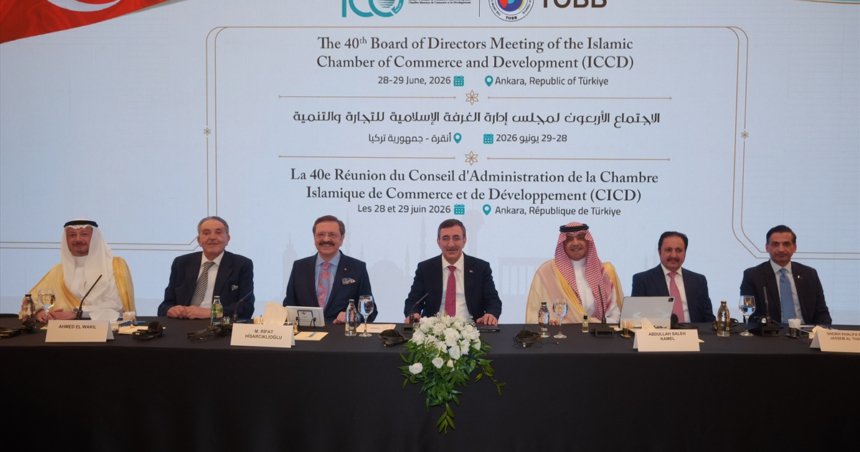
The signing ceremony took place on Sunday evening, in the reception hall of the Union of Turkish Chambers and Stock Exchanges in the capital, Ankara, with the participation of representatives of chambers of commerce from 20 Islamic countries, within the framework of the meetings of the Islamic Chamber of Commerce and Development.
Read also
list of 4 itemsend of list
The memorandum was signed by the President of the Federation of Turkish Chambers and Exchanges, Rifat Hisarcioglu, and the President of the Islamic Chamber of Commerce and Development and the Federation of Saudi Chambers, Abdullah Saleh Kamel, and the ceremony took place in the presence of Turkish Vice President Cevdet Yilmaz.
The memorandum aims to develop trade and economic relations between Türkiye and Saudi Arabia in a more systematic and sustainable manner at the private sector level.
Under the memorandum of understanding, the two parties will exchange experiences in the field of chamber accreditation systems, enhance cooperation between sector councils and committees, establish joint sector platforms, in addition to developing cooperation between think tanks.
The memorandum also stipulates the establishment of the joint forum of the Turkish-Saudi Chambers between the Union of Turkish Chambers and Stock Exchanges and the Union of Saudi Chambers, and the support of its activities.
Great Islamic potential for investment
Hisarcicioglu said in a speech during the signing ceremony that Islamic countries possess great potential for trade and joint investment in various sectors.
He explained that Türkiye is the largest industrial production base in the region extending between Italy and China, and that it is one of the most prominent countries exporting industrial products.
He continued, saying, “We annually export products worth $275 billion to more than 200 countries, through 12,600 different products, 95% of which are industrial production,” explaining that this number reaches $400 billion when service exports are included.
He added that 60% of Türkiye’s exports go to the European Union and the United States of America, which reflects the quality and competitiveness of Turkish products.
Hisarcicioglu pointed out that the diversity of production capabilities places Türkiye among the leading countries in the world in terms of the number of products and markets in which it competes.

Investment flow to Türkiye
Hisarcicioglu pointed out that over the past two decades, Turkey has attracted more than $290 billion in international investments, pointing out that the volume of foreign direct investment coming into the country has increased by 12% in 2025 to reach $13 billion.
He stressed that these investments are not limited to the fields of production and trade, but also include technology and innovation, as more than 740 international companies are currently active in technology zones in Turkey.
He stressed that Türkiye represents an important opportunity for Islamic countries, calling for combining capital in those countries with the productive expertise of the Turkish private sector.
He explained that achieving this integration could make Islamic countries among the most prominent global economic powers, and that the Islamic Chamber of Commerce and Development represents the most important mechanism for achieving this goal.
In this context, Hisarcicioglu called for activating the role of the Islamic Chamber of Commerce and Development and enhancing its presence on the international scene.
He stressed the need to remove restrictions that limit trade and investment between Islamic countries, stressing the importance of working with governments to create a supportive environment for entrepreneurship, encourage innovation, and implement structural reforms that enhance productivity and ensure fair competition.