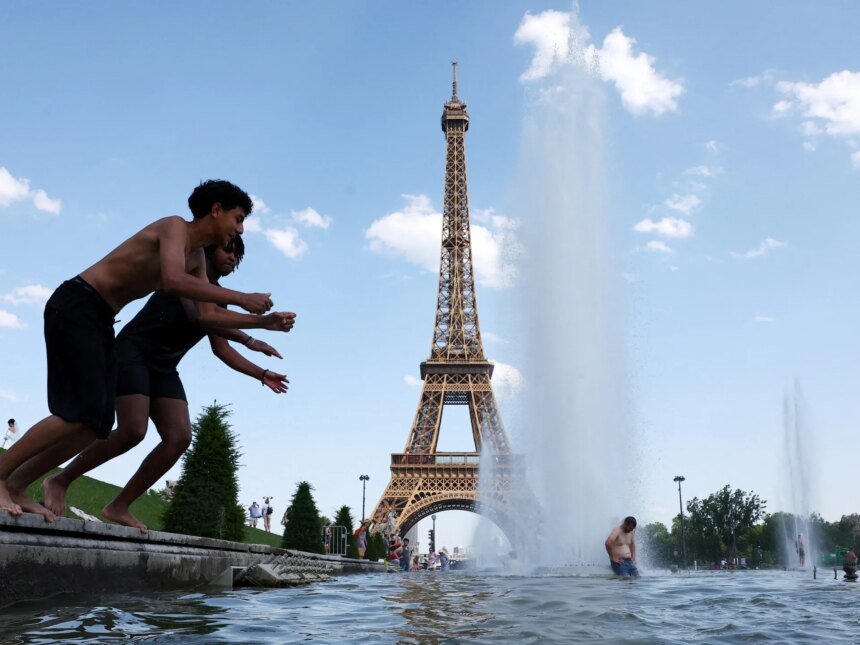
Newspapers and media outlets, local and international, unanimously agreed on one fact that is no longer up for debate, which is that France is suffocating under the weight of a climate it did not know.
With local soil temperatures exceeding 50 degrees Celsius, and successive tropical nights recorded, the discussion is no longer about the possibility of heat waves occurring, but rather about how to deal with them.
Read also
list of 2 itemsend of list
The country has become, as the foreign press monitored by Courier International magazine says, living its desert version, with Paris recording temperatures closer to Dubai, and Montpellier simulating Timbuktu.
This initial consensus on the harshness of the moment opens the door to deeper questions raised by major French newspapers about the extent of infrastructure readiness, the impact of this heat on mental health, and the necessity of changing the work rules themselves.
Le Point magazine is based on an accurate description of the crisis by David Faranda, a researcher at the French National Center for Scientific Research (CNRS), who asserts that “we are facing climate change and not just record numbers.”
Faranda explains that weather patterns that produced certain temperatures decades ago now generate temperatures between two and four degrees Celsius higher.
Climate of the new century
The biggest problem, as the magazine sees it, is that French cities, schools, transportation networks, and agriculture were designed to suit the climate of the twentieth century, not the twenty-first century.
This diagnosis is completely consistent with what the Courier International reported from foreign correspondents in France, who clearly noted the country’s poor preparedness.
This is evident in the uninsulated buildings, the almost complete absence of the culture of central air conditioning, and the short-sighted political orientations, which made the French citizen’s daily life resemble the days of quarantine during the Corona pandemic, when everyone is confined to their home in search of the mirage of cold.
The Le Monde editorial reinforces this diagnosis, considering that the biggest mistake would be to treat the decline of the current wave as the end of the crisis. According to the newspaper, the temperature may decrease for days, but its health effects will continue, while these phenomena are repeated at a similar rate that makes them part of French life. It believes that being satisfied with adaptation policies without addressing the causes of global warming will make the country revolve in an endless cycle of crisis management.
Faranda: We are no longer facing just temperature records, we are facing climate change itself
If the infrastructure is suffering, the human body is not in any better condition. Here, Liberation newspaper intervenes to move the discussion from the street to offices and construction sites. The newspaper confirms that heat waves are no longer just a public health crisis, but rather have become an “occupational hazard” that threatens productivity, which drops by almost half when the temperature exceeds 33 degrees Celsius.
According to Liberation, this new desert reality imposes a radical change in the rhythm of work, and from here there are demands to adapt working hours, so that they start early and finish early, similar to what happens in southern Italy or Andalusia.
The dilemma of wearing shorts (Bermuda) in workplaces as a right to escape the heat has also surfaced again, in addition to activating technical unemployment systems for construction workers during times of extreme heat.

Liberation quoted a researcher at the National Center for Scientific Research, David Faranda, as saying: “We are no longer facing just record temperature numbers, but rather a change in the climate itself,” explaining that the weather patterns that produced certain temperatures decades ago now generate temperatures between two and four degrees Celsius higher.
Environmental anxiety
As the rhythm of life and work changes, a deeper and less prominent effect is emerging, which is monitored by Le Parisien newspaper, which is environmental anxiety (Eco-anxiety). The stifling heat that forces people to remain in their homes – as the Courier International previously indicated – leaves them prey to dark thoughts about the future.
Le Parisien points out that more than 4.2 million French people suffer from this anxiety acutely, and with every heat wave, existential questions escalate: “In what world will our children grow up?”
Sutter: Fear of the climate is no longer just a concern for the environment, but rather a concern for the personal and family future
The director of the Observatory for Environmental Anxiety, Pierre-Eric Sutter, confirms to Le Parisien that fear of the climate is no longer just a concern for the environment, but rather a concern for the personal and family future.
Society’s reactions range from complete isolation to escape reality, as one young woman describes, to an attempt to transform this anxiety into energy for collective action and environmental struggle to change the current consumer system.
This shift also appears clear in the view of the foreign press, as monitored by Courier International. Paris recorded temperatures similar to Dubai, Montpellier seemed closer to Timbuktu, while Nice approached the temperatures of Seville.
Therefore, Courier International chose a striking title for its report: “France in its desert version,” and believes that the scene once again revealed the weakness of the unprepared urban structure, the lack of use of air conditioning, and policies that remain postponed until the arrival of the next heat wave.
Political confusion
In the face of this double danger, physical and psychological, how does the state behave? Le Monde’s editorial returns to address this question in a sharp tone, and thus the newspaper strongly criticized the statements of President Emmanuel Macron, who considered that France had adapted, considering that these statements ignore the continuing declines in budgets for environmental transition and the renewal of building insulation.
Le Monde believes that politicians, instead of addressing the roots, are exchanging accusations; The right and far-right, which have long ridiculed climate reports, are now demanding that air conditioning be deployed everywhere to score political points, ignoring that air conditioning temporarily solves the problem and exacerbates it in the long term.
Here, Le Monde intersects again with what climate researcher Kathy Clairbaut warned against in Le Point, where she asserts that “adaptation does not simply mean installing more air conditioners,” but rather requires a radical change in agriculture and water management.
Past and future
Although the feeling of the crisis seems new, Le Figaro recalls that heat has been part of French history for centuries. Heat waves in the Middle Ages were associated with famines and epidemics, and the summer of 1788 contributed to the destruction of crops and the rise in wheat prices, which was one of the sparks that preceded the French Revolution.
As for the modern era, the 2003 wave remains the most entrenched in memory after it claimed the lives of between 15 and 17 thousand people, before prompting the authorities to develop warning and response plans.

But the newspaper believes that the main difference between yesterday and today does not lie in the presence of heat waves themselves, but rather in the nature of society’s expectations. Climate disasters were previously considered an unavoidable fate, but today the French have come to consider protecting their lives from its effects a direct responsibility that falls on the state.
Through the coverage of these newspapers, it can be said that the current summer is not just an “emergency crisis” that will pass and be forgotten, as Le Monde warned, but rather it is a final warning that confirms what Le Point argued, that France has entered a new climate era, and the solution will not be satisfied with waiting for temperatures to drop, but rather in acknowledging that the rhythm of life and work that prevailed in the last century has irrevocably melted under today’s sun.
Source: Le Parisien + Le Point + Le Monde + Liberation