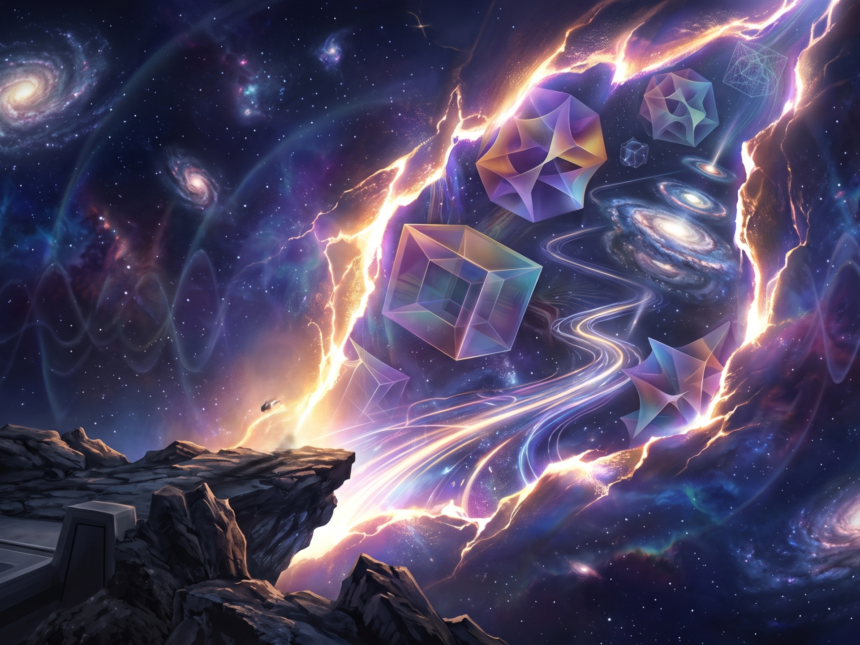
In the world of modern physics, the idea of extra dimensions remains one of the most controversial and scientifically intriguing topics. Since the German physicist Hermann Minkowski combined space and time into one fabric at the beginning of the twentieth century, and then Albert Einstein’s general relativity came to describe gravity as a curvature of space-time, scientists began to wonder: Are the four dimensions that we perceive really everything, or are there other hidden dimensions that our senses cannot see?
From engineering to physics.. How was the idea of higher dimensions born?
The idea of extra dimensions began in mathematics before moving to physics. In the nineteenth century, mathematicians demonstrated the possibility of constructing geometric models in four dimensions and more, even if humans were unable to visualize them visually. In 1919, the German physicist Theodor Kaluza suggested the possibility of adding a fifth dimension to Einstein’s equations, and the Swedish physicist Oscar Klein later developed the idea.
Read also
list of 2 itemsend of list
The goal of this proposal was to unify gravity and electromagnetism into a single framework. Although the model did not achieve complete success, it opened the door to generations of theories that attempted to explain the universe through additional, unseen dimensions.

American physicist Brian Greene, from Columbia University, explains that additional dimensions – if they exist – may be “wrapped” in on themselves at extremely small sizes, such that current devices cannot directly observe them.
The idea resembles an electrical wire that appears from afar to be a one-dimensional line, but upon approaching it we discover that it has an additional circular dimension that is not noticeable from great distances.
This perception represents one of the foundations of string theory, which assumes that fundamental particles are not separate points, but rather vibrating strings in a space that contains more dimensions than the four known dimensions.
What do modern theories say?
String theory and M theory suggest the existence of as many as 10 or 11 dimensions. However, these dimensions remain mathematical assumptions to this day that have not been confirmed by experiments.
Scientists at the European Organization for Nuclear Research (CERN) confirm that the search for additional dimensions is still continuing through the Large Hadron Collider, through the study of high-energy particles. To date, no direct evidence has been found to prove the existence of these dimensions.
Physicist Stephen Hawking points out that mathematics may allow the existence of such cosmic structures, but their scientific acceptance requires observational and experimental evidence, not just mathematical consistency.

Since man began to contemplate the sky, he believed that what he saw was everything. Then he discovered that the Earth is not the center of the universe, that the Sun is just an ordinary star, and that our galaxy is only one of hundreds of billions of galaxies. Every time a person thought that he had reached the end of knowledge, he discovered that he had not yet begun.
Today, some physicists are asking a different question: What if the universe we live in is not all of reality, but just a small slice of it? What if there are other dimensions surrounding us now, but we are unable to see them just as a blind person is unable to see colors?
When the impossible seems just a difference in the number of dimensions
Imagine a two-dimensional world, whose inhabitants live on a sheet of paper in which they only have height and width. If a person from our three-dimensional world passed through that paper, its inhabitants would not see his entire body, they would only see a section of it.
If you pass an apple through that piece of paper, they will see a small circle that suddenly appears out of nowhere, gets bigger little by little, then gets smaller, then disappears.
For them, it will be magic, because it is an appearance from nowhere and a disappearance into nowhere. But the truth is that nothing supernatural happened. All that matters is that the three-dimensional being is larger than their world’s ability to comprehend.
Here the disturbing question arises: Can we ourselves be that flat world in relation to a higher world?

But if higher dimensions actually existed, many things that seemed impossible might become natural. A being living in a higher dimension may not need to cross walls because he does not even see them.
Just as we do not see the boundaries of a circle as an obstacle when we raise the pen above the paper, and it may be able to appear at one point and disappear at another without crossing the distance between them according to our standards, in fact the concept of distance itself may be completely different.
This is why the idea of higher dimensions has fascinated science fiction writers for decades. In Carl Sagan’s novel Contact, and in many other films, instantaneous travel and non-linear time become a natural consequence of breaking out of the familiar geometry of the universe.
Time…is it a river or a whole page?
We experience time moment by moment, the past behind us, the future ahead of us, but some modern interpretations of relativity describe space-time as if it were an entire structure that existed at once, and we only move within it.
It is like someone reading a book page by page. The person believes that the events are formed gradually, but the one who sees the entire book at once realizes the beginning and the end together.
Is there a level of existence in which our entire lives can be seen at once? Science does not answer yes, but it also does not have anything that allows it to prove the absolute impossibility.

What is strangest is that scientists themselves admit that most of the universe is unknown. The matter that makes up the stars, planets, and humans represents only a small part of the content of the universe. The rest is dark matter and dark energy whose true nature we do not know until today. We only observe its effects. It is like seeing the waves of the sea without seeing the wind that created them.
This scientific recognition of the unknown opens a wide door for contemplation, not because the unseen has become science, but because science itself has discovered that the limits of our knowledge are much narrower than we thought.
From physics to metaphysics and miracles
Here begins the area that some scholars do not like to enter, but it is the area that philosophers, mystics, and thinkers have loved throughout history. If there are layers of reality that we do not see, could some concepts of the unseen be somehow related to these layers?
Could some phenomena that seem impossible to us be just natural phenomena on another level of existence?
Science does not have an answer, but it also does not have tools to study everything. The scientific method was designed to study the world that is measurable and repeatable, but what lies beyond that remains in the circle of philosophy, belief, and contemplation.

One of the most exciting ideas is that some supernatural events may seem less strange if viewed from the perspective of higher geometry. If distances can be folded or transcended through a different structure of space-time, then rapid travel, visions from distant places, or a change in the sense of time become easier ideas to imagine, even if they remain unprovable scientifically.
Here we are not talking about a scientific explanation for miracles, but rather about a mental attempt to imagine how a reality broader than our own could make the seemingly impossible less impossible.
Will we ever discover those dimensions?
maybe. Extra dimensions are not just literary fiction. Some models of string theory even assume the existence of additional dimensions that are twisted in a way that prevents us from seeing them directly, but so far there is no experimental evidence to confirm their existence. Perhaps the universe is simpler than all of these perceptions, and perhaps it is much more complex than them.
As science advances, the area of the unknown expands, and the more a person knows, the more he realizes the extent of what he does not know. Perhaps the value of these questions does not lie in arriving at a final answer, but rather in that they push us to go beyond the limits of what is familiar.

Between the microscope that reveals the atom, the telescope that reveals the galaxies, and the mind that wonders what is behind them, the greatest journey known to man begins: the journey of searching for truth. Perhaps the most beautiful thing about the truth is that it never stops hiding behind a new horizon.
Hidden dimensions remain one of the most profound questions in man’s journey to understand the universe. Perhaps the importance of this idea lies not only in proving the existence of new dimensions, but also in reminding us of the limits of our current knowledge. Every major scientific discovery began with a bold question, and every new horizon opened up because a researcher dared to look beyond what the eye can see.