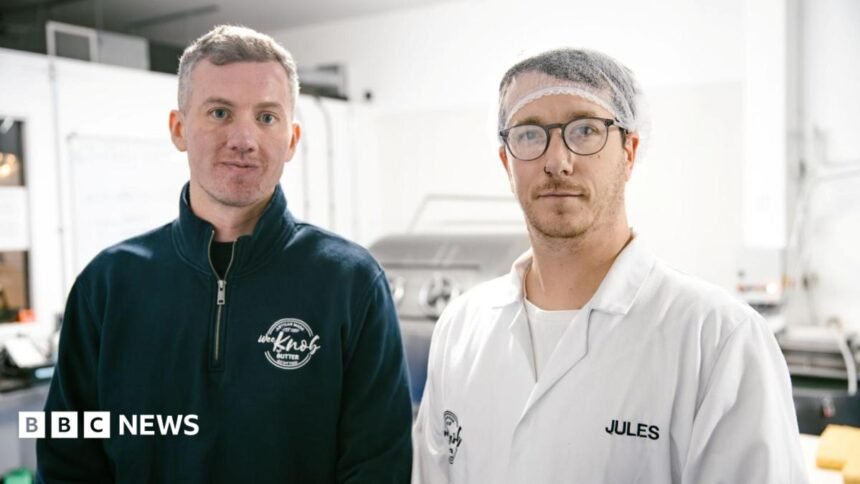

Jules Bal (right) set up Wee Knob of Butter five years ago with his business partner Kieran Woods
Jules Bal (right) set up Wee Knob of Butter five years ago with his business partner Kieran Woods
Jules Bal says he has noticed a change in the way Scots regard their relationship with food and thinks people are increasingly prepared to pay extra for it.
The 34-year-old French national, who co-owns a small artisanal butter manufacturing firm in Glasgow, is among a chorus of people concerned about the push for cheaper food to address the cost-of-living crisis.
He says that in his homeland there is much more focus on quality and that people are most concerned about where the product originates and what it tastes like.
It’s an argument that appears to run counter to recent calls to make some foods more affordable. In its recent manifesto for the Holyrood election the SNP promised a price cap on “a basket of essential food items” including bread, milk and eggs.
The pledge was criticised by farmers and food producers, but the Scottish government said it had a “public health responsibility” to provide an affordable nutritious diet.

The butter is hand made and supplied to high-end restaurants across Scotland
The butter is hand made and supplied to high-end restaurants across Scotland
Jules was born in the French city of La Rochelle – which sits on the coast of the Bay of Biscay – and moved to Scotland at the age of 14.
He was taught by his father who worked as a chef in “high-end” restaurants so he “grew up in a kitchen”.
Wee Knob of Butter was created in 2021 with his friend Kieran Woods and began with them selling their product once a month at a market.
Their butter is now supplied to a range of exclusive Scottish restaurants, is sold by mail order and is even served on the Royal Scotsman pullman train.
“In France, we like to take our time with our food,” Jules said. “We like to have a strong relationship with our food as well and that quality is not necessarily a luxury. It’s just something that we just expect to have as a family.
“But Scotland is really coming up. People really care about where their food comes from. Now, people are taking more time to go and shop at local markets to make sure they get quality produce.”
‘Buying packaged goods’
The amount of our household income which goes on what we eat has changed significantly over the years.
According to the UK government’s Living Costs and Food Survey, external, the proportion of total spending earmarked for food has halved in the 60 years to 2016 from 33% to just 16%.
Experts say some of that is driven by industrialisation of farming which reduces production costs, alongside supermarkets using their buying power to keep prices low.
But food historian Peter Gilchrist says many of us have lost the connection to how food is produced.

Food historian Peter Gilchrist believes many of us have lost our connection with food production
Food historian Peter Gilchrist believes many of us have lost our connection with food production
“At the end of the day, you’re buying packaged goods,” he said. “You’re not going into your greengrocer and asking ‘what is fresh, what’s in season, what’s your best products?’ You really only have one option; you go in with a trolley and you shop.”
Gilchrist believes that during a crisis, governments have to step in to ensure that food is “accessible and affordable” as they have in the past but he says intervention needs to go beyond price caps.
He added: “We can try to fix our food systems and ensure that schools have home economic teachers so that every young person knows how to cook with those capped grocery items, that we have a better education about what is grown locally and what is quality Scottish produce.”

First Minister John Swinney says food price caps are a public health responsibility
First Minister John Swinney says food price caps are a public health responsibility
Although average spending on food amounts to about 16% of total household budgets, those on lower incomes can be paying a much larger proportion on feeding themselves.
That concerns Prof Alex Johnstone, a nutrition scientist from Aberdeen University’s Rowett Institute, who says prices have already risen by 40% over the past five years.
She has calculated that some people will need to spend around half of their disposable income on their food shop and that for families with children, the figure increases to about 85%.
Johnstone added: “That means that these families are ‘food insecure’ – they’re living with food poverty and not able to afford and access a healthy diet.”
She said that if there was a cost cap, it needed to cover a range of foods which were healthy, environmentally sustainable and culturally acceptable, including healthy ready-meals in recognition of lower-income households also often being time-poor.
Farmer worries
Farmers have long been concerned by the squeeze placed on their profit margins by demands for cheaper food, high animal welfare standards and more environmental stewardship.
The pig sector in particular has been struggling because of an outbreak of African swine fever in Spain which has heavily affected the country’s exports and led to a glut of pork hitting the European markets.
It means Scottish pig farmers are losing up to £1,000 per sow place, according to NFU Scotland.
Former president Martin Kennedy has been a long-time advocate of increased food prices to make farm businesses more profitable.
He said: “If we keep putting pressure on the primary producers they’ll just simply say we can’t do this any more and we’ll rely more and more on imports.”
Kennedy, who farms at Aberfeldy in Perthshire, said there was too much focus on delivering “cheap” food which could lead to an increase in imports produced under conditions which would be illegal in Scotland.
“If your priority is really about health and having enough affordable food, then we should be really focusing on the good food that we produce here throughout the UK which is recognised, particularly here in Scotland, as high quality,” he added.
‘Six eggs used to be £1’ – why everyday essentials cost so much more now
Supermarkets hit back over pressure to cap price of milk, bread and eggs
The Royal Highland Show, a highlight of the agricultural calendar, is a showcase for Scottish farm animals and food.
It features an area called Scotland’s Larder in which different regions take turns to highlight and sell food which originates from that area.
This year is was the turn of Aberdeen and Aberdeenshire, with Rora Dairy, near Peterhead, exhibiting for the first time, alongside dozens of other small food producers.
The company makes additive-free organic yogurt from milk produced by its own herd of cows which is sold in some supermarkets, including Sainsbury’s and Morrisons.
Owner Jane Mackie says demand for organic dairy is growing year-on-year, particularly in milk, with that growth happening faster in England than Scotland.
She believes consumers could consider eating products such as yogurt less often, but choosing higher-quality options like organic as a treat when they do.

Rora Dairy near Peterhead in Aberdeenshire produces additive free organic yogurts
Rora Dairy near Peterhead in Aberdeenshire produces additive free organic yogurts
Jane added: “We’re not educating people well enough to realise that they could feed their children differently.
“It’s much cheaper to be feeding them a chicken McNugget than it is to be home cooking food and I think that’s a real issue.
“I think we have to realise that it’s important for our society and long-term health benefits to know that spending a little bit more money on your food is a good thing.”
In 2022, the Scottish government passed legislation called the Good Food Nation Scotland Act, external which aims to ensure that people “eat well” and benefit from “reliable and dignified access” to nutritious, affordable, enjoyable, and age-appropriate food.
The SNP manifesto commitment to capping some food prices was dismissed as a “potty gimmick” by some retailers.
But First Minister John Swinney insisted it was a “moral outrage” that some people could not afford to feed themselves properly.
He told BBC Scotland News: “I admire and respect the quality within Scottish agriculture but I’ve also got to be mindful for the genuine hardship that families are facing in delivering an affordable shop.”
Swinney said that was the reason his government was bringing forward legislation to introduce price caps.
Farmers are facing increasing demands to deliver for nature and the environment, as well as consumers.
There is genuine concern from food producers that we’re in a “race to the bottom” which, they fear, could result in an influx of cheap imports pricing them out of the market.