Published on 6/27/2026
|
Last update: 09:03 (Mecca time)
The “theory” of Dutch seismographer Frank Hoogrebetz has reared its head again, after the Venezuelan earthquake occurred hours after his warnings.
Hogrebetz claims that there is a relationship linking the movement of celestial bodies with changes occurring in the tectonic plates on Earth that lead to earthquakes, and this relationship, according to this theory, is more influential when the planets of the solar system are in conjunction with the Earth.
Although Hogrebets often fails to prove the validity of this alleged theory, as happened last February, when he predicted that seismic events would occur due to the conjunction of the Earth, the Moon, and Jupiter during the period from February 13 to 15 of this year, he does not tire of exploiting any similar astronomical events to make predictions that may sometimes be correct, and are often wrong.

More than 13 thousand active faults around the world
According to estimates by seismologists, there are 13,500 documented active faults around the world, and therefore an earthquake in any of these faults is likely to occur. Therefore, any prediction is worthless unless the location of its occurrence is determined, according to Dr. Sherif Al-Hadi, Head of the Seismology Department at the National Institute for Astronomical and Geophysical Research.
As usual, Hogrebetz’s comment, which gained momentum after the Venezuelan earthquake, was public without any details specifying the location or degree of the earthquake. He said: “The astronomical situation of the planets and the moon is critical during the next two days… there is a stronger possibility of seismic activity occurring.” He accompanied the warning with a picture showing Mercury, Uranus, and Mars with their angles of convergence with the Earth.
Sharif told Al Jazeera Net, “According to the Earthquake Hazards Program of the US Geological Survey, from June 1, 2026 until June 25, 2026, 17 earthquakes with a magnitude of 6.0 or more were recorded in the world, the last of which was the Venezuelan earthquake.”
The logical question that Sharif poses is: “Why was this theory not present in 16 other earthquakes this month?”
This June witnessed a series of strong and moderate earthquakes that struck various regions around the world. It began on June 1 with a 6.2-magnitude earthquake near San Lucido in Italy, followed on June 7 by intense seismic activity that included the Philippines and Russia. The Philippines recorded a strong 7.8-magnitude earthquake near Kaplan, along with two tremors of 6.1 and 6.0 degrees, while a 6.1-magnitude earthquake struck the region. Severo-Kurilsk, Russia.
On June 8, the tremors continued in the Philippines with a new earthquake measuring 6.5 degrees, coinciding with a 6.1 magnitude earthquake in Cuba.
On June 10, a 6.0-magnitude earthquake struck the Auckland Islands in New Zealand, and then the middle of the month witnessed a new wave, as a 6.2-magnitude earthquake struck the Philippines on June 15, followed on June 16 by two powerful earthquakes, the first with a magnitude of 6.7 near Palu in Indonesia, and the second with a magnitude of 6.3 near Dunhuang in China.
On June 17, a 6.6-magnitude earthquake occurred in the middle of the Atlantic Ocean, before Russia was shaken again on June 19 by two 6.6- and 6.0-magnitude earthquakes near Petropavlovsk-Kamchatsky.
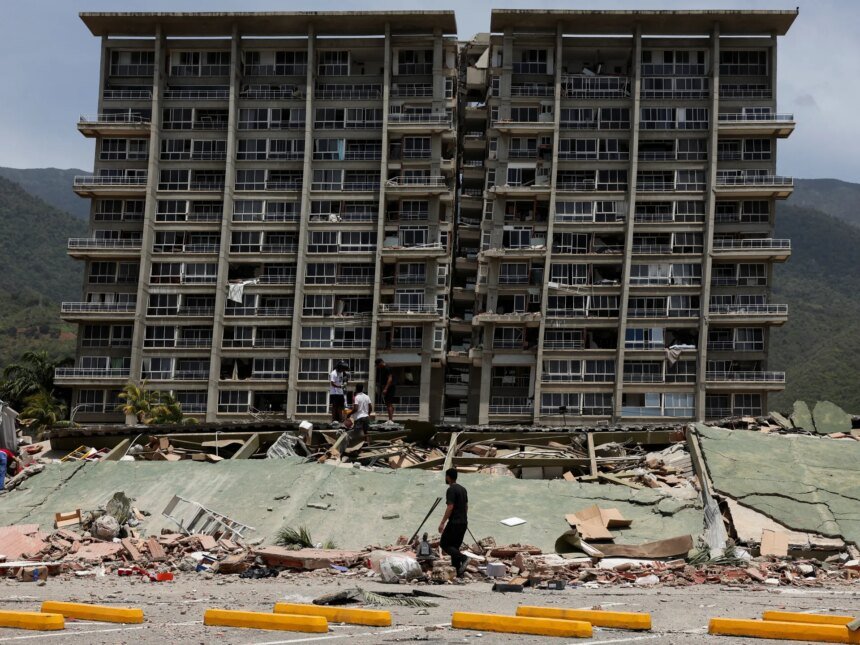
On June 24, Venezuela was hit by a strong double earthquake of 7.5 and 7.2 magnitude near Yumari and San Felipe, coinciding with another earthquake of 6.9 magnitude off the coast of northeastern Japan near Kogi.

The Venezuela earthquake is no exception
Regarding the attempts of some supporters of this theory to give it credibility because the strong Venezuelan earthquake occurred in an old fault that has not produced strong earthquakes for more than 100 years, Sharif said, “The same thing happened in the Turkey earthquake in 2023, as it happened at that time in a fault that had not produced earthquakes for a long time, and it was also after predictions made by Hogrebets, and our opinion has not changed from that date until now.”
He added: “The fact that these faults do not produce earthquakes for a long period of time does not mean that they are not active. They store energy until the moment of breaking occurs, and at this moment it is in no way possible to imagine that they were waiting for the movement and alignment of planets that are millions of kilometers away from Earth.”
Sherif reiterates that “there is no proven physical or geological relationship between the movement and alignment of the planets and the movement of tectonic plates inside the Earth,” indicating that if there is a celestial body that has an impact on the Earth, it must be the moon only, because it is the closest to it, and what is scientifically proven is that its effects are limited only to the phenomenon of tides and tides.
However, Sharif concludes his speech by saying: “I will acknowledge any prediction that Hogrebets makes in the future when he determines the location and degree of the earthquake.”