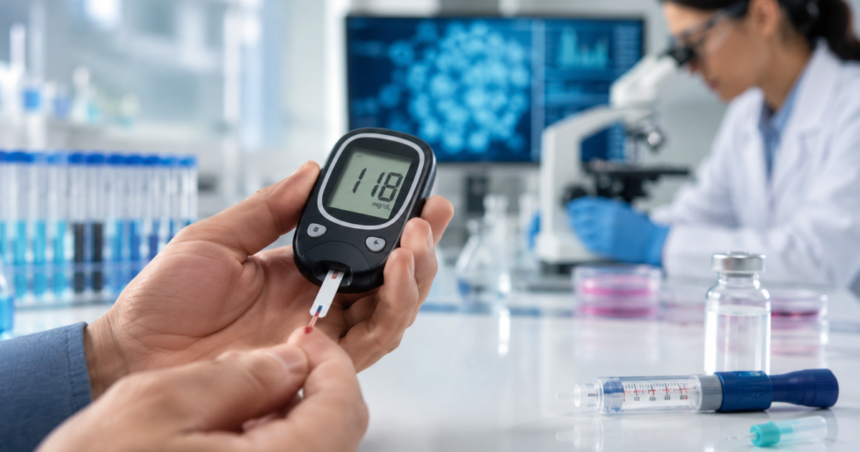
Diabetes is no longer just a chronic disease that can be dealt with as an individual problem for the patient alone. Rather, it has become one of the biggest health challenges in the world.
According to the World Health Organization, the number of people with diabetes has increased from about 200 million people in 1990 to 830 million in 2022, meaning that the number of people infected has increased more than three-fold over the course of about three decades.
Read also
list of 4 itemsend of list
The organization indicates that the spread of the disease is accelerating in low- and middle-income countries at a greater pace compared to high-income countries, which makes diabetes a double health and economic burden in societies that are less able to afford the costs of treatment and regular follow-up.
In 2021, diabetes and related kidney diseases caused more than two million deaths, and high blood sugar contributed to about 11% of deaths related to cardiovascular diseases.
The International Diabetes Federation’s 2025 figures confirm the scale of the problem. It indicates that 589 million adults between 20 and 79 years old live with diabetes, equivalent to 11.1% of this age group, or approximately one person in every 9 adults.
What is more dangerous is that more than 4 out of 10 infected people do not know that they are living with the disease, which means that millions of cases may remain undiagnosed until complications appear.
In the face of this reality, scientific research is no longer just looking for drugs that lower blood sugar, but rather is turning to deeper questions: How do we protect insulin-producing cells? How do we prevent damage? Can we replace it, restart it, or implant it inside the body in a safe and long-term way?

Biogel may pave a new way
In one of the remarkable experiments, researchers from the University of Geneva and the University Hospitals in Geneva announced scientific progress in the field of treating type 1 diabetes, within the European project VANGUARD.
The results were published in the journal Trends in Biotechnology under the title “Implantable glandular and vascular constructs for broad clinical delivery of insulin.”
The idea is based on developing an innovative hydrogel called Amniogel, extracted from the human amniotic membrane, which is the inner membrane surrounding the fetus. This gel acts as a vital incubator environment for insulin-producing cells after they are transplanted, giving them better protection and a greater opportunity to survive and work within the body.
In type 1 diabetes, the immune system attacks beta cells in the pancreas, which are the cells responsible for producing insulin. Therefore, patients often need daily insulin injections for life. Transplanting insulin-producing cells faces major obstacles, most notably the poor survival of the transplanted cells, the difficulty of forming blood vessels that nourish them, and the possibility of attack by the immune system.
This is where the importance of Amnigel appears. The new technology does not grow cells alone, but rather places them within a biological environment designed to help them form a precise network of blood vessels, ensuring the access of oxygen and food to them, and improving their ability to respond to changes in blood sugar levels.
According to the researchers, these formulations succeeded, after being implanted in diabetic mice, in maintaining normal blood sugar levels for a period of up to 100 days, which is the follow-up period in the experiment, superior to traditional transplantation methods that relied on cells alone or on less advanced formulations.
But despite the importance of the result, it does not mean that the treatment is ready for patients. The technology still needs additional studies to ensure its ability to work for years, prove its safety, expand the size of the implants to suit the human body, as well as ensure their protection from immune attack in the long term.
When the cell fails to ‘arrange’ the protein
Another, no less important pathway focuses on what happens inside the insulin-producing cells themselves. Insulin production does not occur directly, but rather it begins from a precursor protein called “proinsulin,” which needs to be folded or formed in a precise manner inside the cell before it is transformed into effective insulin.
When this process fails, misfolded or misfolded proteins accumulate inside the cell, causing stress and impairing its ability to function. As diabetes progresses, especially type 2, beta cells become less able to keep up with the increasing demand for insulin, and may become stressed and then damaged.
In this context, scientists from the Sanford Burnham Prebys Institute for Medical Discovery and the University of Michigan published new results in the Proceedings of the National Academy of Sciences this June, revealing deeper details about how beta cells manage the process of “folding” of proinsulin.
The results indicate that improving this process may help in the future to protect insulin-producing cells from damage. Popular treatments today often focus on lowering blood sugar, either by helping tissues absorb more glucose, increasing insulin secretion, or reducing sugar production from the liver. But it does not necessarily treat the internal defect that affects the beta cells themselves.
Highlighted in this study is a protein known as BiP, which acts as an essential regulator in the process of folding proinsulin. If researchers can understand how to regulate the activity of this protein and the molecular partners surrounding it, this could open the door to early treatments that keep beta cells healthy before their function deteriorates significantly.
These results do not provide a ready-made medicine, but they do suggest a different therapeutic direction: instead of dealing with blood sugar only after it rises, in the future it is possible to try to protect the insulin factory itself inside the pancreas.
Oral semaglutide… results from daily life
Aside from laboratory experiments, a large nationwide Finnish study showed that oral semaglutide, used in adults with type 2 diabetes, was associated with a clear improvement in a number of metabolic indicators in daily medical practice.
The study was published in the journal Diabetes, Obesity and Metabolism, and included more than 7,000 adults with type 2 diabetes who began oral semaglutide treatment between April 2021 and December 2023.
The results showed that the use of the drug was associated with an improvement in control of blood sugar levels, a decrease in body weight, and an improvement in a number of lipid indicators, in addition to a decrease in the enzyme alanine aminotransferase (ALT), which is one of the indicators associated with liver function.
These results are particularly important because they come from the “real world” and not just from a controlled clinical trial setting. It also included various age groups, including the elderly, who are not always adequately represented in drug trials.
However, semaglutide remains a treatment within a medical plan determined by the doctor, and is not a substitute for monitoring, diet or physical activity. Its use must also be subject to an assessment of the health status of each patient, especially in the presence of other diseases or multiple medications.

Genes were out of the spotlight
In a different direction, a study from The Jackson Laboratory (JAX) has uncovered dozens of unexpected genes that are strongly linked to type 2 diabetes. The results were published in The EMBO Journal, based on a detailed genetic map of pancreatic cells from healthy people, others in the pre-diabetic stage, and those affected by the disease.
The researchers analyzed about 246,000 pancreatic cells from 48 human donors, and were able to distinguish 14 different types of cells within the pancreatic islets. The team sought to understand how gene response and activity change as the disease progresses, and how this is reflected in the cells’ ability to regulate blood sugar.
The study showed that people with type 2 diabetes lose about 25 to 30% of their beta cells, which are the cells mainly responsible for producing insulin. The researchers also identified 511 genes whose activity changes in beta cells in people with the disease, then narrowed the list through genetic, protein and metabolic analyzes to 58 candidate genes, some of which may have a causal role in beta cell dysfunction.
Among the genes that emerged in the study were GRAMD2B and PDZK1. The first gene appears to be linked to insulin secretion and maintaining beta cell mass, and its levels were consistently lower in patients with type 2 diabetes. When the researchers deleted the same gene in mice, problems with glucose control arose, making it an important candidate for future studies.
As for the PDZK1 gene, although its deletion in mice did not lead to a similar disorder in glucose control, reducing its levels in human pancreatic islets was associated with increased cell death. The study also indicated pathways related to vitamin A metabolism, which may be important in the ability of beta cells to resist stress and survive.
The value of these results is that they do not look at type 2 diabetes as a mere matter of insulin resistance or weight gain, but rather reveal a more precise aspect related to the fate of the pancreatic cells themselves, and the genes that may determine their ability to survive or collapse.
Stem cells… great hope under difficult conditions
In type 1 diabetes, loss of beta cells is the main problem. Therefore, many researches are active on the use of stem cells to produce cells similar to pancreatic islets capable of secreting insulin.
In June 2025, the American Diabetes Association presented the results of two studies on treatments derived from stem cells, including a treatment based on islet cells derived from stem cells from a donor, and another that uses genetically modified stem cells with the aim of reducing the risk of the immune system attacking them.
According to what the association announced, the Forward study, which evaluated VX-880 treatment in adults with type 1 diabetes, showed encouraging results. The participants regained their internal insulin secretion, their need for external insulin decreased significantly, and 10 out of 12 participants who received the full dose were able to dispense with external insulin within the announced follow-up period.
But these promising results come with important limitations. The treatment is still under development, requires longer follow-up and a larger number of participants, and some of these treatments require the use of immunosuppressive drugs to prevent rejection of the transplanted cells. This is why modern research seeks to develop genetically modified cells capable of escaping immune attack, while maintaining safety standards.
Officials and researchers at the American Diabetes Association said that stem cell treatments may change the future of type 1 diabetes care, but they are still in a transitional stage between scientific promise and widespread application. The goal is not only to produce cells that secrete insulin, but to make them work safely within the body for years without turning into a new burden on the patient.
Between scientific promise and medical reality
These studies reveal that diabetes research is moving in more than one direction: more effective medications in daily life, biomaterials that protect transplanted cells, a deeper understanding of protein dysfunction within beta cells, genetic maps that reveal new therapeutic targets, and stem cells that may restore the body to part of its natural ability to produce insulin.
But there is still a long way to go. The success of an experiment on mice does not necessarily mean its success in humans, and early results in a limited number of patients require larger and longer experiments. Diabetes treatment does not depend on one drug or technology, but rather on a system that includes prevention, early diagnosis, follow-up, lifestyle changes, and providing treatment at a fair cost.
However, what is happening in laboratories today carries a clear message: the battle against diabetes is no longer limited to lowering the number that appears on the glucose meter, but rather extends to a deeper understanding of cells, genes, proteins and tissues. From this understanding may come treatments that are more precise, longer-lasting, and perhaps less reliant on daily insulin injections in the future.