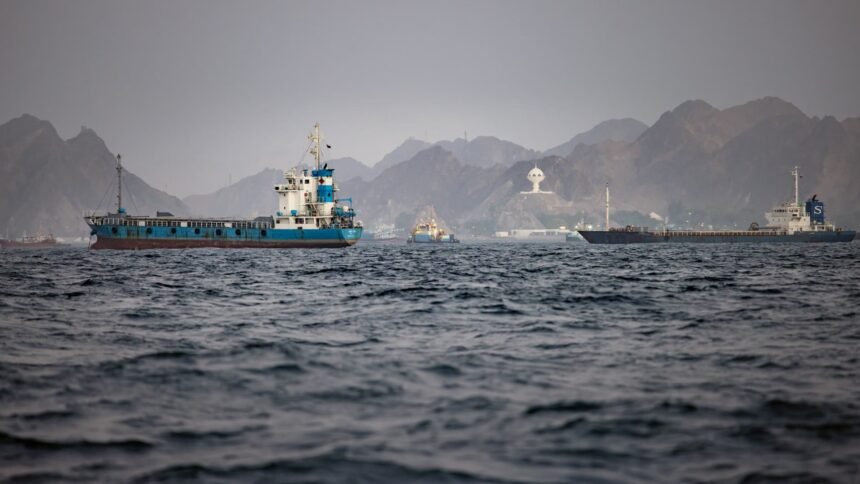
Oil tankers and cargo vessels remain anchored off Port Sultan Qaboos on June 21, 2026 in Muscat, Oman.
Elke Scholiers | Getty Images
Oil prices extended declines on Friday as more tankers exited the strategically vital Strait of Hormuz, easing supply concerns despite a vessel coming under attack in the Gulf of Oman.
International benchmark Brent crude futures for August settled down 4.34% at $71.99 a barrel, while U.S. West Texas Intermediate futures for August declined 3.74% to end at $69.23 a barrel. The last time WTI futures closed below $70 was on Feb. 27 — the day before the start of the Iran war.

Brent crude in 2026
The move lower came as investors closely monitored developments in the Middle East, while assessing whether recent diplomatic efforts would reduce the risk of supply chain disruptions.
A U.S. official told MS NOW that Iran was behind an attack on a cargo ship near the coast of Oman in the Strait of Hormuz. The ship was sailing under a Singapore flag, according to the Wall Street Journal. The United Kingdom Maritime Trade Operations said the ship reported no casualties and no environmental damage.
President Donald Trump then said Friday that Iran had violated the ceasefire with drone attacks on the Strait of Hormuz. “Damage was done, but the Ship was able to proceed on its way. We knocked down three other Drones. Obviously, this is a foolish violation of our Ceasefire Agreement,” he said in a Truth Social post.
“Following the launch of the [International Maritime Organization’s] evacuation plan, through which several vessels have already been successfully evacuated, I have decided to temporarily pause its implementation in order to reconfirm that the necessary safety guarantees continue to be in place for the ships on our evacuation list and all those in the region,” said Arsenio Dominguez, secretary-general of the IMO, a United Nations agency.
Meanwhile, tensions in the Middle East remained high, with Iran and the U.S. disagreeing over the use of funds covered under a memorandum of understanding between the two countries.
The speaker of Iran‘s parliament on Thursday rejected claims by the Trump administration that the Islamic Republic’s unfrozen assets will be used to buy U.S. agricultural products.
U.S. officials, however, maintained that any released funds would remain subject to American approval.
“As Vice President JD Vance announced this week, if Iranian assets are released, they will be used to purchase American agricultural products to feed the Iranian people,” a U.S. official said.
Scott Nations, president of Nations Indexes, said on CNBC’s “Squawk Box Asia” that “there is so much still that is to be questioned about the actual agreement.”
“I think we’re being too optimistic, because nothing really has been resolved, and Iran knows that they have the world economy where they want it if they want to shut down the strait,” Nations added.
Meanwhile, OPEC faces the possibility of another exit by its second-largest producer, after the United Arab Emirates left the cartel in May. Iraq has reportedly sought a higher production quota from the cartel and told the group it could leave if demands are not met.
— CNBC’s Joseph Wilkins and Dan Mangan contributed to the report.