Published on 6/26/2026
|
Last update: 10:20 (Mecca time)
Caracas- “Faces that break the heart,” with this phrase, Venezuelan journalist Catherine Garcia, in an interview with Al Jazeera Net from the state of Aragua, southwest of the capital, Caracas, summarizes the humanitarian scene less than 24 hours after the earthquake that struck the north of the Caribbean country.
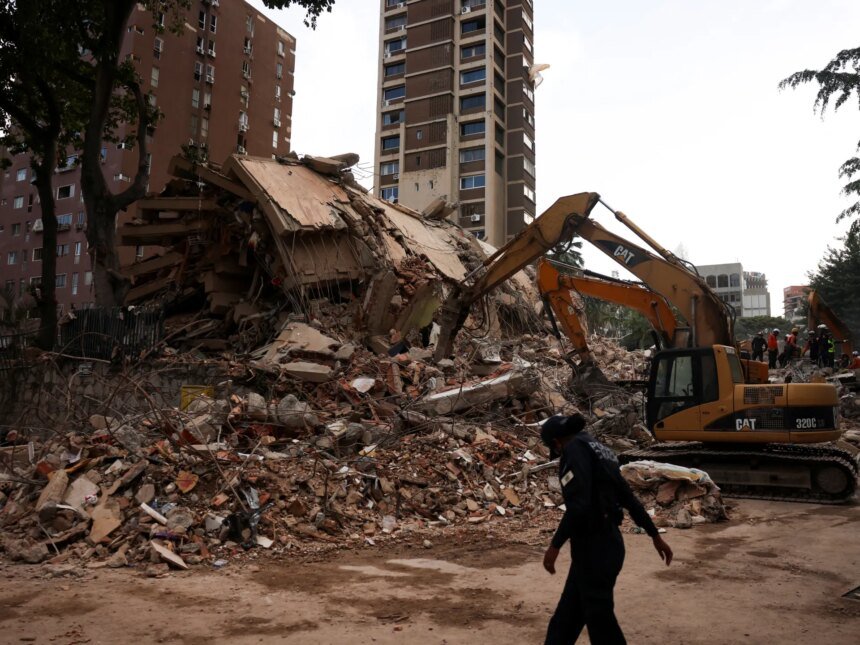
She recounts that she went out yesterday morning, Thursday, to inspect the affected neighborhoods, and saw collapsed houses, including one with 4 floors that had been flattened to the ground, while a child who was playing on its roof survived, and two people who were on the last floor survived. But what remained stuck in her memory was not only the extent of the destruction, but the faces of the residents.
“Fear, despair, and sadness” are the words that Catherine chose to describe what appeared on people’s features, noting that many are thinking about how to react if a new aftershock strikes. She stressed that, despite fear, Venezuelans are trying to stick together and support each other, saying, “We have a feeling that we are brothers, so it pains us to see anyone suffering.”
A state of mourning
From the capital, Caracas, Venezuelan citizen Billy Monsalve, a surgeon, describes what the country is experiencing as a “state of mourning,” after dozens of deaths and the loss of many of their homes, while families are still waiting for news of missing relatives under the rubble.
He told Al Jazeera Net, “What we are experiencing today is a psychological shock that has affected everyone, and we call for national unity and for everyone to come together, because families in La Guaira and the capital, which are among the most affected areas, still need our help.”
This picture is also embodied in the testimony of a resident of Caracas, who preferred to remain anonymous, saying that many people are sleeping in the open after their homes have become uninhabitable. He explained that those affected are not limited to poor neighborhoods, but also include middle-class families who lost their apartments in buildings damaged by the earthquake, citing families who were residing in the same building and all of whom became homeless.
He added to Al Jazeera Net that volunteers and civil groups have begun collecting food, medicines, and basic supplies, while rescue teams are working with limited capabilities that do not always enable them to quickly reach the stranded people or remove the rubble.

High risk
However, what worries experts today is what might come after the earthquake, especially with the presence of cracked buildings and others threatening to collapse.
The researcher at the Spanish Geological and Mining Institute, Raul Pérez Lopez, explains the seriousness of what happened by saying that the disaster is not related to the strength of the earthquake alone, but rather to the occurrence of two strong tremors in the same location within a very short period of time, less than 40 seconds, which doubled their impact on populated areas.
He explained to Al Jazeera Net that the region is located on one of the most active tectonic boundaries in Venezuela, where seismic energy has been gradually accumulating for decades, noting that the earthquake was geologically formed over a period of about 100 years.
The researcher warns that the risk of aftershocks is still high, suggesting that tremors with a strength ranging between 5 and 6 degrees on the Richter scale are likely to be recorded, which may pose an additional threat to the damaged buildings.

Experts believe that the earthquake did not create a new crisis, as much as it revealed years of infrastructure erosion and the state’s limited ability to respond to disasters.
Nastassia Rojas, a professor and researcher in the field of human rights and specializing in Venezuelan affairs, says that the effects of the disaster went beyond the collapsed buildings, revealing “infrastructure and institutions that did not receive the necessary maintenance,” including roads, the health system, and emergency response mechanisms.
Speaking to Al Jazeera Net, she indicated that the most vulnerable groups, especially the elderly, face more complex situations, stressing that the priority now is to strengthen rescue efforts and accept international aid.

Deepening the crisis
Laura Cristina Dibb, Director of the Venezuela Program at the Organization for Supporting Human Rights, Promoting Social Justice and Strengthening Democracy in Latin American and North American Countries (WOLA), supports this assessment, pointing out that the earthquake struck a country that was already experiencing a humanitarian crisis, as 12.4 million people were suffering from critical or severe humanitarian needs even before it occurred.
She added to Al Jazeera Net that the crisis is evident today inside hospitals, where field reports speak of doctors who “do not even have gauze to bandage wounds,” and of a shortage of ambulances, while “rescue and ambulance operations are taking place with the simplest capabilities.” It also warns that the decline in international aid funding may make the response more difficult.
For his part, Victor Mijares, professor of political science at the Colombian Andean University, says that the disaster also revealed the limited ability of state institutions to manage emergencies.
He told Al Jazeera Net, while he was on a visit to Caracas at the time of the earthquake, that some areas, such as La Guaira, have not witnessed reconstruction that takes into account earthquake resistance standards since the 1999 disaster, adding that civil protection and firefighting teams are working with limited capabilities.
Mijares believes that the population’s reliance on civil initiatives during the first hours reflects the size of the vacuum left by official institutions, and that managing this crisis will be a test of the state’s ability to regain citizens’ confidence.
Accumulated challenges
While the search for survivors continues, and thousands of Venezuelans face the loss of their relatives and homes, it does not seem that the effects of the earthquake will be limited to human and material losses. For many, the disaster merely “exposed challenges that had accumulated over years.”
Journalist Catherine Garcia, who lived through the first hours after the earthquake in Aragua, summarizes this reality with the phrase: “We do not have psychological stability…there is no outlet.”
The death toll from the two powerful earthquakes that struck Venezuela on Wednesday evening has risen to 235 dead and more than 1,500 injured, according to what the country’s parliament speaker announced.