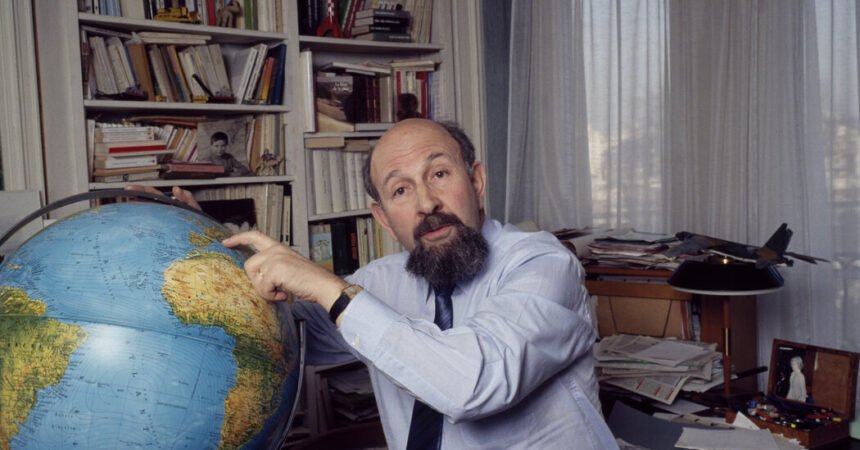
Yves Lacoste, a French geographer who showed that the United States was deliberately bombing diked areas of North Vietnam during the Vietnam War, putting millions at risk of drowning, and who, in the process, founded a modern school of geopolitics in his country, died on June 20 at his home in Bourg-la-Reine, outside Paris. He was 96.
His death was announced by Hérodote, an influential quarterly periodical about geopolitics and geography that he started in 1976.
Four years earlier, Mr. Lacoste had infuriated American authorities by offering conclusive proof that the bombing in Vietnam had deliberately targeted civilian infrastructure. They denied it and barred him from the U.S. in retaliation.
In the summer of 1972, he had visited the Red River Delta in North Vietnam to inspect the fallout from the massive U.S. bombing campaign known as Operation Linebacker.
A geography professor at the University of Paris whose work had attracted the attention of the North Vietnamese government, Mr. Lacoste deployed a geographer’s standard techniques, along with some nascent ideas about geography as a tool of war and politics. He mapped the terrain and the pattern of the bombing, inspected the damage and interviewed local residents.
The puzzle to be solved, he said, involved “hydrology, topography, flood patterns, population distribution.”
His conclusions, published first in Le Monde and then in The New York Times, were unequivocal. Two to three million lives had been put at risk by the American military campaign, he said.
“The concentration of bombing attacks on the dikes in the eastern part of the delta, which also happens to be the most thickly populated and heavily farmed area in the country,” Mr. Lacoste wrote in The Times in September 1972, can “be regarded as deliberately planned, for the attacks are directed against a region where they can have the gravest consequences.”
In an area farmed by some 600,000 Vietnamese peasants, he added, the U.S. had intentionally targeted, in nine bombing raids, a series of waterways known as the Lan locks. They were vital to pumping water from the plains, which lay below the levels of converging rivers, toward the sea.
And “even after they were wrecked,” Mr. Lacoste noted, “three more bombing attacks were launched against this installation, which is far from any military objective.”
After 150,000 tons of explosives had been dropped, the U.S. halted Operation Linebacker. “Lacoste’s exposé had played a pivotal role,” Gavin P. Bowd and Daniel W. Clayton, professors at the University of St. Andrews, wrote in Annals of the American Association of Geographers in 2013.
Mr. Lacoste’s work also suggested a new way of conceiving of geography, which in the hidebound French academic world had been concerned above all with climate, topography and botany. For Mr. Lacoste, though, the discipline was about the intersection of landscape, politics and history.
In 1976, inspired by his Vietnam experience, he published a book “whose title alone set off a polemics-laden debate that still hasn’t ended,” Le Monde wrote in 2018. That book, “Geography Serves Warfare, Above All,” set out Mr. Lacoste’s credo.
“From the moment the warlord, the sovereign, has to make decisions in regard to areas he can’t traverse in a single day, maps had to be invented,” Mr. Lacoste explained in an interview with Le Monde in 1983. “The warlord makes a kind of geographical reasoning in deploying his forces on a given terrain.”
Yves Jean Paul Lacoste was born on Sept. 7, 1929, in Fez, in what was then the French protectorate in Morocco. He was the eldest of three sons of Jean Lacoste, the chief geologist for the state mineral exploration bureau, who died when Yves was 12, and Georgette (Petit) Lacoste, a librarian.
Yves attended the Lycée Lakanal in Sceaux, outside Paris, and then studied at the Institut de Géographie de Paris, part of the University of Paris. He received his teaching degree in 1952, graduating first in his class. The same year, he moved to Algiers with his wife, the anthropologist Camille Dujardin, to teach at the Lycée Bugeaud.
By the mid-1950s, he was an assistant professor at the Institut de Géographie and had started publishing books about what was then called the third world.
Mr. Lacoste began teaching at the University of Paris, on the Vincennes campus, in 1968. He received his doctorate in 1979, with a thesis on underdeveloped countries, and in 1989 founded what became the French Institute of Geopolitics. He retired from Vincennes in 1998.
By then, his periodical Hérodote had become “the largest and most substantial body of contemporary geopolitical analysis in the world,” Leslie W. Hepple wrote in “Geopolitical Traditions: Critical Histories of a Century of Geopolitical Thought” (2000).
Ms. Dujardin died in 2016. Mr. Lacoste is survived by their sons, Jean-Philippe and Olivier.
“I detested geography when I was in school,” Mr. Lacoste told an interviewer for the radio station France Culture in 2014. “Little by little, I discovered it was actually fascinating as long as you didn’t ignore the high stakes, the power relations, the risks.”
Sheelagh McNeill, Kirsten Noyes and Susan C. Beachy contributed research.