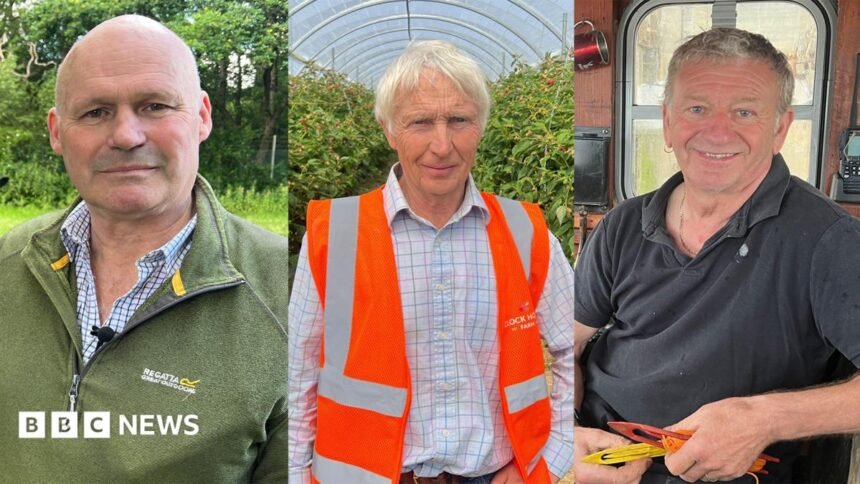

Polls from a decade ago suggested the majority of farmers and fishermen in England voted to leave the EU
Polls from a decade ago suggested the majority of farmers and fishermen in England voted to leave the EU
In the run-up to the 2016 EU referendum, farming opinion over Brexit was split, with polls suggesting a narrow majority of farmers wanted to leave the EU.
Eurosceptic MPs said outside of the union Britain would be free to set its own subsidies and – crucially – its own environment policies.
The vote among the fishing industry was more united. A poll conducted before the referendum showed 92% of fishermen intended to vote to leave the EU.
A decade on, the BBC spoke to farmers and fishermen in the South East and asked if, given what they know now, would they vote the same way today?
Surrey beef farmer, Simon Maiklem, voted to remain in the EU.
He said he has not seen any advantage from coming out of Europe.
“If anything, things are probably worse than were predicted,” he said.

Simon Maiklem said his beef farm business model disappeared after Brexit
Simon Maiklem said his beef farm business model disappeared after Brexit
Maiklem said his business model was built around exporting “high health, high pedigree cattle to Europe” and as soon as the UK left the EU that market disappeared for him.
“That market has now been taken up by the Southern Irish,” he explained, adding that because Ireland are still in the EU “they’ve done very well out of it”.
He also said farm subsidies have been “lost” over time with changing governments.
“I still haven’t got my head round why we did it [vote to leave],” Maiklem added.
He said he recognised that Europe had become “top-heavy” with legislation, but added: “It would have been far better if we’d just stayed in and tried to change it from within.”
Promises of less bureaucracy have not materialised, he said.
“A very old friend of my father’s said that farmers voting for Brexit was turkeys voting for Christmas. I think he might have been proved right,” added Maiklem.

Fisherman Mark Ball voted to leave but said nothing has changed
Fisherman Mark Ball voted to leave but said nothing has changed
Sussex fisherman, Mark Ball, voted to leave the EU.
He said when the UK was in the European Union “everything was one-sided and unfair”.
“I felt that if we could leave, we could get control back of our waters and hopefully make fishing a bit better,” he said.
Ball said he wanted European boats to be banned from fishing inside 12 miles off the UK coast.
Ten years on from the referendum he said nothing has changed.
He said EU boats “still come to six miles” and that for British fishermen there was now “loads of red tape around exporting fish”.
“It’s so unfair,” he said. “They’ve got everything they wanted and more on top. And all we’ve got is a load of regulation.”
‘I’d still vote leave’
Ball says he would still vote leave today, adding: “I just think they’re bullies.”
He said it was not Brexit that was the problem but the agreement that was made.
“Hopefully in the future we can tear that agreement up and get another agreement,” he said.
He said fishermen feel betrayed by what has happened and he hoped for a change adding that if things don’t change, “inshore fishing just doesn’t stand a chance”.
Jim Partridge, from Monteum Ltd, a fishing company in Shoreham, voted to leave the EU but said of Brexit: “We really haven’t had it.”
He said the UK was “meant to be freed from Europe”, but French fishermen were still operating in the Channel up to six miles from Sussex.
The current fishing boundary is set at six miles from the UK based on “historical rights”, he said, but UK fleets wanted “a line down the middle” of the Channel.
Partridge said French boats were taking fish stocks, leaving “very little” off the Sussex coast – an area where there should be Dover sole, plaice, cod in season, brill and turbot.
After 69 years of selling fish, stocks in the Channel now, compared to when he started at eight years old, were like “chalk and cheese”, he said.
Partridge said since Ted Heath took the UK into Europe, fishing fleets had “been suffering ever since”.
“The best fish stocks have been off the UK,” he said, and “that lot over there want it”.
When asked about calls to rejoin the EU, he said: “Europe is not performing and people think we would perform better with them.”
Partridge said there was “no question” when he voted to leave 10 years ago, and “no question” he would do the same again.

Robert Pascall says there have been some positives, but importing is harder
Robert Pascall says there have been some positives, but importing is harder
Kent fruit farmer Robert Pascall, voted to leave.
Ten years on he said purely on economic terms “remaining in the EU probably would have been the right answer”.
But he said “national pride” also comes into the debate, adding that at the time of the referendum he “felt quite dominated by the EU”.
Pascall said his business no longer receives the same farming subsidies as European fruit farmers, making it difficult to compete in the EU market.
However, he said there are positives to leaving the EU.
He said tighter post‑Brexit plant health checks, introduced to reduce pests and diseases, have made importing harder.
But, he said, it has pushed his farm to grow more of its own stock plants so that they were “no longer reliant on importing through the channel tunnel”.
A Department for Environment, Food and Rural Affairs spokesperson said the government was “determined” to give “farmers, fishers and food exporters the support they need to enable them to thrive”.
The government says it has renewed its Sustainable Farming Incentives deal and has invested around £800m in farmers and food producers, alongside £360m through its Fishing and Coastal Growth Fund.
“Our reformed SPS deal will also make trade with EU, our biggest market, cheaper and easier,” the spokesperson added.
Follow BBC Sussex on Facebook, external, on X, external, and on Instagram, external and listen to BBC Radio Sussex on Sounds. Send your story ideas to southeasttoday@bbc.co.uk, external or WhatsApp us on 08081 002250.
Related topics
Government relaunches green payment scheme for farmers after sudden closures
Traders report rise in red tape and costs post-Brexit
How Brexit hurt and helped one small port
Ten years on, Brexit’s economic impact is becoming clearer
Related internet links
Department for Environment Food and Rural Affairs (DEFRA)