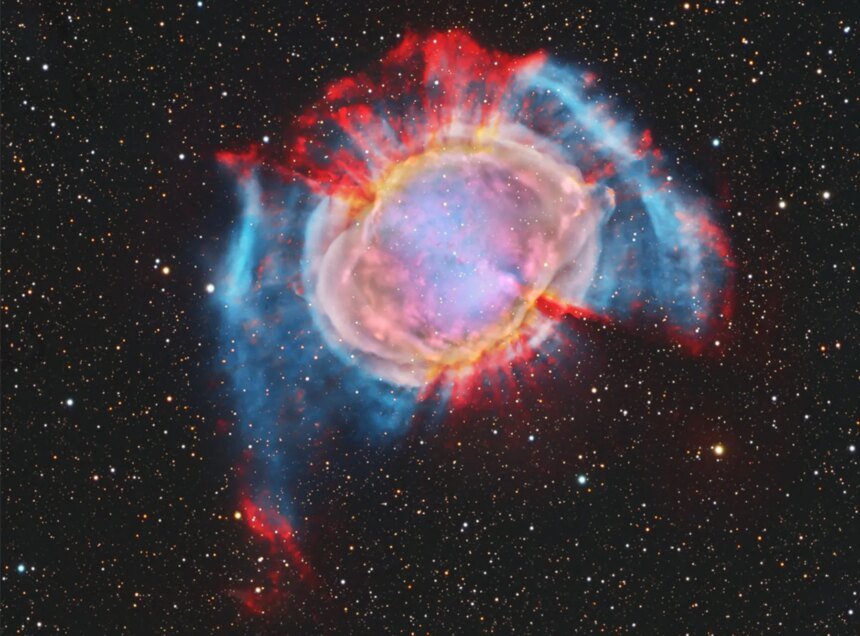
In 1764, the French astronomer Charles Messier was searching for mysterious objects that might confuse comet hunters, so he recorded a mysterious object in his famous list under the number 27. He did not realize at the time that he had recorded the first planetary nebula discovered in history, which was later known as the Dumbbell Nebula.
The nebula is located in the constellation Fox, between 1,200 and 1,360 light-years from Earth, and its apparent magnitude is 7.5, making it one of the brightest planetary nebulae in the sky and can be monitored with binoculars and small telescopes.

It gained its common name due to its distinctive shape that resembles mathematical weights with bulging ends, while it is known scientifically by the symbol “Messier-27” (M27) in reference to its position in the Messier index.
Read also
list of 2 itemsend of list
How was a nebula born from the death of a star?
Astronomical studies indicate that the Gravity Nebula represents the final stage in the life of a star very similar to the Sun. When a star exhausts its nuclear fuel, its inner layers collapse under the influence of gravity, while its outer layers are ejected into space in a slow and majestic process.
These gases are exposed to ultraviolet rays from the remaining nucleus, and they glow in different colors, forming the nebula we see today.

Scientists believe that our sun will follow a similar path after about 6 billion years, as it will expel its outer layers to form a planetary nebula, while its center will turn into an extremely hot white dwarf that emits X-rays.
Recent images show amazing details inside the nebula, where oxygen appears in blue, hydrogen in green, while red colors represent sulfur and nitrogen emissions.
Mysterious gas nodes and unsolved details
Although centuries have passed since its discovery, the Dumbbell Nebula still holds many scientific secrets. Images from the Hubble Space Telescope of the US Space Agency (NASA) and the European Space Agency revealed hundreds of dense knots of gas and dust spread within the nebula. Some of these nodes resemble long fingers pointing toward the central star, while others appear as separate clouds with extended tails.
The sizes of these clumps range from 17 to 56 billion km, which is several times larger than the distance between the Sun and Pluto, while each node contains a mass approximately three times the mass of the Earth.

Researchers believe that these structures form when stellar winds are unable to completely disintegrate large blocks of matter, so they sweep away the lighter particles, leaving behind distinct tails. However, the exact mechanisms that give planetary nebulae their complex and beautiful shapes are still the subject of ongoing scientific study and debate.
A laboratory to understand the future of stars and planets
The Gravity Nebula is one of the best natural laboratories for studying the evolution of medium-mass stars. The elements released into space by a dying star do not disappear, but rather become part of the raw material from which new generations of stars and planets are formed.
Astronomical observation teams explain that studying the emissions of hydrogen, oxygen, and sulfur inside the nebula helps scientists understand how matter is recycled in our galaxy, and how dead stars contribute to enriching the interstellar medium with the heavy elements needed to build planets and life.
Recent images taken by astronomical observation teams, including the astronomical imaging project of the LilTecan team, showed precise details of the three-dimensional structure of the nebula using specialized filters to monitor hydrogen, sulfur, and ionized oxygen.
Between the end of a star and the beginning of a new story
The Dumbbell Nebula reminds us that death in the universe is not an absolute end, but rather a continuous stage of transformation. The gases exhaled by a dying star today may, after millions of years, become part of new stars or worlds that have not yet been born.
By contemplating this distant nebula, scientists are not only studying the future of the sun, but they are also reading chapters of a larger cosmic story, where birth, death, and renewal alternate in an endless cycle.
It is a message that highlights the value of scientific research and its ability to transform dim points of light in the sky into keys to understanding our past, our future, and our place in this vast universe.