In the summer of 1933, Austrian Chancellor Engelbert Dollfuss arrived in the Italian resort of Riccione to meet with Italian Governor Benito Mussolini. Austria was under increasing pressure from Nazi propaganda and incitement, and Dollfuss wanted a guarantee from Rome that Italy would stand up to any German attempt to swallow up his country. But when he arrived, he found Mussolini in the sea, swimming as if he did not care about the future of an entire nation. Dolphus did not wait long on the beach. He took a small boat, approached the Italian leader, and the two returned to the coast amid the applause of vacationers.
The image was more eloquent than the political statement. Mussolini is almost bare-chested, huge, displaying a body that wants to be the image of the fascist state. Next to him, Dollfuss, short and dressed in formal clothes, seems to represent an old world crumbling. The scene was not only about Austria and Italy. It was about how Mussolini wanted Fascist Italy to be seen: young, strong, disciplined, confident in her body and in her future.
Read also
list of 4 itemsend of list
A few months later, Italy was preparing to host the 1934 World Cup. The second edition of the tournament, which had been born four years earlier in Uruguay as a transatlantic football dream, entered in its new version the laboratory of power and politics. In the 1934 World Cup, it was no longer just a matter of holding matches between teams within the framework of a football tournament, but rather the tournament itself became a display of the state’s capabilities, the creation of its image, and the confirmation of a political narrative about a nation that emerged from confusion to order, from weakness to strength, and from spontaneity to fascist discipline.
Why did Italy want the championship?
Mussolini was not a big fan of football in the traditional sense. But he understood, like the hardened fascists, and with the intuition of a propaganda man before he was a statesman, that sport gives politics what speeches alone do not: a body and a visible entity. Therefore, he often appeared in pictures skating, riding horses, or standing bare-chested, because fascism to him was not only an abstract idea, but rather a continuous representation of strength, jurisprudence, and toughness.
Hence, the World Cup seemed to the fascist leadership a rare opportunity. Italy had united politically in the nineteenth century over the fragments and ruins of the fading empire, but the idea of a single Italian nation still needed common symbols around which the nation in its infancy could rally. Football, with its fans, newspapers, and stadiums, was able to do what chants, flags, and schools do: instill similar ideas in people and bring people together around the symbol. Elected in this case.
The fascist regime knew that an external victory would stabilize the internal situation. If Italy wins a world championship on its home soil, this will not be, in the official discourse, an achievement of a team only, but rather proof of the validity of the system itself and its ability to achieve.
Therefore, organizing the 1934 World Cup was not only a sporting or administrative decision, but was preceded by a broader process of re-engineering Italian football. At the Viareggio Congress in late 1925 and early 1926, journalists and football officials met to chart the future of the game. The door was opened for southern clubs to enter the national competition, and the way was paved for professionalism. Then “Seria A” emerged as a true national competition in the 1929-1930 season. Restrictions were placed on foreign players in an attempt to build an Italian footballing culture, but clubs soon found a circuitous route through South American players of Italian descent, known as “Uriundi Italiano” – the “Italian diaspora”.
This was a fascist contradiction par excellence, a speech about national purity, and a practical need to import talent from abroad. Italy, which wanted to present itself as a self-sufficient nation, did not hesitate to take advantage of players such as Luis Monti, Raimundo Orsi, Enrique Gaeta, and other players coming from the other side of the Atlantic. In politics as in football, the end justified the means.
FIFA is in the face of an authority that knows what it wants
The 1934 edition reveals something early about FIFA’s relationship with power. The organization, whose spiritual father, Jules Rimet, dreamed of being a football bridge between nations, found itself facing an authoritarian regime that understood the value of heroism more than some European democracies. In the 1930s, FIFA was not the commercial empire it is today, but it had something very important: international legitimacy. Giving Italy the right to host means that the football world recognizes Rome as the venue for the tournament and that attention will be focused on it.
At that moment, FIFA was not a direct partner with the Italian authority or a conspirator with it, as much as it was ignorant of the power it possessed. National team football was still feeling its steps and discovering its strength, while authoritarian regimes were quicker to understand that strength. Mussolini was not expecting FIFA to be a propaganda partner, but rather to provide him with the platform and opportunity. When the opportunity arrives in a country with a fascist central state, a politicized press, and stadiums prepared in advance, sporting neutrality becomes an unattainable dream, even if no written instructions are issued.
Uruguay, the champion of 1930, refraining from traveling to Italy increased the meaning of the tournament. The absence of the defending champion left the field vacant for European teams, especially for the Italian-Austrian conflict. Austria, with its famous “Team of Miracles”, presented a real challenge to Mussolini. If “The Duce” was able to outperform Dolfus in Riccione in his physical appearance, then overcoming Hugo Maisel and Matthias Sindelar on the field was a much more complicated matter.
Football is a theater of fascism
The Italian state has invested in football infrastructure. Stadiums were not just places for spectacle, but political facades. Some of them bore explicit fascist names and connotations, such as the “National Fascist Party” stadium in Rome, or the “Giovanni Berta” stadium in Florence, a fascist who was killed in armed clashes by leftists and who was immortalized by fascist Italy as its martyr. In such a context, the stadium moves out of the space of place and into the space of political meaning and symbol. The player does not enter a neutral stadium, but rather into a political text written in stone, concrete, banners, and fans.
The audience was part of the stage too. At an England match in Rome in 1933, chants in support of Mussolini left a heavy impression on English officials. The Italian stands were part of a general mobilization, in which patriotism intertwined with loyalty to the regime, and sporting enthusiasm with political ritual.
As for the press, it has played its role in amplifying the meaning since years before the Italian World Cup. The author of Glory and Power: A History of the World Cup, Jonathan Wilson, reports that the fascist newspaper Il Littoriale wrote in 1928 that Italian sporting victories abroad were “clear signs of racial superiority” whose effects extended to areas outside sports. The victories were not only read as tactical superiority or individual skill, but rather as evidence of the “moral strength,” “manliness,” and “maturity” of the new state. Early on, fascist newspapers linked athletic excellence to the idea of racial or civilizational superiority. Thus, the result of a match turned into a sign of the validity of an entire political project. While on June 11, 1934, after the World Cup was won, the newspaper “La Gazzetta dello Sport” published on its front page a headline saying: “The major victories of fascist athletes in the name of the Duce and for his prize.”
Pozo between the coach and the system
In the middle of this stage, Vittorio Pozo, the Italian coach, stood confused and wavering between the ball and power. It is easy to reduce the coach to the image of a man of order, but that does not explain the complexity of his personality or his football genius. Pozo was a man fascinated by the game since his youth, influenced by English football, strict in preparation, adept at managing men, and able to bring together discordant players within one team.
He knew that the team needed a balance between cruelty and imagination. In Luis Monti, Argentina’s previous captain in the 1930 final, he found a midfielder who combined solidity, passing and defensive awareness. He needed a striker capable of stabilizing the game, so he brought back Angelo Schiavio, despite a previous dispute between him and Monti that had reached a harmful level of tension in the league. As usual, Pozo dealt with the tension in his own way, gathering the discordant players in one room, not necessarily so that they could become friends, but rather so that they would accept to be colleagues.
But Pozo was not working in a vacuum. Italian Federation President Leandro Arbinati, one of football’s leading men, fell politically after accusations of insufficient loyalty to fascism, and was replaced by Giorgio Vaccaro. The message was clear: Italian football is not independent from politics, specifically loyalty to the regime. Even when the coach is left with an artistic space, it remains surrounded by walls of politics.
The pressure on the team was enormous. Italy was not only required to play well, but to prove something about the country. The defeat would have been read as a sporting failure, but it would also have damaged the regime’s image. Therefore, winning became a political necessity before it was a football ambition.
The road to the title…violence and protests
Italy started the tournament with a huge victory over the United States in Rome. Mussolini was in the stands, in his navy hat, in the middle of a carefully drawn scene. A broad victory, an audience present, a leader who sees with his own eyes the first chapter of the story he wants.
But the tournament was not easy. Spain came in the quarter-finals to seriously test Italy. In Florence, at the Stadio Giovanni Berta, Spain took the lead through Luis Reguero, before Giovanni Ferrari equalized. Spanish goalkeeper Ricardo Zamora protested the goal, considering that he had been subjected to a violation. The match ended in a draw, and was repeated the next day, as was stipulated in the tournament rules at the time, as extra time and penalty kicks had not yet been introduced.
Here doubts began to grow. Zamora missed the replay with a bruise and swelling, and Spain was forced to make several substitutions. The second match was also violent, and Italy won with a goal by Giuseppe Meazza, amid a new Spanish protest over a violation against the goalkeeper. It is difficult to confirm that the result was made by a direct political decision. But it also cannot be ignored that the tournament was taking place in an atmosphere that put pressure on the referees, opponents, and fans alike.
Just forty-eight hours later, the biggest test came… Italy against Austria at San Siro. The rain had turned the field into a heavy field, and this greatly harmed Austria, a team whose beauty is based on short passing and intelligent movement on the field. Mussolini sat in the stands silently, with Jules Rimet next to him in a position that seemed closer to embarrassment than comfort. They were surrounded by members of the royal family, and in front of them was a match that was not related to sports alone.
Matthias Sindelar, the star of Austria, was the complete opposite of the fascist dream of a solid body. A skinny, smart, elusive player who creates danger through lightness, not muscle. That’s why his confrontation with Monti carried a symbolic meaning: Vienna’s football mind against the solidity of the Italian project. Monti subjected him to severe physical control, to the point that Sindelar required treatment after the match, and Italy coach Pozzo later wrote him a letter of apology. Italy won with a goal by Enrique Gaeta after a shot, which the Austrians in turn protested, claiming that their goalkeeper had been subjected to a violation overlooked by referee Ivan Eklind.
The name of Swedish referee Ivan Eklund will remain present in the controversy. He managed the semi-finals, and then he was assigned to manage the final as well. There were many rumors about him, but there is no conclusive evidence that he received money or received a direct order. This distinction is important. History does not need to invent a complete conspiracy to see what is wrong. Sometimes it is enough for the balance itself to be imbalanced and the balance of politics tipping the balance with a host authority that wants to win, a mobilized public, a press that spreads propaganda, and rulers who know, even without written orders, that their decisions fall under the eye of a regime that does not like to lose.
The final…the World Cup and the Duce Cup
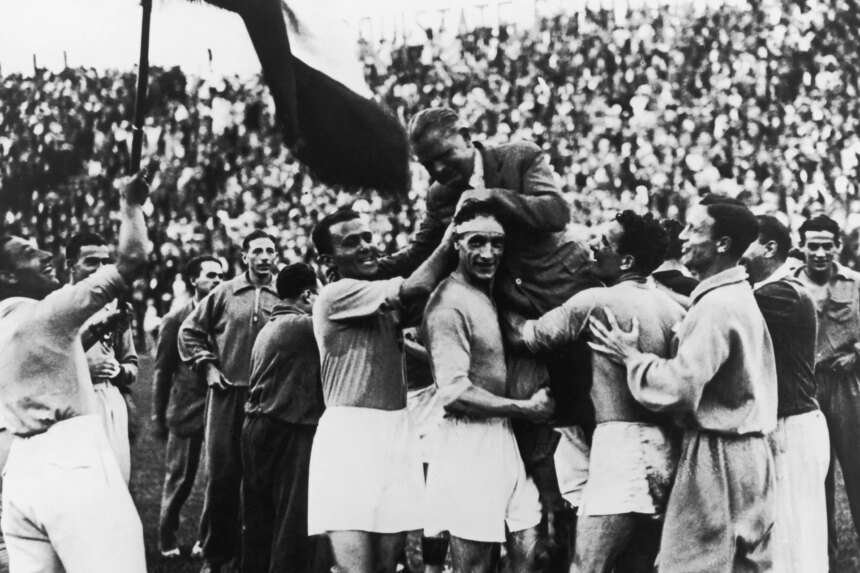
In the final, Italy faced Czechoslovakia on a very hot day. The match was no Italian picnic. Antonin Butsch took the lead for Czechoslovakia in the 71st minute, and Franzek Svoboda could have doubled the lead when he hit the post. For a moment, it seemed that the whole show was in danger of collapsing and that heaven’s justice was being meted out to the victims of fascism on and off the field. But Raimundo Orsi saved Italy nine minutes before the end, after he dribbled and shot the equalizer, and then Schiavio scored the winning goal. The match ended 2-1, and Jules Rimet handed over the World Cup, then Mussolini handed over the “Ducce Cup”, which is a huge additional award for the champion team, as if the authorities wanted to make the tournament an official cup and a political one.
At that moment, victory was not just a result. It became complete propaganda material: an Italy that organizes meticulously, hosts elegantly, and wins in the end. The Italian press celebrated foreign visitors’ praise of the good organization, and presented the tournament as evidence that the country had reached “maturity,” “preparedness,” and “strength.” As for some external voices, they were not convinced. Belgian referee John Langenus later described the tournament as, in the eyes of many countries, akin to a sporting failure, because the desire to win overcame sporting considerations, and because a heavy spirit permeated the competition.
How did the 1934 version differ from the 1930 version?
In Uruguay in 1930, the World Cup was still an adventure. A ship crossing the Atlantic, a few European teams, a stadium completed in a race against the rain, and a small country that wants to grow in the eyes of the world. Politics was present there as well, but its presence was closer to a modern country’s desire to gain recognition. In Italy 1934, everything changed. Heroism is no longer a dream, but rather a tool in the hands of a state that mobilizes, mobilizes, and charges souls. However, the story should not be simplified and reduced to one sentence, such as “a fascist World Cup.” There was real football, a capable coach, great players, strong opponents, and difficult matches. Italy was not a weak team that was carried to the cup without talent or real work, but it played within a political climate that gave every touch, every whistle, and every runway an additional meaning. This is the essence of 1934: politics did not abolish football, but rather surrounded it until it became impossible to separate the goal from the discourse.
The legacy of the 1934 World Cup
The 1934 World Cup reveals that the World Cup, from its beginnings, was not completely free of politics. What Jules Rimet began as a project for football brotherhood among nations, he discovered early on that what is popular possesses the wand of magic and influence, and what becomes influential is attracted by politics, unwillingly or willingly. In Rome, Florence and Milan, the world learned that the tournament is not only a place and time to play, but rather a platform and opportunity for countries to present themselves as they want to be seen, not as they necessarily are.
Fascist Italy was the first to understand this with complete clarity. Stadiums, teams, shirts, fans, newspapers and symbols were used to create the image of a victorious nation. There was no need to hide politics behind football; She wanted to make football itself a political language.
That is why the 1934 edition remains a decisive milestone in the history of the World Cup, not only because it is the first Italian Cup, but because it explains to us how the competition entered a new phase, a phase in which the World Cup became a mirror of power, a tool for building the country’s reputation and painting its image, and a stage on which sport intersected with nationalism, propaganda, and power.