There’s no hard and fast number detailing how long people can survive trapped in rubble after an earthquake, researchers advise.
For people who are unable to escape a building before it crumbles, the odds of survival depend on a long list of variables, including: How severe were the injuries? Is there access to food and water? How tall was the building? Can survivors breathe?
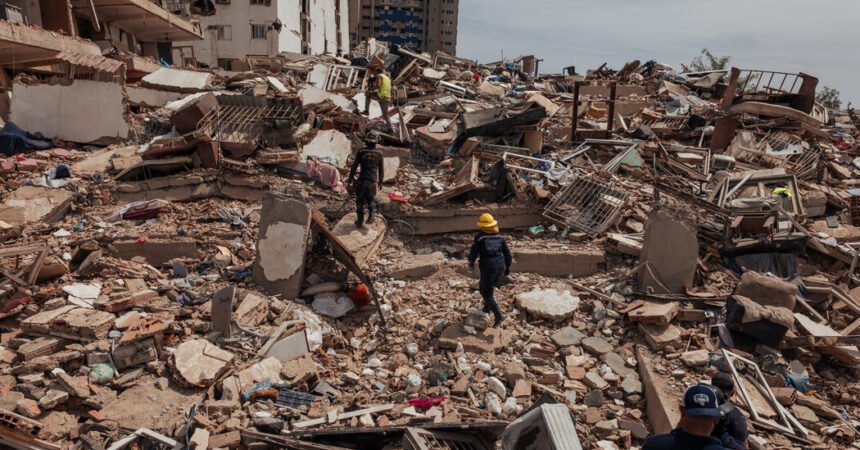
The authorities in Venezuela estimate that there could be hundreds of people still trapped under collapsed buildings following back-to-back, powerful earthquakes that struck on Wednesday. Local community organizations and emergency responders in Venezuela have been joined by families, neighbors and strangers to dig for survivors while additional rescue teams from various countries are racing to join the search.
The first 24 to 48 hours after an earthquake are crucial for finding survivors, said Dr. Jarone Lee, an associate professor at Harvard Medical School who has studied and been involved in disaster responses for over a decade. Other experts maintain that there is a 72-hour “golden” window of time during which the most lives can be saved.
But hope can sometimes outlast these guidelines. Two Turkish brothers survived for about eight days under rubble before they were rescued in 2023. An earthquake on the border between Syria and Turkey that year killed more than 50,000 people, the United Nations estimated.
“The chances of finding survivors in a building that’s collapsed after five to seven days is rare, but not impossible,” Dr. Lee said.
In some cases, collapsed buildings create pockets — or “voids,” as some researchers call them — in which survivors are trapped, but not crushed. Depending on the availability of air, water and food, people can survive for days or even weeks at a time — though such instances are uncommon. People who are trapped but uninjured are still in danger of being exposed to the elements or suffering from a lack of food and water. The dust-laden air can be suffocating.
Venezuela has a relatively warm climate, so cold-related deaths are not as much of a concern for people trapped in the rubble, said Ilan Kelman, a professor who studies disasters and health at University College London. But medical resources in Venezuela — which has regularly suffered from shortages of basic goods in recent years — were stretched thin before the earthquakes.
Dr. Lee said some fatalities can occur right after earthquakes, when would-be rescuers rush into structures that are still unstable to save family members.
Another major hazard for emergency medical workers is the possibility of aftershocks. Based on decades of historical data, the U.S. Geological Service predicted that at least one aftershock with a magnitude of 5.0 or greater was likely over the next week.
The quality of infrastructure is a key factor in determining how deadly a building collapse can become. The images of destruction emerging from Venezuela suggest many of the collapsed buildings were made of brittle concrete without adequate steel reinforcement, said Christian Málaga-Chuquitaype, a structural engineer at Imperial College London who specializes in seismic resilience.
Dr. Kelman said it is more accurate to view deaths during earthquakes as resulting from earlier political decisions, rather than as unavoidable natural tragedies.
“Earthquakes do not kill people, collapsing infrastructure does,” he said, emphasizing the importance of creating and enforcing building safety standards, and ensuring a prepared public.