
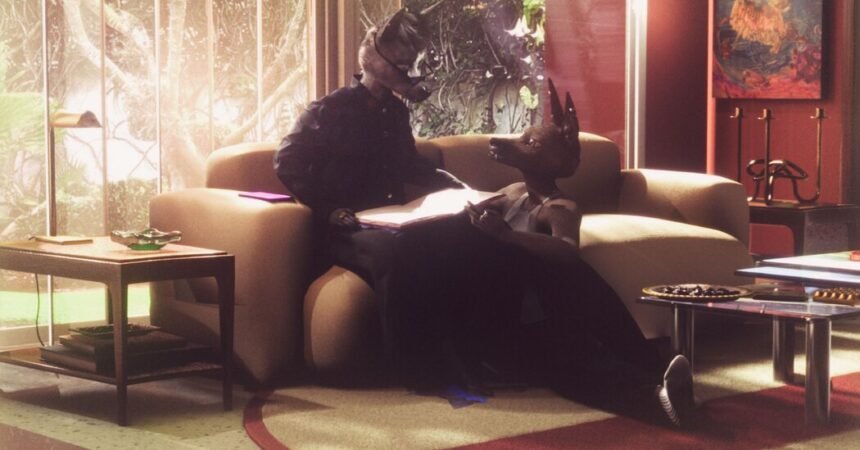
One of the beguiling attractions of tales about humanlike animals and beastly humans is their characters’ hybridity. Are they fish or are they fowl or are they cursed, like the enchanted royal in “The Frog Prince”? A similar question juices up the 3-D animation “Bouchra,” whose title character is a coyote. She isn’t a metaphor, or not altogether. Rather, she is a handsome, healthy-looking animal with glossy hair and sharp teeth, if one who moves through the world on her rear legs. She walks and she talks, smokes and drinks, and wanders around in a black motorcycle jacket. Sometimes she works on the autobiographical movie that she’s making.
“Bouchra” was written and directed by Orian Barki and Meriem Bennani. Its anthropomorphized figures and photorealistic backgrounds make it a piece with their earlier celebrated project, “2 Lizards,” a series of short videos that they released on Instagram in 2020 over a period of several months. In installments that run between just over one minute and under five, two New York lizards (voiced by the artists) navigate the early surrealism of the coronavirus pandemic with trepidation, humor, a dash of politics and shifting, complicated sense of wonder and wistfulness. They wander the city, stare into screens. In the most poignant episode, they visit a thoughtful hospital nurse who happens to be a pretty cat.
The movie is more ambitious than the series; somewhat paradoxically given the stakes, it is often darker visually and tonally. It takes place in New York and in Casablanca, Morocco, and skips between the past and the present, where its title character (voiced by Bennani), is preoccupied with her movie. She’s also trying to come to terms with her mother, Aicha (Yto Barrada), who’s in Casablanca and loves her daughter but failed to support her coming out. When you first see Bouchra she’s staring out the window of a moving subway car, the sight and clattering sound of the train making a distinct, engaging contrast to her long muzzle and ears. She’s on the move yet her distant gaze suggests that mentally she’s somewhere else.
Bouchra looks like a coyote, but the resemblance is fur deep; for the most part, she is a wholly recognizable woman with dreams, desires, struggles and friends, including Yani (Barki, again voicing a lizard). Bouchra works and she plays, at one point hooking up with an ex, Nikki (Ariana Faye Allensworth), who looks like a very fit cow. They nuzzle in human fashion, their muzzles awkwardly touching as jazzy notes waft on the soundtrack. The entire episode is lightly amusing and modestly provocative, and is capped by a shot of Nikki playfully shaking her shapely rump at Bouchra (and the camera). Some of the character designs are more zoologically legible than others, but these are not Disneyesque cute and fuzzies.
They’re different, at least outwardly. They are also, alas, not all that interesting, despite their fangs and tails, and the appealingly naturalistic vocal performances. Bouchra certainly looks intriguing, never more so than when holed up in her dim apartment, an expressionistic lair. (The cinematographer is John Michael Boling, the head of animation is Jason Coombs.) The filmmakers stir up interest and tension from their hybrid beings while circling questions about the nature of identity and what it means to exist between seemingly opposite worlds. Stories of family hurt have a way of working you over, and “Bouchra” has its moments. Yet the more the filmmakers focus on the mother-daughter relationship, all while also embracing narrative self-reflexivity, the more drearily familiar — and toothless — this movie becomes.
Bouchra
Not rated. In English, French and Arabic, with subtitles. Running time: 1 hour 23 minutes. In theaters.