
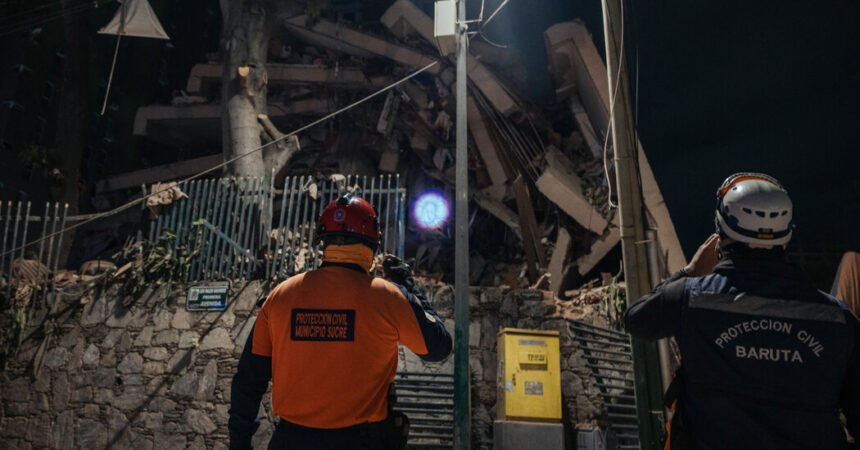
The two major earthquakes that struck Venezuela late on Wednesday hammered the country’s fragile infrastructure, raising the prospects of a high death toll and threatening to further set back the country’s recovery after years of mismanagement and corruption.
Venezuela’s acting president, Delcy Rodríguez, said in a televised address that the quakes had caused widespread disruption to public infrastructure, especially in the capital, Caracas, and the neighboring state of La Guaira, which she said was the hardest hit.
Early Thursday, no lights were on in parts of Caracas, especially in the west of the city, and streets were flooded from burst water pipes.
“Dozens of buildings have collapsed, and right now we are in very arduous rescue operations,” Ms. Rodríguez said, adding later: “This is a true tragedy.”
Venezuela’s electrical grid has suffered chronic outages, including in 2019, when a national blackout was attributed to a failure at a hydropower plant caused by mismanagement and corruption. Over the past ten years, water supply has run dangerously low. Hospitals have also been failing, and lack basic resources.
The U.S. Geological Survey said that many people in the affected region live in vulnerable structures constructed from bricks and adobe. Similar weaknesses existed in 1967, when an earthquake in Caracas killed hundreds of people. Officials attributed the deaths to faulty construction.
After the quakes on Wednesday, Ms. Rodríguez said that there were power outages in Caracas and La Guaira, though the grid continued to function in the rest of the country. Officials shut off domestic gas supplies in the affected areas and water service was disrupted in parts of Caracas and several northern states, including Miranda, Falcón, Yaracuy, Zulia and La Guaira, she said.
Subway and rail services were also suspended for rescue and recovery efforts, she said. Simón Bolívar International Airport, which serves the capital, was closed after it suffered heavy damage. Schools would be closed for the rest of the week, she added.
Internet connectivity in Venezuela dropped after the quakes to around 65 percent from over 90 percent late Wednesday, according to network data from NetBlocks, an internet monitoring group. The country’s restrictions on the social network X appeared to remain in place, said Isik Mater, director of research at NetBlocks. Such internet restrictions, which are widespread in the country and aimed at political control, have added to the communication limitations.
The pre-existing weaknesses in Venezuela’s health system have made rescue efforts more challenging, said Dan Hovey, vice president of emergency response at Direct Relief, a California-based humanitarian organization providing aid to Venezuela. The road closures, power outages and communication disruptions have also created logistical hurdles for delivering aid, he said.
“We have been in contact with some partners this evening and are continuing to reach others as they assess conditions,” he said.