Published on 6/24/2026
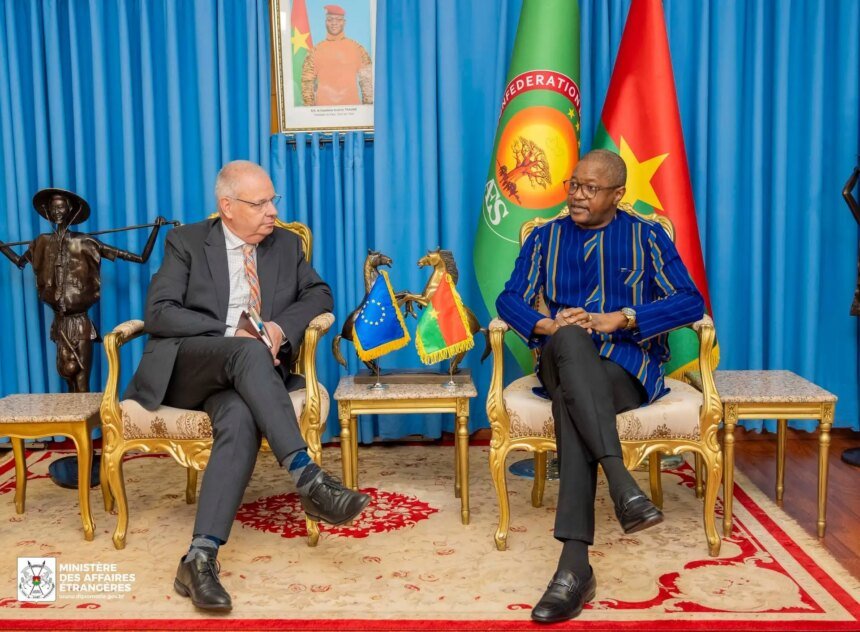
The Ministry of Foreign Affairs in Burkina Faso summoned, the day before Monday, the head of the European Union mission accredited to the country, Philippe Bronchin, to inform him of Ouagadougou’s dissatisfaction with a resolution adopted by the European Parliament criticizing what it described as the continued “campaigns of repression” and the “deterioration of basic freedoms,” in a move that revealed a clear discrepancy between an offensive tone on the part of the Burkinabe authorities and a cautious diplomatic response on the part of the Union mission.
According to a statement by the Ministry of Foreign Affairs, Burkina Faso’s Foreign Minister Jean-Marie Traoré summoned the European official to inform him of his country’s protest, considering that the decision represents interference in the internal affairs of a country that “exercises its full sovereignty in managing its security issues and its civil space.”
The European Parliament adopted the resolution last Thursday with a majority of 476 votes, 11 votes against, and 75 deputies abstaining from voting, criticizing the Burkina Faso authorities’ dissolution of political parties and the suspension of the activity of hundreds of civil society organizations.
The resolution, published on the European Parliament’s website, stressed that “press freedom is seriously threatened” in Burkina Faso, calling for “lifting restrictions imposed on the media and allowing journalists to work freely and in complete safety.”
The European representatives called for “independent investigations into all allegations of crimes and human rights violations,” denouncing what they described as “acts of intimidation, illegal forced recruitment, harassment, arbitrary arrest, and enforced disappearance.”
The resolution affirmed that “counter-terrorism efforts must be conducted in full respect for international human rights law and international humanitarian law,” expressing “deep concern about Russian influence in Burkina Faso since the expulsion of European forces,” which it considered contributing to “human rights violations and the slide toward authoritarian rule.”

Ouagadougou replied
For its part, the Burkina Faso government denounced the decision, and its head of diplomacy criticized what he considered “misinformation” and “ignorance of the efforts” the country is making in the field of combating insecurity, according to what the Ministry of Foreign Affairs published on its Facebook page.
The minister denounced the statements of French member of the European Parliament, Christophe Gomart, considering that his talk about a country he had not visited and his presentation of numbers about it “is tantamount to an insult to the position of the European Parliament by delivering a speech carrying a neo-colonial tendency.” He also saw that some European officials ignore the consequences of NATO intervention in Libya on stability in the African Sahel region.
The minister said that the decision was based on inaccurate information, and that it ignored the sacrifices and efforts made by Burkina Faso in its war on insecurity alongside Mali and Niger.
A cautious diplomatic response
On the other hand, European Union Ambassador Philipp Bronchin merely acknowledged the concerns raised by the Burkinabe authorities, pledging to convey the message to the relevant institutions in the European Union, in a position that seemed more conservative than the escalatory tone adopted by the Burkinabe side.
This diplomatic exchange, according to the West African Voice Network (WAVN) website, reflects continued tension between Ouagadougou and some European bodies over issues related to security, governance, and national sovereignty.
It is noteworthy that Burkina Faso’s relations with Western partners have witnessed tension since Captain Ibrahim Traoré came to power following a military coup at the end of September 2022.