Published on 6/25/2026
|
Last update: 07:50 (Mecca time)
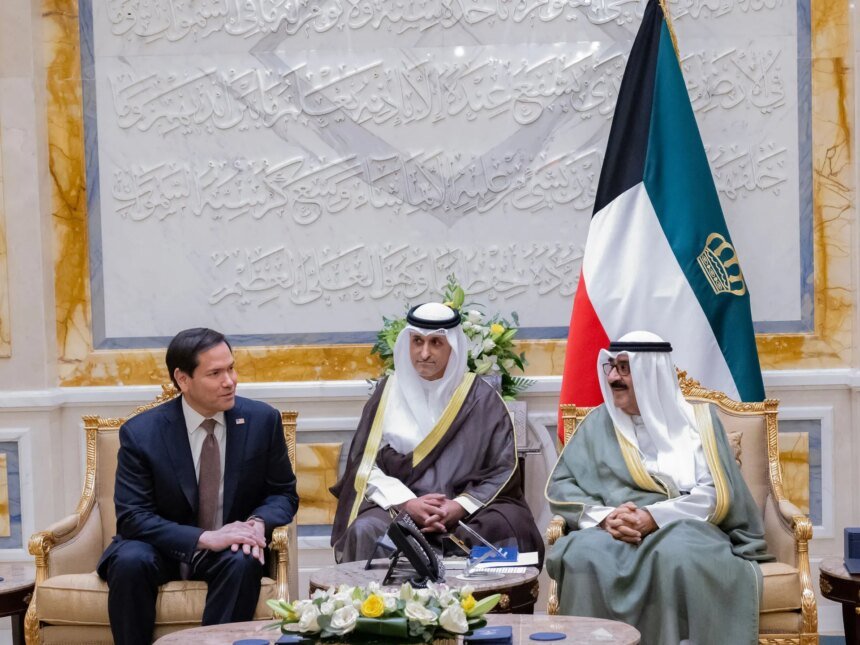
US Secretary of State Marco Rubio pledged that the United States would take into account the interests of its allies in the Gulf during its ongoing negotiations with Iran, stressing that Washington would be “fully compatible” with them in the various stages of the negotiation.
This came during Rubio’s visit to Kuwait yesterday, Wednesday, following his visit to the Emirates as part of a Gulf tour to discuss the security of the region and ensuring that the Strait of Hormuz remains open. After Kuwait, he arrived in Bahrain to participate in the joint ministerial meeting between the Gulf Cooperation Council countries and the United States of America.
The American minister stressed that his country will involve its Gulf allies “in the talks regarding every decision taken” as part of the efforts aimed at reaching a permanent settlement to the war in the Middle East, noting that these countries “incurred a great cost after being subjected to Iranian attacks with missiles and drones” during the conflict.
Rubio said that his country seeks to ensure the return of free navigation through the Strait of Hormuz without fees, stressing that “all countries of the world support this approach,” pointing out that the memorandum of understanding signed with Iran is supposed to be implemented within a time limit extending to 60 days, as part of efforts aimed at consolidating a comprehensive agreement.
He pointed out that US President Donald Trump calls on Iran to adhere to the memorandum of understanding, and that his country has “many options,” including imposing sanctions on Iran if it does not adhere to the agreement, noting that Washington continues to coordinate with its partners in the region.
Stuck files
Last week, the United States and Iran signed a memorandum of understanding and began consultations mediated by Pakistan and Qatar with the aim of reaching a final agreement within a period of 60 days that can be extended, with technical talks to resume in Switzerland at the end of this June.
Despite this, disagreements still exist regarding several issues, most notably the Iranian nuclear program, sanctions, and the future of navigation in the Strait of Hormuz, which was reopened after months of closure that caused energy prices to rise.
In this context, Washington stressed its refusal to impose any crossing fees in the Strait, while US President Donald Trump said that he had received assurances from Tehran not to impose fees, despite Iranian indications that they might be imposed in the future.
US President Trump had previously hinted at imposing fees in the Strait of Hormuz if the declared 60-day ceasefire expired without an agreement with Iran, stressing that during the aforementioned period no fees would be imposed on passage through the Strait.
The US President wrote on the Truth Social platform: “There will be no fees in the Strait of Hormuz for 60 days during the ceasefire period, and there will be no fees after the end of the 60-day period.”
Trump added, saying that the United States “may impose fees in its favor in the event that the agreement is not concluded, in exchange for services provided as the guardian angel of the countries of the Middle East, with the aim of compensating for past, present and future costs.”
He announced that the negotiations are “going well,” considering that Iran is “making major concessions,” at a time when the talks face complex challenges that include issues of enrichment, nuclear stockpiles, and post-war arrangements.
The Iranian Revolutionary Guard closed the Strait of Hormuz – last Saturday – in response to what Tehran described as American and Zionist violations of the memorandum of understanding on ending the war. The Iranian Foreign Ministry also called on Washington to expedite the implementation of the terms of the memorandum, “otherwise it will face problems.”
The memorandum of understanding between Washington and Tehran includes provisions related to stopping the war, reopening the Strait of Hormuz, and allowing Iran to sell oil until next August 21, while other files remain pending, most notably the nuclear program and mechanisms for lifting sanctions.
In this context, the Director-General of the International Atomic Energy Agency, Rafael Grossi, confirmed that inspections of Iranian nuclear facilities “will inevitably occur,” despite the discrepancy in statements between the two sides.
The repercussions of the war also cast a shadow on the Lebanese arena, as tension continues with the exchange of accusations of violating the ceasefire, amid Israel’s assertion of the continued presence of its forces in southern Lebanon “as long as necessary,” while Lebanese parties accuse Tel Aviv of violating the agreement.
Regional movement
Yesterday, Wednesday, Sultan of Oman Haitham bin Tariq discussed with the Prime Minister and Minister of Foreign Affairs of Qatar, Sheikh Mohammed bin Abdul Rahman Al Thani, efforts to enhance the security and stability of the region, and stressed the need to keep the Strait of Hormuz open, during their meeting in Muscat.
The Qatari Ministry of Foreign Affairs said that the meeting witnessed a discussion of the latest regional developments, especially the diplomatic efforts made to enhance security and stability in the region, after the signing of the memorandum of understanding between the United States and Iran.
Qatari Prime Minister and Foreign Minister Sheikh Mohammed bin Abdul Rahman also discussed – in a phone call – with Saudi Foreign Minister Prince Faisal bin Farhan the latest regional developments, especially diplomatic efforts aimed at enhancing security and stability in the region, following the signing of the memorandum of understanding between the United States and Iran.
Sheikh Mohammed bin Abdul Rahman affirmed the State of Qatar’s full support for the ongoing negotiations between Washington and Tehran, stressing the importance of reaching sustainable solutions through dialogue and peaceful means, in a way that enhances the security of the region and opens broader horizons for cooperation and development.
The Qatari Prime Minister and Foreign Minister spoke – earlier – about the features of the regional arrangements for the post-war period against Iran, touching – in an interview with the Financial Times – on the Strait of Hormuz file, a new regional security framework with Iran, and a mechanism to verify the ceasefire in Lebanon.
Sheikh Mohammed bin Abdul Rahman confirmed – in his interview with the Financial Times – that the Strait of Hormuz is still open, indicating that Doha received confirmation that it would not be ordered to close it. He said that navigation in Hormuz is supposed to return to its levels within 30 days of the agreement.
He stressed that establishing a line of communication between Washington and Tehran is necessary to prevent obstruction of the opening of Hormuz and during the mine clearance process, adding that the line of communication agreed upon in Switzerland is necessary to confront misleading information.
Sheikh Mohammed bin Abdul Rahman pointed out that the Swiss talks established permanent settlement negotiations, noting that the work is still at its beginning, and that Qatar continues to mediate with Pakistan to reach a final settlement.
He explained to the newspaper that any model for managing Hormuz must be discussed with Iran, Oman, and the Gulf states, noting that Qatar will oppose any Iranian plan to impose fees on crossing the Strait of Hormuz. “We cannot accept a situation in which our gateway to the world is under the control of one party,” he said.
The Qatari Prime Minister had revealed to Al Jazeera – last Monday – that there were problems facing the negotiating track since the signing of the memorandum, especially with regard to the Strait of Hormuz and Lebanon, but he stressed that mechanisms had been put in place to avoid such problems, so that the focus would be on negotiations and reaching an agreement.