
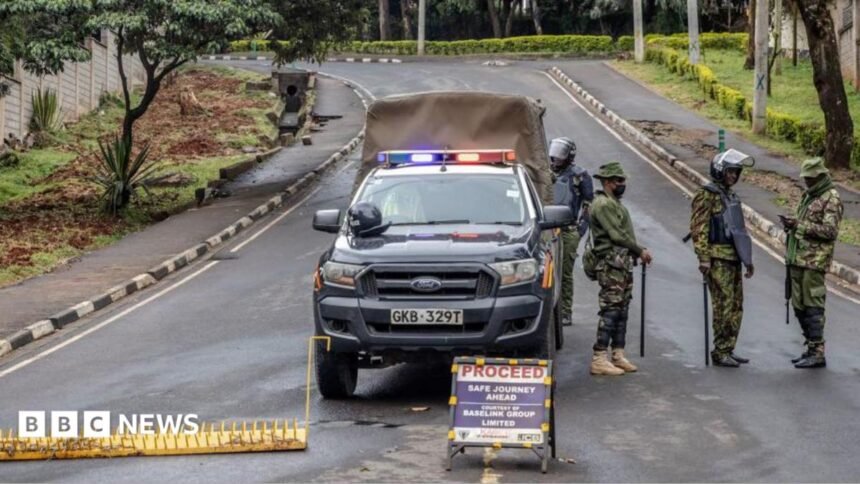

Major roads leading to the capital have been barricaded, disrupting the movement of motorists (file photo)
Major roads leading to the capital have been barricaded, disrupting the movement of motorists (file photo)
Police in Kenya have sealed off key roads leading into central Nairobi ahead of planned nationwide protests marking two years since the deadly Gen-Z-led anti-government demonstrations.
Thousands of Kenyans protested against proposed tax hikes in June 2024, culminating in the storming of parliament and the eventual withdrawal of the controversial finance bill.
Protesters say they are demanding justice for more than 80 people killed and dozens more injured during the 2024 anti-tax demonstrations and last year’s anniversary protests.
Commuters were left stranded on Thursday morning after security forces blocked access to the city centre, while many businesses and schools remained closed
Kenya battles to stop the ‘goons and guns’ as fears of political violence grow
‘They aimed to kill’ – BBC identifies security forces who shot Kenya anti-tax protesters
The planned protests, largely mobilised through social media platforms, are expected to take place in major towns including Nairobi, Mombasa and parts of central Kenya.
Security agencies have heightened surveillance in major urban centres ahead of the protests, with police expected to maintain a heavy presence in Nairobi and strategic installations.
Early on Thursday, police mounted roadblocks along the Thika Super Highway, Mombasa Road, the Nairobi-Namanga Highway in Athi River, Kenyatta Avenue, Waiyaki Way, Jogoo Road, and other major routes, preventing motorists and pedestrians from accessing the city centre.
Authorities have urged protesters to remain peaceful and avoid acts of violence, looting, or destruction of property.
President William Ruto on Friday said people had a right to protest but warned that anyone “mobilised to destroy property or cause chaos” would not be tolerated.
Several political leaders, civil society groups, and human rights organisations have expressed support for peaceful demonstrations, describing them as part of democratic expression protected under the country’s onstitution.
Ruto’s former deputy Rigathi Gachagua, now a bitter rival, has urged Gen Z activists to stay away from the streets, citing concerns that the protests could turn violent. Instead, he has called on Kenyans to remain at home in a symbolic show of dissent.
Last week, President Ruto announced a fund of nearly $15m (£11m) to compensate nearly 2,000 victims of protest-related human rights abuses between 2017 and 2025 identified by rights groups.
Ruto said the compensation was not a “price for life, pain or loss” and should not be seen as rewarding violence or criminality.
However, human rights organisations have rejected the compensation plan, citing the exclusion of some victims, inadequate pay-outs and a lack of transparency.
President Ruto is facing growing public discontent ahead of the 2027 elections, with critics accusing his government of failing to deliver on key campaign promises.
He rejects those claims, insisting his administration has fulfilled most of its pledges and saying he is ready to defend its record as he seeks re-election.
More about Kenya from the BBC:
The ever-shifting alliances that fuelled Kenya’s impeachment drama
Kenya at crossroads as nation reels from Odinga’s death
Is William Ruto the most disliked president in Kenya’s history?

Go to BBCAfrica.com, external for more news from the African continent.
Follow us on Twitter @BBCAfrica, external, on Facebook at BBC Africa, external or on Instagram at bbcafrica, external
Related topics
BBC Africa podcasts
Focus on Africa
This Is Africa