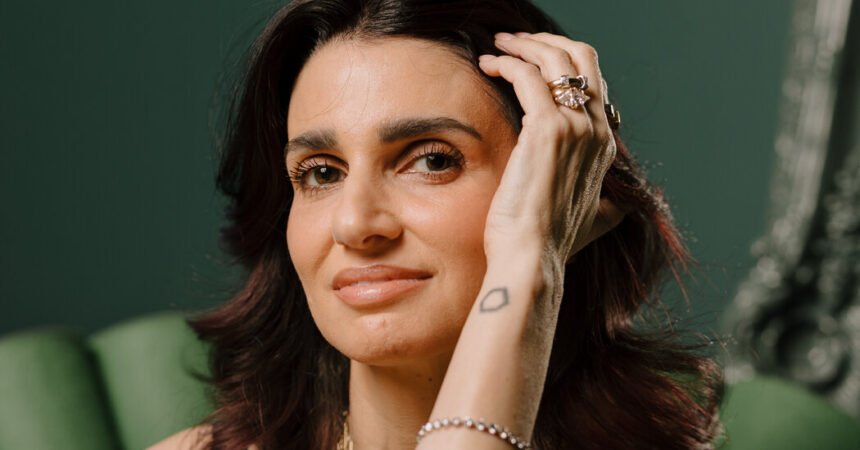
Shahla Karimi considers herself an unconventional jewelry designer.
“I’m your ring designer, therapist and friend,” said Karimi, who moved to New York from Louisville, Ky., in 2004, and created her jewelry brand, Shahla Karimi Jewelry, in 2014. A SoHo showroom followed in 2022. “Rather than sell you a diamond and a setting, I design pieces that reflect a couple’s relationship and emotion,” she said.
Karimi, 44, has left a sizable female footprint in New York’s male-dominated diamond industry, and last year, created a self-funded reality series called “Diamond Divas,” 40 one-minute episodes that follow Karimi and the eight women who work in her showroom. They can be viewed on social media platforms like Instagram and YouTube.
“I’d never seen a show about women in the diamond industry,” she said, “and what love and relationships look like right now.” This includes rings that reflect nonmonogamous relationships, something Karimi and her husband, Tim MacGougan, 42, an app entrepreneur, experimented with themselves, which she mentions on the show.
In the fall, she will open a design studio and store in TriBeCa that will offer customers a range of jewelry, design options, a behind-the-scenes experience and a menu with Persian delicacies, reflecting Karimi’s culture. (Her father is from Iran; her mother is from Kentucky.)
“My parents wanted me to be a doctor, lawyer or engineer,” she said. “Those were the choices they gave Persian women back then. I knew that would never make me happy.”
This interview has been edited and condensed.
What makes you an unconventional designer?
I take snippets of people’s stories, and I make an entire ring about them. I tell their story through the shape, color and origin of the stone; how it’s set; and through design details that will only be meaningful to them.
What’s your process?
I ask the person or couple as many details as possible — from how they met and who kissed whom first to what makes your partner special. That can make people uncomfortable. Many people weren’t expecting to have this discussion; they came to look for pretty things. It’s an intimate experience. Some people cry.
How has the way people look for rings changed?
There’s a rejection of how our parents used to find love, of the notion that a man proposes to a woman, and it’s his choice. Now people come in as a team, looking for rings together. It’s a life choice for both people.
Does that mean the customer is changing, too?
Yes. We have women proposing to men, same-sex couples and throuples. People are now meeting on nontraditional apps, like Feeld, at sex parties, on the train or through matchmakers. They are not listening to rules.
What kinds of rings are people looking for?
Nontraditional shapes: elongated hexagons; antique pills; and lucky cuts. They’re considering unusual colors like champagne, light pinks and warmer whites.
Almost no one wants a solitaire. If they do, they want to put a chunky band underneath so it can transform into something else. They’re leaning into cocktail, signet, and fashion statement rings as engagement rings. My customers don’t want anything that looks like an engagement ring, but that’s also a trend happening with people in general.
What was it like being a woman in a male-dominated business?
It was very hard. I wasn’t taken seriously by the men in the industry. They felt threatened. I couldn’t show any sign of weakness, and I got charged more because they tried to take advantage of me. Now there’s a wave of independent women designers who are not on 47th Street in the Diamond District. They’re in the neighborhoods where their customers live.
What made you create “Diamond Divas”?
I took our $100,000 marketing budget and made a reality show. I wanted to show people the interesting women who work here and our just-as-interesting customers, so people who are not living in New York City can see how love looks different today. I wanted to humanize all different kinds of experiences while debunking old traditions — like you don’t spend three months’ salary on a ring.
Tell me about your own marriage.
I got married in 2014. It was never an easy marriage. After eight years, we looked for alternative options. We tried everything: a shaman, therapy, doing mushrooms, having an open marriage and being polyamorous. That was a struggle. We didn’t know how to put guardrails up, create boundaries and have an ethical, nonmonogamous relationship. We got hurt and hurt each other.
But we grew a lot. It made me appreciate him differently. We have a son together, and we love him. We are stronger as a family together. There’s an innate feeling that this is my person, and I can’t imagine my life without him. That’s why I stayed.
How did your relationship experience change your work?
Love is a bigger story. The ring is more than an engagement statement, or one person asking, “Will you marry me?” It’s really asking, “Will you design a life with me?”