
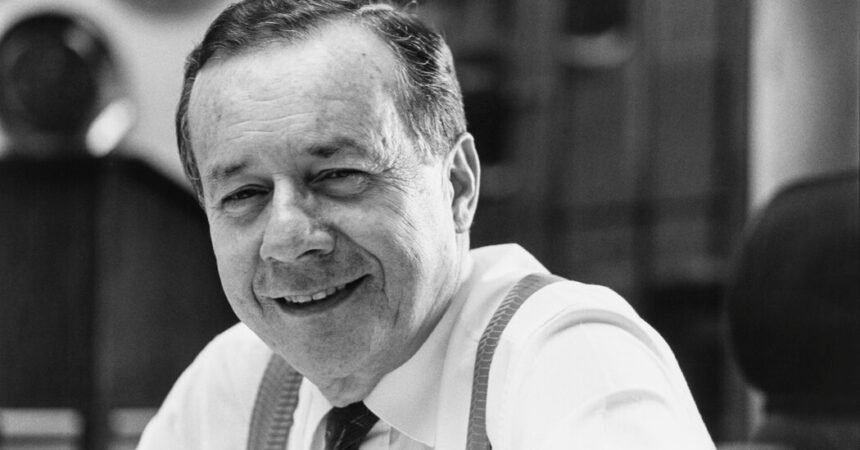
Frank J. Guarini, a reform-minded, seven-term northern New Jersey congressman whose influence extended from his perch on the House Ways and Means Committee to the other side of the Hudson River, where he was known to butt heads with New York politicians, died on Saturday at his home in Jersey City, N.J. He was 101.
His death was confirmed by a funeral director for Greenville Memorial Home in Jersey City.
A Democrat, Mr. Guarini represented the ethnic polyglot that is Hudson County from 1979 to 1993, routinely winning re-election by 2-to-1 ratios. He chose not to seek an eighth term after his 14th Congressional District had been carved up in a redistricting.
Earlier, as a state senator from 1966 to 1972, he played a central role in dismantling the long-entrenched Hudson County Democratic Party machine, which had produced such storied bosses as Frank Hague, the Jersey City mayor, from 1917 to 1947, who once proclaimed, “I am the law.”
In his 14 years on the tax-writing Ways and Means Committee, Mr. Guarini offered a pragmatic mix of progressive legislation and conservative fiscal philosophy. He was involved in the enactment of free-trade agreements with Israel, Canada and Mexico. He fought to preserve the federal income-tax deduction for state and local taxes, which President Ronald Reagan had sought to abolish. He pushed for funds to renovate public housing.
Though known in Congress for his reserve and willingness to negotiate, Mr. Guarini relished a bit of contention with New York politicians. He was one of his state’s most vocal opponents of Westway, a proposed project to extend and widen the West Side Highway in Manhattan. He argued that the landfill that would be required for the project would cause flooding and pollution in the New Jersey Meadowlands, a prime development area.
After Congress voted overwhelmingly in 1985 to block the allocation of federal highway funds for the landfill, Governor Mario M. Cuomo and Mayor Edward I. Koch abandoned the project.
When Mr. Koch, in 1984, opposed the use of federal grants for development along the Jersey City waterfront, contending that it would pirate jobs from Manhattan, Mr. Guarini called the accusation “ludicrous.”
And why, he wondered, should New York have control of Liberty Island and Ellis Island when they were only about 2,000 feet from his state and more than 10,000 feet from New York? In 1986, to mark the Statue of Liberty centennial, he distributed T-shirts to all 535 members of Congress. They bore the majestic lady’s face and the claim: “Liberty Lives in New Jersey.”
To win control specifically of Liberty Island, he and a former Jersey City mayor, Gerald McCann, filed a lawsuit, Guarini v. New York, challenging an 1834 interstate compact that had established New York’s sovereignty over the islands.
The courts didn’t buy it. The Superior Court of New Jersey rejected the claim and, in 1987, the U.S. Supreme Court declined to hear the case on appeal.
Five years after he had retired from the House, Mr. Guarini obtained a measure of satisfaction at least regarding Ellis Island. In 1998, in a case filed by New Jersey against New York seeking sovereignty, the Supreme Court found that the substantial part of Ellis Island that had been created from landfill over the years — amounting to 90 percent of the site — belonged to New Jersey.
Frank Joseph Guarini Jr. was born in Jersey City on Aug. 20, 1924, to Frank and Caroline (Critelli) Guarini. His father, a lawyer, was a state assemblyman in the 1930s. Mr. Guarini is survived by his sister, Caroline Mangin. His marriage, in 1954, to Audrey Berman ended in divorce.
After serving in the Navy in the Pacific during World War II, Mr. Guarini completed his bachelor’s degree at Dartmouth College in 1947. He received his law degree from New York University in 1950 and soon joined his father’s practice.
As a state senator, when a coalition of insurgent Democrats upended their party’s Hudson County machine in 1972, defeating all but one of its candidates in the primary, Mr. Guarini managed the reform campaign. He called the results a “smashing victory that has consigned to the scrap heap one of the most discredited political machines that ever existed.”
He stepped down from the State Legislature that year and did not run for office for the next six years, focusing instead on his successful law practice, although he remained active in county Democratic Party affairs.
Then, when he was easily elected to represent the 14th District (with its mix of Italian, Irish, Polish, Hispanic, Asian and Black voters), his grasp of the intricacies of tax law prompted an immediate appointment to the powerful Ways and Means Committee — a coveted seat rarely assigned to a freshman.
Mr. Guarini was the principal House sponsor of the Employee Educational Assistance Act of 1991, which provided a tax deduction for employers who paid for further education of their workers while not requiring the workers to pay income tax on the money they received.
Still, he was an advocate for fiscal responsibility. “America’s most urgent issue is getting the budget deficit under control,” he said in 1986 when he received another influential appointment, to the House Budget Committee. “Our $2.3 trillion public debt will undercut our standard of living and threaten our national security.”
Back then, Jersey City was gritty and industrial, and did not have the towering, glistening skyline that it has sprouted in recent years. After serving in Congress, Mr. Guarini would play a significant role in that development. In partnership with several major corporations, he built a real estate portfolio of office buildings, a shopping center and more than a dozen residential buildings, some more than 40 stories tall, near the Jersey City waterfront.
In recent years, he lived on Central Park South in Manhattan.
“Hey, I love New York,” Mr. Guarini had said in 1988 while proposing an interstate détente. “I just stand up for New Jersey’s interests.”
Dennis Hevesi, a former reporter for The Times, died in 2017.
Ash Wu contributed reporting.