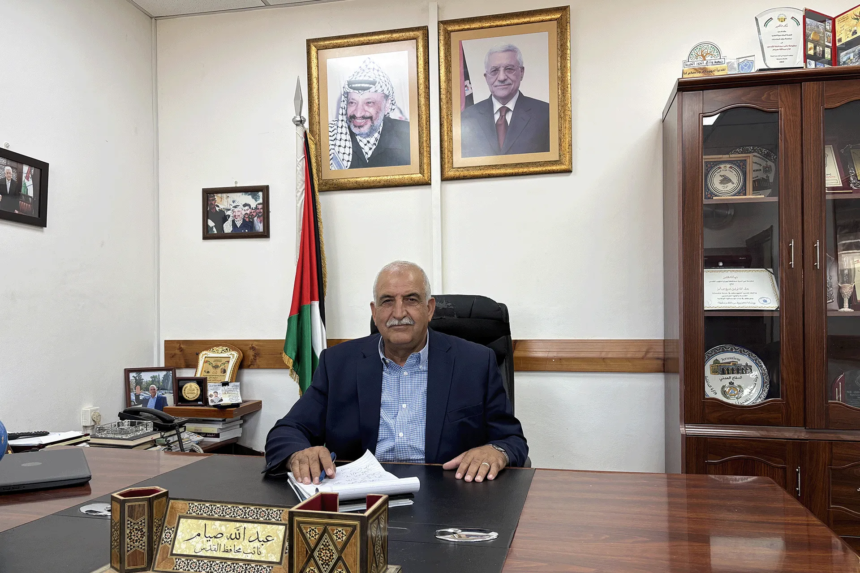
Jerusalem- Israeli policies in the occupied city of Jerusalem are no longer merely field violations. Rather, in recent years, they have turned into a comprehensive resolution strategy through which the occupation government is racing against time to close the city’s political file “permanently,” according to the Deputy Governor of Jerusalem, Abdullah Siam.
Between the hammer of major settlement plans that seek to impose the reality of “Greater Jerusalem” and to stifle Palestinian geographical communication through strategic projects such as the “E1” project, and the anvil of isolating Islamic and Christian sanctities and persecuting national and religious symbols by deportation and arrest, the Palestinian capital is experiencing the most dangerous stage according to the estimates of the official Palestinian institutions, where Israeli measures are intertwined to Judaize geography and change awareness and identity.
To understand the complex political scene facing the city of Jerusalem and its Palestinian residents in light of the continuing escalation of Israeli measures, Al Jazeera Net interviewed Abdullah Siam, Deputy Governor of Jerusalem, about the most prominent challenges in Jerusalem and its surroundings.
-
How to undermine the occupation The role of official Palestinian institutions in the city of Jerusalem?
The occupation authorities are taking aggressive measures to undermine the role of Palestinian institutions in the city of Jerusalem, especially the official ones, in the context of their attempts to impose full Israeli sovereignty over the city. This is the decision for which several legislations were enacted in the Knesset to officially confirm it.
The occupation’s greed and arrogance escalated after the previous American administration recognized Jerusalem as the capital of Israel (in 2017) in what was known as the “Deal of the Century.” Since that date, it has dealt with any Palestinian activity, whether issued by the website of an official institution, or public, sporting, and artistic events, as a violation of its alleged sovereignty.
From this standpoint, the occupying authority launched a systematic war against the Palestinian presence and the authenticity of the city to give it an “Israelized” character by harnessing laws, confiscations, and demolitions to create a demographic and geographic imbalance in favor of the settlers.
The sovereignty law in this context is considered the most dangerous in this regard, as the extremist government seeks through it to create new facts on the ground to deepen its control, and to consider every Palestinian outside the scope of this sovereignty. In this context, Al-Hakawati Theater activities, plays, and peaceful marches were cancelled, Jerusalemite figures were arrested, and Palestinian education was targeted by imposing the Israeli curriculum to distort the memory of our children and erase this civilization and deep history.
Despite the Arab and Islamic landscape that constitutes the identity of the city of Jerusalem, bulldozing operations are continuing to build neighborhoods and high-rise buildings in the high-tech style (hi-tech) at the expense of the city. Matters have been further complicated by the imposition of 4 cordons of isolation around Jerusalem. Represented in:

-
What does the occupation want for the Holy City and its residents?
The laws imposed by the occupation legitimizing “unified Jerusalem as its capital” are a strategic plan that it seeks to implement and place within a legal framework to delude the world that future political efforts have no horizon before effective legislation becomes a fait accompli and requires complex procedures to be undone under the pretext of “democracy.”
The occupation does not just want Jerusalem with its current borders. Through the “Greater Jerusalem” project, it seeks to extend its ambitions to reach the outskirts of Nablus and the borders of the Dead Sea, a strategic waterway, and seize 30% of the West Bank’s lands. For him, the borders of Jerusalem are the borders reached by the bulldozer and the settlement machine.
When they talk about the “Abrahamic Path,” their ambitions go beyond Palestine and target large parts of other Arab countries over which they seek to impose sovereignty under the umbrella of current American policy.
-
“Greater Jerusalem” is an Israeli project that brings together the Israeli parties. What about its impact on the Palestinians and the two-state solution?
The “Greater Jerusalem” project aims to seize a wide geography that constitutes 30% of the West Bank, and completely end geographical communication between the north and south of the West Bank.
The eastern foothills and the Palestinian desert are considered a red line in Palestinian politics, and their loss means separating the south of the West Bank (Bethlehem and Hebron) from its center and north (Nablus), and creating a serious demographic imbalance that drops the percentage of Palestinian presence from 40% previously to less than 17% in the future, which destroys and combats Palestinian political hope.
Jerusalem is a mosaic that brings together Islamic and Christian components as brothers in the present and the future, in hope and pain, and is surrounded by 43 Bedouin communities representing the city’s countryside and its desert cemeteries, and uprooting them is considered forced displacement.
The governorate also includes 28 residential communities and camps, which are the most crowded, such as Shuafat and Qalandia, adjacent to Jerusalem International Airport, where more than 90,000 citizens live in an area of less than one square kilometer.
The Bedouins, who are part of this formation, refuse displacement despite the confiscation of their pastures and the burning of their tents, and insist on protecting their way of life and culture stemming from their faith and historical role. No one has the right to force a Bedouin to live on the upper floors to make him a civilian.
-
What are the latest settlement projects in Jerusalem and what are the most dangerous?
The city of Jerusalem is subjected to a fierce settlement attack that is expanding at a faster rate than what the occupation has done in many years past in conjunction with the ongoing war. This expansion is based on 3 destructive paths:
- Planting dangerous settlement outposts in the vicinity of the Old City and confiscating lands and converting them into public gardens to impose what is known as the “Holy Basin.”
- Expanding the huge existing settlements around the city of Jerusalem, such as “Ma’ale Adumim,” “Nabi Ya’akov,” “Givat Zeev,” and “Pisgat Zeev,” by flooding them with thousands of new settlement units.
- Spreading “pastoral settlement outposts” by erecting 3 or 4 tents on each hill and giving them to groups of violent settlers and immigrants with the aim of completely controlling the hills, which has achieved for the occupation more control over the geography during the last two years than it achieved in many years ago, threatening to completely isolate the Old City and turn it into a mere marginal landmark surrounded by huge settlement blocs that change the space of Jerusalem and its historical landmarks.
-
What changes did the occupation bring about to the status quo (the historical situation and the status quo) in Jerusalem?
The occupation brought about a radical change and clear bulldozing of the city and its various areas. On the ground, many streets have turned into geographical borders and separation walls surrounding the city itself, and underground excavations, tunnels, and the planting of fake graves and monuments continue to distort the depth of the city, its history, and its space.
Whoever looks at Jerusalem from above would see the Dome of the Rock and the Resurrection, but today the occupation has inserted about 28 additional domes for newly created Jewish synagogues spread in the Old City, the largest of which is the “Synagogue of Destruction” on the southwestern side of the city wall to change the space, in addition to the “cable car” project and the suspension bridges between the Mughrabi Gate area and the opposite Al-Thawri neighborhood.
The occupation seeks to impose a clear Western style that does not resemble the city, so that the Old City becomes just a simple thing in front of the huge settlement blocs surrounding it, just as happened with the “Wadi Nisnas” neighborhood in Haifa, which today requires a guide to take you there.

-
What is the nature of Jordan’s interventions as it administers the holy sites and the Palestinian Authority to confront the occupation’s measures?
It faces the ongoing occupation plans since 1967, which began with the demolition and burning of the Moroccan Quarter, the conversion of some prayer halls and cells in the vicinity of the Dome of the Rock into police stations, the targeting of education and buildings, the cessation of family reunification since 2003, and the legendary steadfastness and close bond of the Jerusalemite citizen.
It is a very costly steadfastness, especially during the past four years, during which Jerusalem lived in stifling isolation, in which security measures overlapped with the period of the Corona pandemic. During last Ramadan, the number of worshipers did not exceed 60,000, after more than 300,000 worshipers had gathered in previous years. The markets of the Old City, which were crowded with tourists, pilgrims, and residents, were also damaged.
Even the Church of the Holy Sepulcher during recent holidays, Christians were prevented from accessing it or gathering there due to restrictions. However, the insistence on remaining the master of the situation remains, supported by a solid political position expressed by Palestinian President Mahmoud Abbas in his categorical rejection of the deal of the century and his assertion that “Jerusalem is not for sale.”
Jerusalem is the trust of the martyrs and prisoners, and the national constant that no one can give up. Despite the nation-state law, sovereignty laws, and forced displacement policies, Palestinian individual and institutional steadfastness from 1967 until today has been able to preserve the Arab, Islamic, and Christian face of Jerusalem. They wanted Palestine “a land without a people for a people without a land,” but the people remained rooted in their land, and Palestine today has become an observer member of the United Nations, and its flag flies in more than 169 countries.
This steadfastness, which is waged with bare chests, awaits an active Arab and Islamic role to intervene for Jerusalem to remain the compass of political and national action and a destination for the world. The seriousness of what is happening in Jerusalem lies in the fact that any demolition or destruction of its landmarks and history cannot be easily replaced or rebuilt, and the conflict there is taking place over the “simple square tile,” where stability and bond over an area of 20 square centimeters constitute adherence and a national and historical role to preserve the city, so that Jerusalem is the capital of the independent Palestinian state.
-
Where are the Islamic Endowments Department and Jordan regarding the transformations, and how did the occupation strip its powers?
The Kingdom of Jordan plays an important and pivotal role towards the city of Jerusalem, represented by the Hashemite custodianship held by His Majesty King Abdullah II over the Islamic and Christian holy sites. It is a role that is fully integrated and consistent with the official Palestinian political position, which sees Jerusalem as the capital of an independent Palestinian state.
From here stems the unity of position and joint action to protect the sacred identity of the city and implement Security Council Resolution No. (2334), which affirms that Jerusalem is an integral part of the occupied Palestinian territories and that all changes taking place in it are invalid and illegal. This comes at a time when we have witnessed many countries recognizing the Palestinian state with Jerusalem as its capital, including countries in the European Union that previously adopted extremist positions.
Jordanian guardianship and the Palestinian role face serious challenges and plans that the occupation is trying to impose. The first is the “Deal of the Century,” and the second is the so-called “Abrahamic Path” promoted by the United States to impose the alleged rights of the occupation in the blessed Al-Aqsa Mosque under a religious cover that confuses the cards on the basis that Abraham is the father of all the prophets.
The Jordanian role stems from a firm belief in duty and challenges all obstacles, at a time when the Palestinians are facing a major financial blockade that targets Palestinian decision-making and existence. Likewise, great pressure and real threats are being exerted on Jordan to try to undermine its responsibility for Al-Aqsa Mosque, but the Jordanian response is taking hold on the ground through the Islamic Endowments Department and the strong partnership with the Palestinian side.
-
What about the Christian community, the city’s churches, and its future?
When talking about sanctities, Al-Aqsa Mosque cannot be separated from the Church of the Holy Sepulcher and the other churches inside the Old City and its surroundings, which form a continuous path with the Church of the Nativity in Bethlehem. The Christian pilgrimage is not complete without completing this journey.
Today, the occupation imposes the same impossible measures that deprive the people of the city of Bethlehem of access to Jerusalem through checkpoints, gates, and the separation wall, all the way to limiting the number of people arriving to the Church of the Holy Sepulcher at the beginning of 2026.
Christian-Islamic coexistence and unity in Jerusalem and Palestine are based on the foundation that the suffering is the same, the pain is the same, and the goal is the same, which is a unified Jerusalem as the capital of the Palestinians.
-
Jerusalem is subjected to a severe media blackout, and activists and journalists are prevented from working. Tell us about your documentation in this field?
Despite the decision of the Arab Information Ministers to make “Jerusalem the capital of the Arab media,” the city remains greatly oppressed in the message of the Arab media, which has begun to turn towards scoops on other issues and ignore the fundamental daily changes. The issues of accelerating demolition, the displacement of families, the suffering of children, and the collapse of the local economy pass as if they were passing events without sufficient documentation.
Global news should not shift the media’s focus and leave the file to social media alone. The occupation must not get away with its crimes, and documentation is a very important issue so that Jerusalem is not lost in the darkness, as Palestine was lost previously when the crimes of Zionist gangs were hidden.
Here we wonder: Where are the Arab media correspondents in Jerusalem? Doesn’t the city deserve for every institution to have a reporter who conveys the daily message of Rabat? There are 1,480 Jerusalemite merchants who have been suffering for 4 years, and there are 25,000 homes threatened with demolition, and every Palestinian there refuses displacement and lives in a state of national faith and struggle.

-
What tools are available to the Jerusalem Governorate to deal with these changes? What is required to stabilize and protect Jerusalemites?
The full Palestinian role led by President Mahmoud Abbas is based on a leadership that believes in its goals of establishing a Palestinian state with Jerusalem as its capital, and a citizen who stands firm and is patient in a stage in which we clearly declared that it is “the stage of patience and steadfastness.”
This steadfastness is the duty undertaken by our besieged Palestinian institutions and towns that face the crisis of salaries and funding, and the municipalities that have gone through the past four years without being able to provide the projects that the citizen deserves due to this siege.
The aim of this siege and the suffering imposed by the international community is to impose a political price on the Palestinians to force them to accept dictates and compromise. We reaffirm one matter of principle: There is not a single Palestinian leader who can give up our inalienable right to Jerusalem as the eternal capital of the Palestinian state.