Published on 6/24/2026
|
Last update: 17:54 (Mecca time)
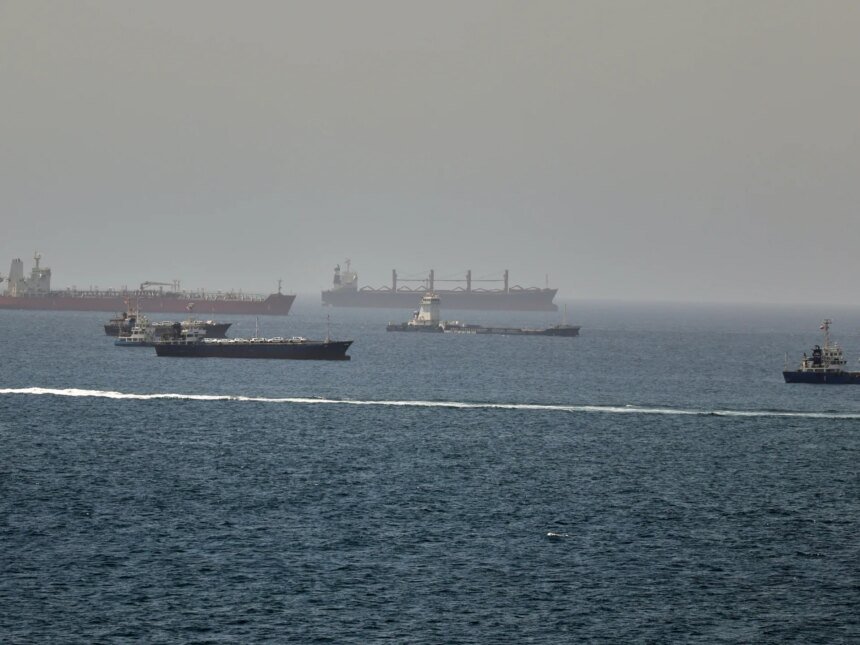
The cost of renting a giant oil tanker in the Arabian Gulf has jumped to about 9 times the standard price, an indication that the Strait of Hormuz crisis is no longer limited to crude prices only, but has extended to the market for ships available to transport oil from the region to Asia.
Bloomberg quoted shipping brokers as saying that the South Korean company Sinocor agreed in principle to provide a tanker to transport oil from the Arabian Gulf to India at 897 points on the “WorldScale” index, i.e. 897% of the freight cost standard, which is the highest level recorded this year.
Read also
list of 2 itemsend of list
According to Bloomberg, this price shows the extent of the imbalance in the tanker market near the Gulf, as shipowners’ appetite for risk declined during the American-Israeli war on Iran, while shipping companies are now trying to balance high returns with the possibility of continuing risks in the Strait of Hormuz.
The US Energy Information Administration says that about 20 million barrels per day of crude oil, condensates, and petroleum products passed through the Strait of Hormuz in 2024, equivalent to approximately 20% of the world’s consumption of petroleum liquids, and it also accounted for more than a quarter of global seaborne oil trade.
Substandard movement
The jump in shipping costs comes despite the beginning of a gradual return to ship movement through the strait after the temporary agreement between America and Iran. The Associated Press reported that large shipowners began moving their ships through the strait for the first time in 110 days, but the movement is still below pre-war levels.

The agency quoted Intertanko’s director of maritime affairs, Philip Belcher, as saying that the main central route in the strait is still closed due to mines that need to be removed, noting that ships are using two smaller routes through Iranian and Omani waters.
According to the Associated Press, these restrictions indicate that the market problem is not only the number of ships wishing to enter the Gulf, but rather the speed of their rotation and their ability to cross, load and exit, at a time when alternative routes do not have the same energy that the central corridor provides under normal circumstances.
Ships be careful
International shipping organizations, including BIMCO, Intertanco, and the International Chamber of Shipping, issued guidelines for crossing the Strait of Hormuz in May, saying that hundreds of ships were still unable to cross, and that the return of a large number of them at once to normal movement could become a major navigational hazard.
The International Maritime Organization also warned that the safety of seafarers must remain a priority, and its Secretary-General Arsenio Dominguez said that there is no commercial justification for risking the lives of seafarers in the absence of reliable security guarantees for crossing the Strait.
These warnings mean that part of the tanker fleet may remain outside the region or demand large bonuses before accepting shipments, which explains why the Sinocor contract reached an unusual level on the Worldscale index, which is widely used in pricing oil tanker trips.
Intertanko says Worldscale is a freight metric used when chartering carriers on instant voyages, and the cost is expressed as a percentage of a base fare, allowing prices to be compared between different routes in a rapidly changing market.
Sinocor was among the most active companies in the giant tanker market in the Gulf during the war, and it continued to display its fleet, as a message seen by Bloomberg showed an offer of giant tankers to load oil from the Iraqi Basra terminal by Wednesday.
According to Bloomberg, 4 empty giant tankers owned by Sinocor have entered the Arabian Gulf since the signing of the temporary agreement last week, and 3 other giant tankers owned by major companies have entered, adding a transport capacity of no less than 14 million barrels to the region.
Navigation data reported by the Associated Press show that dozens of ships are currently crossing, compared to a daily average that before the war was about 100 to 130 ships.