The Kansas City, Mo., Police Department operates nine drones that fly to accidents and crime scenes at a moment’s notice, transmitting images back to the station.
The program has operated for over a year, but, until recently, it couldn’t identify or track drones that were not its own. A $11.4 million grant from the Federal Emergency Management Agency allowed the city, which is hosting several World Cup games, to purchase sensors and radars to detect and identify private and commercial drones across the city during the matches.
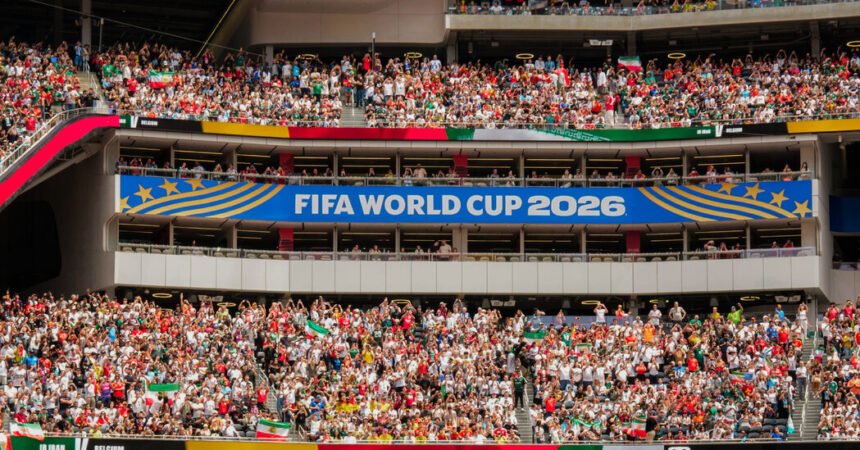
Previous global sporting events left behind stadiums that were later repurposed or torn down. This year’s World Cup could leave behind something more useful: equipment that can detect, track and — if need be — neutralize hostile drones in the sky.
“It will be huge,” said Maj. Gregory Williams, who oversees the operational support division at the Kansas City Police Department. “Having this capability is going to really provide us a level of security.”
Just as cheap drones have changed the calculus of war, they have also changed the way domestic law enforcement agencies protect against threats at heavily populated venues.
The fear that armed drones could be used to attack crowds or critical infrastructure played a major role in the preparations for World Cup matches in the United States.
FEMA, which falls under the Department of Homeland Security, announced in December a total of $250 million in grants to the states hosting the games, leading to a spending spree on counterdrone technology.
The Los Angeles Police Department has been authorized to spend nearly $10 million on radars, sensors and mobile tracking units, according to public records. Dallas added $10.4 million worth of counterdrone technology to an existing 10-year contract with Dedrone, a company owned by Axon Enterprise, which makes Tasers and body cameras.
More than half of the host locations have purchased a system that allows law enforcement to hack into an enemy drone’s radio controls, enabling the authorities to control it and fly it safely away from crowds, according to Eric Brock, the founder and chief executive of Ondas Holdings, a West Palm Beach, Fla., company that owns the technology.
The Federal Bureau of Investigation has also begun training local law enforcement in drone mitigation tactics at a counterdrone center in Huntsville, Ala. Police departments across the country want the authority to remove suspicious drones from the sky, action that previously only certain federal agencies were authorized to take.
Congress passed a law in December that deputized local police departments to take down enemy drones, as long as the departments were trained and certified by the federal government. But the Justice Department has yet to release the rules on how certification will work. As a result, the police in host cities must be under the supervision of the F.B.I. or another federal agency to use much of the counterdrone equipment they bought with their FEMA grants.
New York City purchased $6.5 million worth of drone mitigation equipment with its FEMA grant, and its Police Department is assisting the F.B.I. at FIFA-related events in the city.
“If there is one threat that keeps me up at night, it is from drones,” Jessica Tisch, commissioner for the New York Police Department, said last month. “The technology has changed, and our capabilities have to change with it.”
Eight matches are being played at MetLife Stadium in New Jersey, including the final on July 19, while watch parties and other related events are being held across New York.
Commissioner Tisch called the new authority “a major operational breakthrough,” and said she was looking forward to the Justice Department release of the new rules that would allow the city to deploy the technology on its own.
Yet in the days leading up to the first matches, many host cities were still scrambling to install equipment and train personnel because of a delay in the processing of their grant requests, partly due to a 76-day D.H.S. shutdown.
“Everybody’s a little bit behind,” Homeland Security Secretary Markwayne Mullin said at a congressional hearing this month.
Mr. Mullin said the United States had spent a lot of resources on building up the capacity to use drones for military purposes but far less money on technology that could defend domestic infrastructure against drone attacks, which he described as “one of the areas that we are struggling with every single day.”
Nonetheless, the authorities have so far seized more than 300 drones across the country, a sign that delays haven’t impeded protection efforts.
“All systems are operating as expected,” a D.H.S. spokesman said.
In Kansas City, at least 16 drones have been confiscated by the authorities, according to the F.B.I. The Police Department was able to detect them using software from Airspace Link, a company that gives subscribers access to a digital map depicting all drones flying in the area. The system also provides the unique identification numbers that drones broadcast — digital license plates known as Remote ID — and the location of their pilots.
“This gives us the ability now to not only see the drone, but locate where it is coming from,” Major Williams said.
Airspace Link’s chief executive, Michael Healander, sent staff to Kansas City last week to support the police during the Argentina-Algeria match. The system showed blue dots spreading across a digital map of the city — a flock of police drones dispatched to check on various disturbances, including a fan who had fainted in the crowd. It also showed Amazon Prime delivery drones across the state border in Kansas.
“It’s a big moment for our company,” Mr. Healander said.
Fortem Technologies, a Utah-based company that makes a drone that captures other drones with a net, won a multimillion-dollar contract from D.H.S. for a dozen systems — one for each U.S. World Cup stadium, with a spare.
Next year, FEMA will expand the drone mitigation program to other cities and states, giving out another $250 million, according to a FEMA spokeswoman.
A new D.H.S. office plans to spend $115 million buying counterdrone technology, in addition to the previously announced grant program. Equipment funded from the new office is being used by federal agencies to help protect the World Cup games as well as festivities surrounding America250, the nationwide commemoration of the 250th anniversary of the Declaration of Independence.
However, the Association for Uncrewed Vehicle Systems International, a trade group, is calling for a congressional review of how the first tranche of funding was spent before the second round goes out.
“We would expect the oversight to focus on effectiveness of the grant to improve for the future,” said Michael Robbins, the group’s chief executive, adding that lawmakers should look into whether the equipment was actually used and whether it matched the host city’s threat profile.
Not everyone is cheering the prospect that counterdrone equipment will linger on after the games. Matthew Guariglia, senior policy analyst at the Electronic Frontier Foundation, a nonprofit that defends free speech, worries about what it will mean for citizens’ privacy.
“Our major concern, as always, is the potential for this technology to chill people’s civil liberties and the fact that surveillance infrastructure is just that: infrastructure,” he said in an email. “It will outlast the current World Cup and leave cities with drastically more surveillance to be used on a day-to-day basis.”