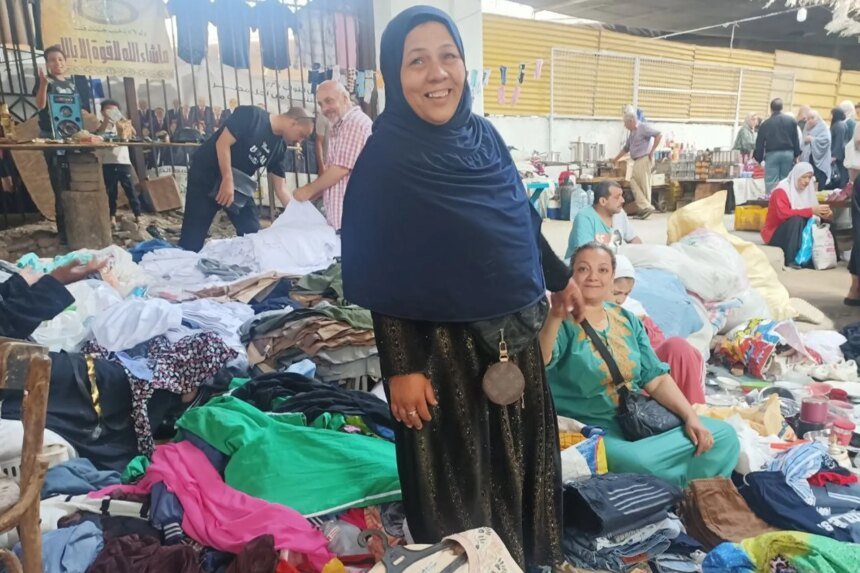
The one-day markets in Egypt were not just a space for selling cheap goods, but rather, over the decades, they constituted one of the tricks that Egyptians invented to adapt to economic crises.
With the rise in inflation rates and the erosion of purchasing power, going to these markets is no longer limited to people with limited incomes, but has begun to attract new segments of shoppers from the middle class, while retirees and women who have lost their sources of income have found in them a last opportunity to confront the high prices.
Read also
list of 4 itemsend of list
One-day markets are spread in several areas, from Wakalet al-Balah on Sunday, to Shubra al-Kheima on Tuesday, to Matareya on Thursday, and Sayyeda Aisha on Friday, where shop owners make way for street vendors to spread out on the sidewalks and alleys.
Sellers move around throughout the week, carrying sacks (cloth bags) of goods and landing in a different market every day. Some go to the agency only, some choose two days, and a few complete 3 days in multiple places. The trouble of moving and striving between markets is not possible for many nomadic sellers.

Retirees storm the markets
The inflation that Egypt has witnessed over the past two years has changed the features of the Sunday market in Wakalet al-Balah. The new faces are no longer limited to buyers, but rather extend to the sellers themselves.
Salah Youssef, a former ticket collector at the Public Transport Authority, retired 3 years ago with a pension not exceeding 3,300 pounds (about 68 dollars), and found himself forced to go through the experience of selling in popular markets.
Salah spent a whole year thinking about the matter: should he go out into the street and try his luck, or should he stay at home not knowing how to meet the expenses of his four children? He married one of them, while the second graduated from college and started working, while two of them are still in secondary education.
He finally made his decision and went to the markets, sleeping on the agency’s sidewalk on Sunday, and for the rest of the week he spent the rest of the week near the metro stations that were relatively far from his home. He does not buy his goods, but rather they come to him from family and neighbors, and everyone has something that he has dispensed with: simple shoes, old clothes, bags that are about to be worn out, and other things that are awaited by those most in need.
Salah Youssef says to Al Jazeera Net: “The agency has changed over time. It is no longer for the poor, and going to it is no longer a curse that must be managed. It has become a destination for the middle classes and above, and even the Sunday market, which citizens from the poorest classes used to come to, is no longer like that.” Rather, it has become a destination. Customers come in their cars
The impact of inflation on Umm Kyrollos
A study entitled “The Effects of Economic Inflation on the Living Life of the Egyptian Family,” published by researcher Azza Tahoun, indicates that the rise in prices prompted families to search for cheaper alternatives and change consumption patterns, and also caused a severe inability among poor families to meet basic needs.
The study – which was published – confirms In Research magazine The Middle East December 2025 Inflation has changed the daily habits of families, made basic expenses a heavy burden, and prompted an increasing number of consumers to replace high-priced goods with less expensive ones.

The results of the studies did not include a study of the case of Umm Kyrollos and Umm Ali, two friends who came to the Wakala wharf from Al-Basrawi in Imbaba. What was united by poverty and friendship was not separated by differences in religion. Umm Kyrollos (43 years old) lost her small shop in which she sold groceries and clothes. The owner took it from her after the issuance of the old rental law. The only person who helped her in this case was her neighbor and friend “Umm Ali” (47 years old), who accompanied her on her visits to the markets, on Sunday in the Wakala market, And Wednesday in Matareya.
Umm Ali told Al Jazeera Net: “We start cleaning from 2 p.m., Sunday night, until nine p.m. the same day.” The three women living next to each other spend the whole night on one spacious mattress, part of which is dedicated to clothes, new and old, another part is designated for kitchen supplies, and a third is for selling imitation perfumes to a fourth friend who leaves them bottles of perfume, which they sell on her behalf, and she stays at home in Imbaba, taking care of everyone’s children.
The social solidarity witnessed by Umm Ali and Umm Kyrollos begins with obtaining the goods themselves. Umm Ali says: “We bring the goods from factories on credit, and a portion is given to us by associations that collect clothes from charitable people and distribute them to us so that we can sell them.”

A haven from high prices
Economist Diab Muhammad believes that one-day markets have become one of the means of adapting to the economic crisis, and he tells Al Jazeera Net: “Egyptians are skilled at circumventing crises.”
Diab Mohamed adds that inflation “devoured everything that Egyptians had saved in recent years, and disturbed the status of the classes, wiping out the middle class, and its impact extended to the higher classes as well… Therefore, the one-day markets became a safe haven for those searching for a lifeline from the aggravating high prices.”
He points out that these markets are no longer limited to poor neighborhoods, but rather have become more specialized, as families go to them in search of specific types of goods, from furniture in the Sunday market to furniture in the Friday market and fabrics in the Tuesday market.
“One-day” markets have an additional advantage, according to Diab Muhammad, as they have volatile prices. The price at the beginning of the day is not the middle of the day, and it is definitely different from the end of the day.
Diab Mohamed adds: “The one-day market in Egypt is the Egyptian woman’s market par excellence, whether she is buying or selling. This place does not require buying a store or special abilities in selling and knowing the customers. Rather, it is enough to find something to sell that people will accept. It is a last chance to survive for many women who were forced by economic conditions to the sidewalks.”