
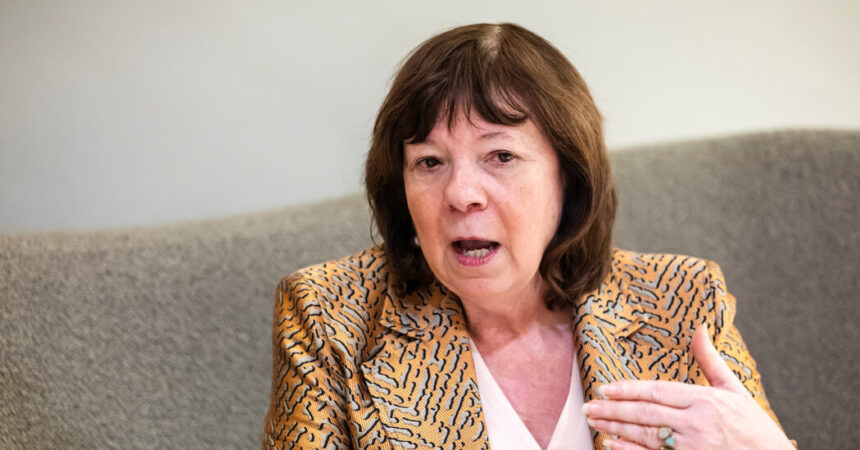
The Trump administration imposed sanctions last year against Kimberly Prost, a Canadian judge at the International Criminal Court. Now, she and two other judges are suing President Trump and his administration, claiming the penalties exceeded his authority.
The case, filed in the Southern District of New York on Wednesday, is the latest effort to challenge what many experts have described as the Trump administration’s efforts to undermine international law.
If successful, the lawsuit could curb the American government’s ability to use sanctions to punish judges for making rulings it disagrees with.
Ms. Prost is joined in the suit by Judge Reine Alapini-Gansou from Benin and Judge Solomy Balungi Bossa from Uganda. A copy of the newly filed complaint was provided to The New York Times by one of the judge’s lawyers.
The State Department in February 2025 imposed sanctions over the I.C.C.’s investigations into actions by Israelis and Americans. Neither Israel nor the United States are members of the court, which is based in The Hague and was officially established in 2002 to prosecute the most serious international crimes, like genocide.
Over the following months, the list of sanctioned judges on the court grew. In June, Secretary of State Marco Rubio announced sanctions on four judges, including Ms. Alapini-Gansou and Ms. Bossa, for issuing arrest warrants against Israeli leaders.
In August, officials added two judges to the list, including Ms. Prost. She was targeted for her role in authorizing an investigation into U.S. military personnel at secret C.I.A. sites in the years after the Sept. 11, 2001, attacks. The administration then imposed sanctions against two more judges in December.
The United States has also placed other I.C.C. officials under sanctions, including the chief prosecutor, Karim Khan.
Officials under sanction have faced asset freezes, travel bans and restrictions on services from U.S. companies.
The new lawsuit argues that the sanctions exceeded Mr. Trump’s authority under the International Emergency Economic Powers Act because they were not based on a national emergency and they conflict with international and federal law.
The suit also argues that the State and Treasury Departments violated the Administrative Procedure Act, which prohibits decisions that are “arbitrary and capricious.” These sanctions fall into that category, according to the lawsuit, which argues that the State Department has not even shown that the judges fall within the category of people against whom sanctions have been authorized.
Ms. Prost and Ms. Bossa also claim that blocking their U.S.-based bank accounts violated the Fifth Amendment, which requires due process under American law..
Their executive-power arguments bear some similarities to those other plaintiffs have used successfully to challenge Trump administration policies, including the sweeping global tariffs that the Supreme Court struck down in February.
Legal experts said, however, that courts might be less willing to apply that type of reasoning to sanctions.
“Courts have always said that it is not the domain of federal judges to second-guess factual, policy-infused judgments of emergencies or foreign policy matters that are made by the executive branch,” said Aziz Huq, a law professor at the University of Chicago. That makes this case different from one challenging an economic policy like tariffs or a domestic law, he said.
The administrative-law claim may be more likely to succeed, experts say.
“The low hanging fruit for them is to challenge the process rather than the president’s ability to have done it at all,” said Nabeel Yousef, who leads the global sanctions, export and trade practice at Freshfields, an international law firm. “I think there might be something there.”
Plaintiffs ordinarily must exhaust administrative remedies for those claims before filing a federal suit, however, and it is not clear whether the judges have done so.
(Mr. Huq and Mr. Yousef spoke about this area of law generally. They have not reviewed the new lawsuit.)
This challenge, if it works, could build on another case, one involving Francesca Albanese, a United Nations official appointed to report on human rights in the West Bank and Gaza.
This year, a U.S. federal judge temporarily blocked the administration’s sanctions against Ms. Albanese for her contributions to the I.C.C. case against Israel, though an appeals court later halted the injunction while the case is pending.
Legally, the cases are different. Ms. Albanese, who only submitted information to the court, challenged the sanctions against her on First Amendment grounds.
The lawsuit filed on Wednesday is intended, in part, to push back on what the judges believe is the punitive way in which the Trump administration is using sanctions.
Ms. Prost was at home, standing in her kitchen, when the call came informing she was being sanctioned. It wasn’t a complete surprise, given that many of her colleagues had already been sanctioned, she said during an interview at The Hague this year.
Within hours, she said, she had received a message from Amazon canceling her accounts. Before long, Google and her banks got in touch. Over the following days, credit cards ceased to work.
“Hotel bookings are just a nightmare, because everyone wants that credit card,” she explained. At one point, she said, she had to borrow someone else’s credit card to pay a 15 euro bill for a highway toll pass.
Ms. Prost has a history of working on the other side of sanctions: Between 2010 and 2015, she worked with the U.N. body responsible for putting in place international sanctions against the Islamic State and Al Qaeda. She reviewed those measures.
“I’m still a believer in sanctions, believe it or not, because properly applied, I think they’re an extremely important tool,” Ms. Prost said.