
Published on 6/23/2026
|
Last update: 09:40 (Mecca time)
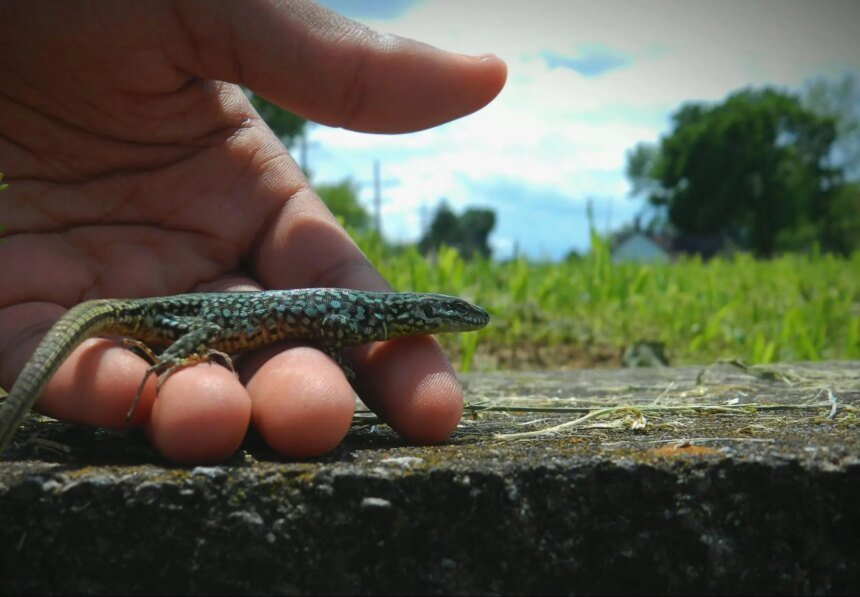
in In the 1950s, an amateur brought a small group of no more than 10 lizards of the common wall lizard, known scientifically as Podarsis moralis, from the Lake Garda region in northern Italy, and released them in the American city of Cincinnati.
These lizards faced a great challenge. When a new population is founded by a small number of individuals, it experiences a genetic bottleneck. Scientists expect that continuous mating between genetically similar individuals will cause the accumulation of harmful genetic mutations, leading to a deterioration in general health and ability to survive, but this has not happened.
In a recent study published in the journal Molecular Ecology, a research group revealed the genetic secrets that allowed this group of lizards to survive a stifling genetic crisis and adapt brilliantly to their new home in Cincinnati, Ohio.
Eric Gangloff, from the Department of Biology at Ohio Wesleyan University in Delaware, USA, and one of the researchers participating in the study, said in exclusive statements to Al Jazeera Net: “It appears that environmental and demographic factors played important roles. The lizards found themselves in a new environment that was very favorable for their survival and reproduction, so they took advantage of those conditions.”

Trying to solve the puzzle
Researchers collected DNA samples from four different groups of lizards to compare them and monitor historical changes. These collections included lizards native to Italy, two collections from Cincinnati collected in 2007 and 2022, as well as a fourth newly established collection in Columbus, Ohio, in 2021.
The team used advanced technology to read the entire DNA code, providing scientists with a golden opportunity to accurately compare genetic changes. Here, the role of the modern Columbus collection emerges as a living guide linking the past to the present.
“In the absence of samples from actual founder individuals or from the first post-introduction generations, we cannot directly assess the amount of genetic diversity that may have been lost or reconfigured during the early years of the invasion,” Eric says. “However, we address this shortcoming by analyzing samples from a recently established population in Columbus, which we hypothesize mimics the processes that accompanied the original founding event in Cincinnati.”
Eric points out that although the size of the founder population is not known, the genetic characteristics of this population show expected levels of close inbreeding, high mutation accumulation, genetic differentiation from the source population, and lowest levels of genome-wide diversity compared to the other populations studied.
Survival shields
The study shows that the success of lizards was based on three basic armor that integrated together to protect them and enable them to survive and adapt. The first shield is environmental pre-adaptation; Before genes began to change and genetic adaptation occurred, environmental compatibility played a helpful role.
“These wall lizard species have lived in European areas with heavy urbanization and heavy human influence for hundreds and perhaps thousands of years,” Eric explains. “So we don’t think urban environments are entirely new to these species in general.” That is, Cincinnati’s urban environment, filled with old stone walls, parks and buildings, closely mimics the rocky environment and hard surfaces that these lizards prefer in their native Italy.
This compatibility greatly reduced the initial shock of living in a new environment, and provided the lizards with safe havens from predators and abundant sources of food, allowing them to focus their vital energy on settlement and rapid reproduction rather than expending it in arduous attempts to confront completely foreign terrain.
The second shield lies in rapid numerical growth as a way out of genetic extinction, as the results of genetic analyzes showed that the Cincinnati lizard population actually went through a period of severe genetic distress at the beginning, but it was able to quickly escape thanks to rapid population growth and a high reproductive rate. Wall lizards are characterized by their short generation time and their ability to reproduce rapidly, as they become sexually mature in their second year.
Pollution resistance
The third, most unusual shield was the observation of genetic adaptations that enabled lizards to withstand poisoning by heavy metals, most notably the toxic element lead. Cincinnati’s lizards live in urban environments with higher levels of toxic lead contamination than their original rural habitat in Italy.
The results of the study showed that, over the decades, natural selection has favored individuals who possess genetic mutations that allow them to resist poisoning through physiological isolation mechanisms for these heavy toxins to protect their cells and nervous systems from damage, which allowed them to run and move with ideal efficiency and balance despite the presence of high levels of lead in their blood that could be fatal to many other organisms.
“We have already identified potential indicators of selection or natural selection in genes that may be involved in neural functions,” Eric explains, “but the functional consequences of this selection still need to be tested. It is possible that this selection may shape behavior in new environments, in this case cities.”
This biological study provides a unique model of the resilience of life and its ability to overcome difficult environmental obstacles, opens new horizons for understanding how organisms respond to urban environmental stresses, and provides a scientific roadmap for studying contemporary adaptations in real time.
“I think we are facing a situation where the distinctions between ecology and genetics are blurring; the two processes are very intertwined at this geographic scale and within this time frame,” Eric concludes. “I wouldn’t say that urban environments protect these lizards, but rather that they coincidentally provide much of what the lizards need.”