Published on 6/22/2026
In a step that could radically transform radio astronomy, scientists announced the completion of the final design of the “Deep Synoptic Array” telescope, which will be built in one of the dark valleys in the US state of Nevada. Construction work is expected to begin soon, and the project will enter service by 2029.
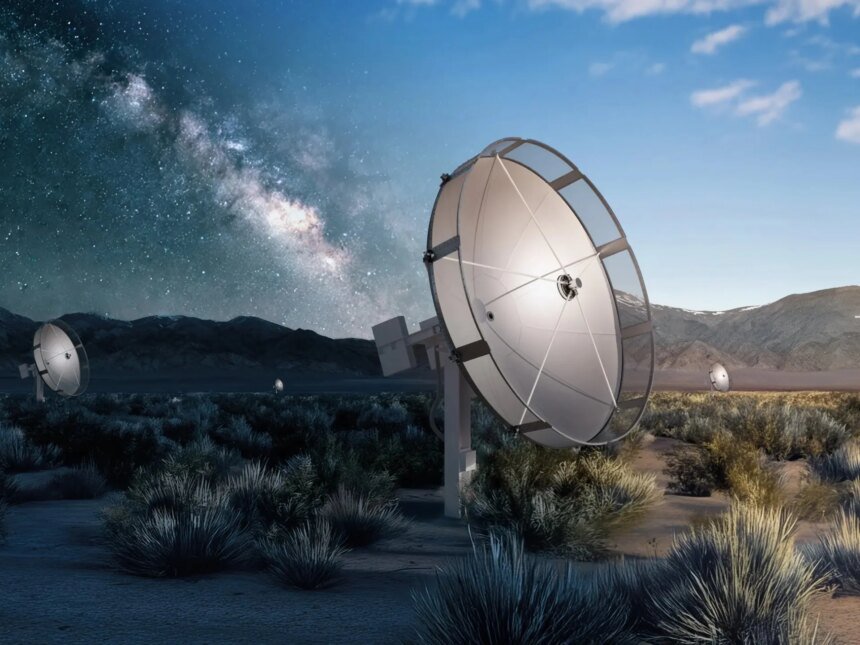
The project is led by the California Institute of Technology (Caltech), with financial support from the Schmidt Sciences Foundation, which in recent years has become an influential player in funding major astronomical research. The observatory consists of 1,650 dish-shaped antennas, each with a diameter of about 6 meters, distributed over an area exceeding 120 square miles (about 310 square kilometers) of desert.

Scientists hope that this observatory will open a new window to understanding how galaxies form and grow throughout the history of the universe, benefiting from unprecedented capabilities in collecting radio signals coming from the depths of space.
Read also
list of 2 itemsend of list
New technology that goes beyond the limits of traditional observatories
What distinguishes this project is not only its size, but the way it will process data. Traditional radio observatories need to store huge amounts of raw data before processing them, which requires a huge computer infrastructure.
The new telescope will collect signals from all dishes and process them immediately in real time, allowing the production of high-resolution images without the need to retain most of the original data. Scientists point out that the raw data that the project could have produced is roughly equivalent to the volume of Internet traffic in the entire United States of America.
Astronomer Dan Wertheimer said: “It is a wonderful, pioneering design in the way telescopes are built, and I believe it represents the future of radio astronomy.”

The project also relies on the latest graphics processing units from Nvidia, in addition to an unexpected engineering solution, which is the use of thousands of metal molds similar to cake-making molds after modifying them to suit the needs of the project, in a step aimed at reducing costs without affecting performance.
Searching for the secrets of radio explosions and universal gravity
The new telescope will allow studying a number of the most mysterious astronomical phenomena. One of its most prominent goals is monitoring fast radio bursts, which are short, powerful flashes of radio waves that have puzzled scientists for years, as their true nature is still unknown.
Researchers expect that the observatory will be able to detect and locate tens of thousands of these explosions, which may help determine whether they result from violent activity in neutron stars or from collisions between these ultra-dense objects. An important part of the observatory’s capabilities will also be devoted to observing pulsars scattered in our galaxy.

These objects are used as precise cosmic beacons through which we can search for huge ripples in space-time. Recent studies have shown preliminary indications of the existence of these ripples, but scientists still need additional evidence to confirm their nature and source.
A multitasking tool for charting the future of astronomy
In addition to its main objectives, the observatory will participate in tracking the stages of star formation inside young galaxies, monitoring explosions from supermassive black holes, as well as working in coordination with other observatories around the world to monitor sudden cosmic events as they occur.
Scientists believe that the project’s exceptional speed will make it able to scan the sky about 100 times faster than any currently existing radio observatory.
Astronomer Maura McLaughlin said: “This telescope will combine the best combination of high sensitivity and the ability to cover large areas of the sky, which is a completely different method of conducting radio observations.”
As for Katie Jameson, the project manager, she described its capabilities by saying: “It will open the sky before us in an absolutely amazing way.”

Arpita Roy, director of the Center for Astrophysics and Space at Schmidt Sciences, believes that the most influential observatories in history are not those that achieve a single scientific goal, but rather those that give humanity a completely new way of seeing the universe.
A new window into the unknown
Each generation of telescopes expands the frontiers of human knowledge, but some projects go beyond just collecting data to change the way questions themselves are asked. The pan-deep array telescope appears to belong to this rare category.
While scientists seek to understand galaxies, black holes, and cosmic explosions, the deeper goal remains to explore man’s place in this vast universe. Every radio signal captured by this observatory may carry new information about the history of the universe, or perhaps a surprise that no one has yet imagined.