
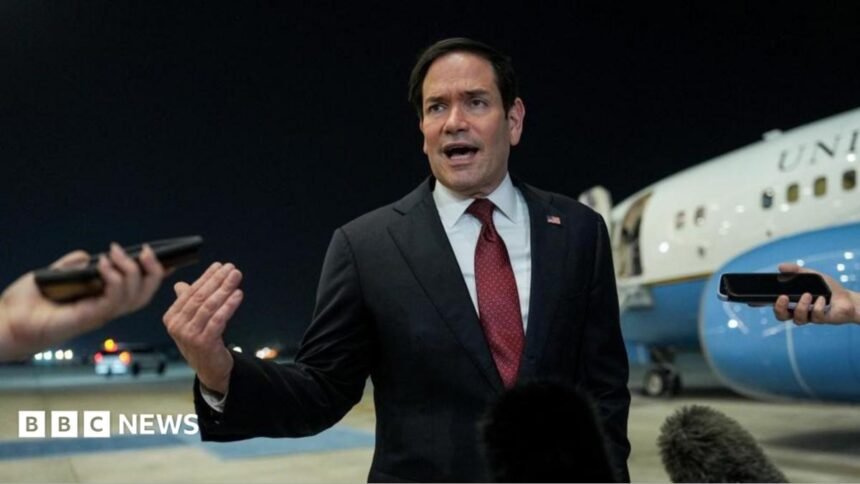

Secretary of State Marco Rubio speaking to reporters after landing in Abu Dhabi
Secretary of State Marco Rubio speaking to reporters after landing in Abu Dhabi
The UN’s International Maritime Organization (IMO) is set to evacuate more than 11,000 sailors who have been stranded in the Gulf because of the US-Israel war against Iran.
IMO secretary-general Arsenio Dominguez said the “large-scale operation” would be carried out in cooperation with Iran, Oman, the US, other coastal states in the region and the maritime industry.
“We have secured the necessary safety guarantees and have thoroughly verified the conditions for safe navigation to support these operations,” he added.
An interim deal was signed last week to end the conflict, but both the US and Iran continue to clash on details of the Memorandum of Understanding (MoU).
The US has said the MoU includes guarantees that Iran’s nuclear weapons programme will come under inspections by the International Atomic Energy Agency (IAEA).
US President Donald Trump posted on social media on Tuesday: “Iran has fully and completely agreed to highest level Nuclear inspections long into the future (Infinity!!!). This will insure ‘Nuclear Honesty.'”
Shortly before Trump’s post, Iran said the UN watchdog would not be able to inspect nuclear sites bombed by the US and Israel last year.
In response, a US official said: “the Iranians have agreed to robust IAEA inspections of the remains of their nuclear weapons programme. The Iranian regime will say what they have to say for their domestic audience.”
Iran’s President Masoud Pezeshkian said during a visit to Pakistan on Tuesday that Iran “will never negotiate with anyone, under any circumstances, ever, about our defensive capabilities”.
US Secretary of State Marco Rubio began a tour of the Gulf on Tuesday in the United Arab Emirates (UAE), and will also visit Kuwait and Bahrain – which both host US military bases – to discuss the deal with Tehran.
The secretary of state warned on Tuesday that no country is allowed to impose tolls on the Strait of Hormuz, where Iran has been pushing to charge ships passing through.
“It’s an international waterway. No country is allowed to charge tolls or fees on an international waterway. That’s existing international law,” he said as he arrived in the UAE.
“I don’t think we have anybody to convince around here in that regard. I think all the countries in this region would agree with us.”

Vessels using the Strait of Hormuz as seen from Masandam, Oman on 18 June
Vessels using the Strait of Hormuz as seen from Masandam, Oman on 18 June
Evacuating stranded sailors hinges on the Strait remaining open.
IMO secretary-general Dominguez said the deal to help them marked “a decisive step towards restoring maritime security and bringing to an end the unacceptable attacks against civilian shipping”.
“After months of hardship and distress for thousands of innocent seafarers, and negative impact on the whole world, I welcome with deep satisfaction the peace agreement concluded between the United States and Iran,” he said.
As part of the IMO’s evacuation plan, two temporary routes through the strait could be used, with vessels being contacted individually for further instructions, according to Oman’s notice to mariners provided by the IMO.
The IMO said it would issue a daily report on the number of ships leaving the region safely.
After February 28, when attacks against Iran first began, the country effectively closed the strait – which caused global oil prices to go beyond $100 (£75) a barrel of Brent crude oil.
The closure also choked off shipments of energy and crucial commodities such as fertiliser.
So far, at least 172 vessels have travelled through the reopened Strait of Hormuz -which included 42 ships on Saturday alone, according to new data from maritime intelligence firm Kpler.
The number of vessels transiting from 18 June, the day after the deal was signed, is still well below the pre-conflict average of some 138 crossings each day.
Ship-tracking data analysed by BBC Verify shows more than 200 tankers appear to be waiting inside the strait on Tuesday.
Related topics
Israeli troops kill two in south Lebanon after lull in fighting, authorities say
Weapons, money and ships: How is this Iran deal different from others?
US-Iran memorandum of understanding in full