When the authority needs a tank in the street, it is an authority that is worried about itself. But when it resides in people’s heads and makes them defend it as their free conviction, that is the authority that is not easily defeated, because the ruled guards it from where they do not know it.
Here, in this gray area between persuasion and coercion, lies the question that preoccupied three of the most prominent minds of the twentieth century: How can people be persuaded to accept what is imposed on them, so that they think it is their choice?
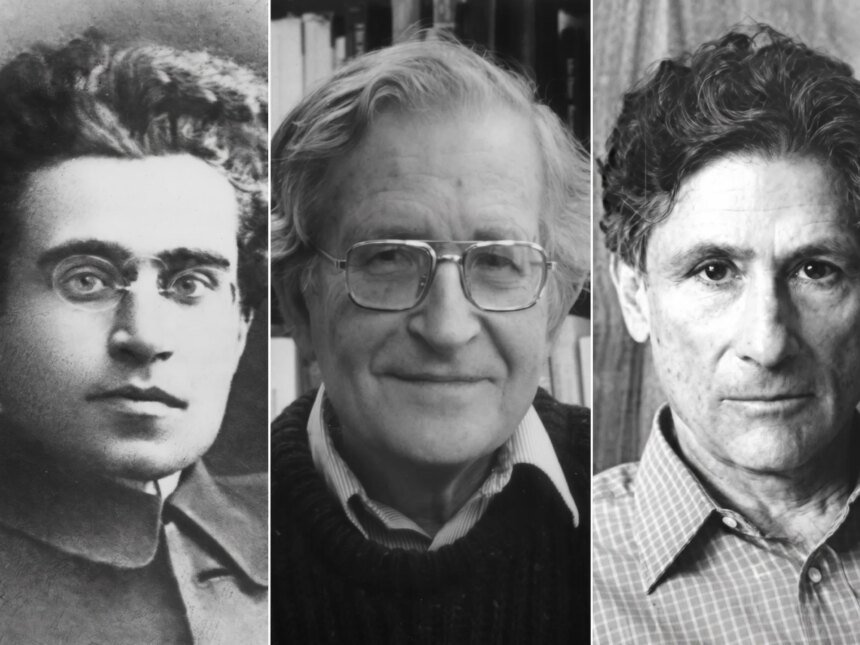
Antonio Gramsci wrote most of his answers from inside a fascist prison. He redefined control as a battle over culture, not weapons alone.
Edward Said took the question to another field, and showed us how the East was “written” and categorized in the Western imagination before it was occupied on the ground. As for Noam Chomsky, he transferred the analysis to the heart of liberal democracies, where direct repression becomes costly, so consent is engineered instead through the media and propaganda machine.
Three thinkers from different backgrounds and specializations, and one field in which they meet, dissect the mechanisms of soft control that penetrate consciousness, not bodies, and from the intersection of their visions a fuller picture of the most dangerous types of domination is formed. Those that are not seen, making stereotypes seem like natural facts, premature news as complete reality, and restrictions as a free choice.
Antonio Gramsci: Cultural Hegemony and the Production of Voluntary Consent
The concept of hegemony, according to the Italian thinker Antonio Gramsci, takes the form of an analytical tool for understanding how the dominant classes maintain power, not only through force and brutal oppression, but also through persuasion and cultural accommodation.
Its hegemonic mechanisms crystallize in three basic points:
Cultural control: Through educational and media institutions.
Production of voluntary consent: Through prevailing values and concepts.
Organic intellectual: Its central role in spreading the ideology of the ruling class.
Thus, according to Gramsci, hegemony cannot be considered merely control by force and coercion, but rather it is a complex strategy to gain the approval of the masses voluntarily – apparently -. Based on the duality of domination and coercion, Gramsci believes that the modern state is based on two pillars:
Political community: This is the field in which physical coercion comes from the army, police, detention centers, prisons, and the judicial system. This area represents traditional hegemony.
Civil society: It is the field of production of intellectual hegemony through schools, universities, media, religion, family, and unions. Here the dominant class produces values and concepts that become the “prevailing standard” or “common sense” that everyone accepts as natural and self-evident.
Accordingly, the primary actor in society’s transition from coercion to civil acceptance is the “organic intellectual.” He is not just an isolated writer or philosopher, but rather the practical translation of class theorists and their defenders, and his mission lies in spreading and justifying the ideology of the elite through the institutions of civil society to ensure the continuation of the system without the need for direct violence.
Here Gramsci proposes the concept of “war of position” as an alternative to direct violent revolution. Counter-hegemonic forces must wage a long-term battle within the institutions of civil society (culture, education, media) to restore “common sense,” reveal the nature of the prevailing mechanisms, and build counter-hegemony.
Illustrative example: The idea of the “American Dream,” which promotes success and wealth as the result of individual effort alone, ignores structural factors such as brutal capitalism and inequality. This idea, disseminated through films and media, makes the poor blame themselves for failure rather than criticize the social and economic system that ensures the continued dominance of the ruling elites.
Edward Said: Orientalism as Discourse and Epistemological Hegemony of Empire
Palestinian thinker Edward Said developed the concept of “Orientalism” to be a form of cultural and cognitive hegemony practiced by the West towards the East. To expand on his vision of hegemony as a “cognitive discourse,” Said applied Gramsci’s ideas to the dialectical relationship between the colonizer and the colonized.
In Said’s opinion, Orientalism is not just an objective study of the East, but rather a powerful “discourse” produced by the West to represent, classify, and then dominate the East. This discourse created the “East” as an imagined entity opposite and backward from the superior and rational “West.”

Hence, “cognitive hegemony” emerges. According to Edward Said, control is not only military or economic, but rather it is control over the right to define oneself and name the other:
The West is the one who writes the history of the East, defines its identity, and controls it.
This domination makes the peoples under colonialism look at themselves through the eyes of the colonizer, swallowing the image of their superiority and their own backwardness.
This leads us to the dual role of culture; Culture was never innocent, but rather was an essential partner in the imperialist project through novels, literature, paintings, anthropological theories, and cinema. These tools played a pivotal role in formulating a stereotypical image of the East that justified its occupation under the slogan of “civilizing and preparing it.”
Illustrative example: Hollywood films’ portrayal of Arabs as fanatical terrorists, corrupt oil sheikhs, or oppressed women is not only intended for artistic entertainment, but rather perpetuates a hegemonic discourse that justifies military and political intervention in the region under the pretext: “They need us to save them from their barbarism,” which is a direct extension of classic Orientalist discourse.
In short, the mechanisms of hegemony according to Edward Said are: building the culturally backward “other”, then controlling it through cognitive and academic discourse, leading to the production of a stereotype that justifies Western hegemony.
Noam Chomsky: Propaganda and “consent engineering” in democracies
American thinker Noam Chomsky focused on the direct practical mechanisms through which acceptance is created in modern democratic societies, where direct military repression becomes difficult and politically costly.
Chomsky, in partnership with Edward Herrmann, developed the “Propaganda Model” to analyze how the media functions as a tool of the ruling system. The concept of “consent engineering” represents the heart of hegemony according to Chomsky. His conclusion is that in democracies governments cannot control by force, so they must “engineer” public consent, or at least create “informed indifference” that makes people accept policies that are not in their interest.
Here, the role of the media is not limited to directing attention to specific issues, but also extends to diverting attention from other issues, which is known as the “distraction strategy.”

While Gramsci and Said focused on the cultural and cognitive dimension, we find Chomsky more focused on the geopolitical and economic hegemony of powerful countries (especially the United States of America), and its role in imposing its will on the world through wars and international financial institutions such as the International Monetary Fund and the World Bank.
Illustrative example: During the 2003 Iraq invasion crisis, the US mainstream media focused intensely on the “weapons of mass destruction” narrative and linking the Iraqi regime to Al-Qaeda, completely ignoring dissenting warnings. This systematic coverage, which was “engineered” through official sources, prepared public opinion to accept the war, and is a classic example of “consent engineering.”
According to Chomsky, the mechanisms of hegemony are summarized in: the economic elites’ control of the media, the use of propaganda to shape the public’s opinions, and concealment of facts to advance the interests of the elites.
Intersections and differences: How do the visions of the three philosophers integrate?
First: meeting points
Criticism of soft hegemony: All three focus on indirect hegemony that controls minds and culture, not just raw material force.
The responsibility of the intellectual: They share in emphasizing the role of intellectuals, either in strengthening the tools of hegemony or in leading resistance fronts against them.
Dismantling power structures: presenting a radical critique of existing systems, whether economic, political, or cognitive.
Naturalism of ideology: They believe that hegemony succeeds when it turns manufactured ideas into “natural” and recognized facts in the consciousness of peoples.
Second: Points of difference (distribution of curricula and fields)
Primary focus: Gramsci sees hegemony as class struggle within capitalist societies, while Edward Said expands it to be mutual cultural and cognitive hegemony between East and West, while Chomsky limits it to the role of media and propaganda within liberal democracies.
The intellectual methodology followed: Gramsci relies in his deconstruction on a renewed Marxist structural analysis, and Said moves towards a deconstructive analysis of (post-colonial) cognitive discourse, while Chomsky employs an experimental critical analysis based on monitoring the media machine and geopolitical policies.
Proposed solutions and alternatives: Gramsci calls for a long-term cultural revolution through a “war of positions,” and Said seeks to undermine the colonial discourse from within and rewrite history from the perspective of the victims, while Chomsky believes that the solution lies in exposing the ongoing propaganda mechanisms to educate the masses about the facts.
Gramsci, Said, and Chomsky provide complete and integrated analyzes of forms of control; While Gramsci deconstructs class domination internally, Said expands the analysis to include relations between nations, and Chomsky completes the picture by analyzing the modern media machine. The works of all three constitute in one way or another a comprehensive critique of contemporary domination in all its forms, enriching understanding of its underlying complexities and revealing how mechanisms of control operate across multiple and overlapping levels.
Perhaps the deepest connection between this trio is their revelation that the most dangerous type of domination is that which is invisible; Hegemony that penetrates consciousness and makes a person believe that the choices imposed on him are his free choices, or that stereotypes are natural facts, or that premature news is the complete truth.
Syrian writer and visual artist