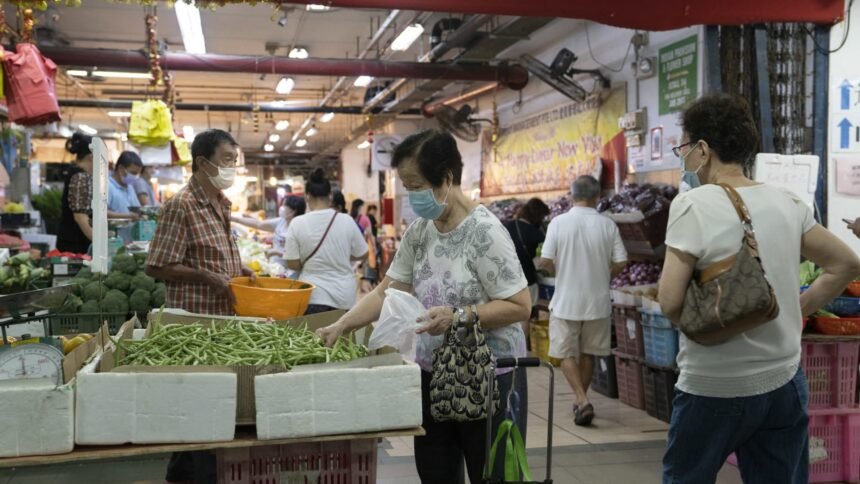
A shopper browses vegetables at a wet market in Singapore, on Wednesday, Dec. 22, 2021.
Bloomberg | Bloomberg | Getty Images
Inflation in Singapore held steady at 1.8% in May, falling short of economists’ expectations as lower prices for telecommunication services helped offset increases in private transport, accommodation, retail and food costs.
The figure was below the 2% expected by economists polled by Reuters and unchanged from the 1.8% recorded in April.
Higher car and motorcycle prices drove up private transport inflation.
Core inflation, which strips out accommodation and private transport costs, came in at 1.4%, against the 1.6% forecast.
The Monetary Authority of Singapore said in a statement that while energy prices have eased recently, they remain elevated relative to 2025 levels.
“As higher energy costs pass through global supply chains with a lag, they are expected to raise production and transport costs for a wider range of Singapore’s imported goods and services over time,” the central bank wrote.
It also said that service labor costs are likely to increase at a slower pace this year as nominal wage growth eases, adding that domestic consumer spending could turn more cautious amid the economic uncertainty.
The data also comes as Singapore’s central bank tightened its monetary policy settings in April, its first policy tightening since April 2022, citing inflation risks stemming from the conflict in the Middle East.
Unlike most central banks, the MAS manages monetary policy through the exchange rate rather than interest rates. It allows the Singapore dollar to move within an undisclosed policy band against a basket of currencies of its major trading partners.
At its April policy review, the MAS raised its forecasts for both core and headline inflation to 1.5% to 2.5% for the year, from 1% to 2% previously.
The inflation report follows stronger-than-expected economic growth in the first quarter. Gross domestic product expanded 6% in the first quarter from a year earlier, exceeding the 5.1% growth forecast in a Reuters poll.
The Ministry of Trade and Industry has maintained its 2026 GDP growth forecast at 2% to 4%, although it warned that “downside risks have risen significantly as a result of the U.S.-Israel-Iran conflict.”