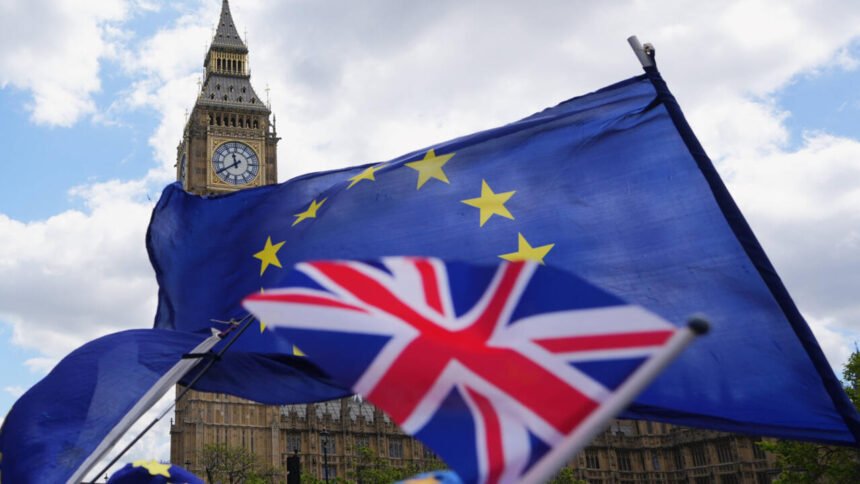
When the UK voted to leave the European Union on June 23, 2016, the close-run result dumbfounded many and kickstarted a climate of political tension in the UK that has become arguably worse ever since.
With polls finding that 23% of leave voters now regret their choice – either because they’ve changed their mind on Europe, or feel that politicians bungled the exit process – it seems many agree that Brexit has not been a success.
Watch moreBrexit: 10 years of regret?
But there is one area where 10 years of data shows the true scale of its failure – economists now estimate that Brexit has reduced the UK’s gross domestic product by as much as 8 percent.
This means average the Briton is up to 8 percent poorer than if Brexit had never happened, while at the national level there is an equivalent “loss in tax revenue that the government is getting which it spends on public services”, said Jonathan Portes, professor of economics and public policy at King’s College, London.
Among economists, “there’s a clear consensus that Brexit has done significant damage”, Portes added.
‘Pure hell’
To analyse the Brexit data, economists at Stanford’s Institute for Economic Policy Research used two models. The first compared the UK’s rate of growth over 10 years to other countries, factoring in global economic shocks such as Covid-19 and the impact of wars in Ukraine and the Middle East.
“Before the Brexit referendum, the UK was doing okay, and we’ve fallen behind relative to our peers since then,” said Gregory Thwaites, one of the authors of the Stanford study and associate professor of economics at the University of Nottingham.
“Our economy is about 8 percent smaller than it would be if we had not left the European Union, based on a comparison with other countries,” he added.
The second method assessed firms within the UK to see how well those that have frequently interacted with the EU since Brexit performed compared with those that have not.
It found that those still in high contact with the EU were performing significantly less well. “When you run those numbers, it looks like the UK is about 6 percent poorer than it would have been without having left the European Union,” Thwaites said.
The UK’s goods trade – especially cars and agri-food produce – has been hit particularly hard, as Brexit ramped up paperwork demands, making everyday procedures more time-consuming and costly for businesses.

The owner of a UK logistics company told a government committee in January that it was “pure hell” to acquire a sheaf of paperwork with 26 stamps to export lamb and beef to the EU – as opposed to the single sheet needed before Brexit.
There are hopes that the UK and EU will implement a new agreement to ease trade, particularly for dairy products, eggs, fish and fresh red meat, that would come into effect from summer 2027.
But that will come too late for the businesses that have already folded under increased demands. UK food exports to the EU have shrunk by nearly a quarter since Brexit came into effect, according to Britain’s Food and Drink Federation.
Read moreUK to rejoin Erasmus student exchange programme in post-Brexit reset
Brexit ‘held the UK back’
At the same time, the impact of Brexit has made a significant contribution to UK food price inflation that has seen basics such as orange juice soar by 134 percent.
While higher earners may be able to absorb the price hikes and stagnating wages that have impacted Britons across the board since the referendum, it is more difficult for others. “It hits the bottom harder, and that means that the poor are suffering more,” Thwaites said.
However, he added, it is not as simple as drawing a straight line from Brexit to potential indicators of poverty – such as the soaring use of food banks in the UK over the past 10 years – as there are so many other societal and economic factors at play.

“Brexit has never been the UK’s only [economic] problem by any means,” said Portes. “Like other European countries, it has lots of problems with lack of investment, slow growth and lack of innovation – but Brexit, over and above these, has held the UK [economy] back.”
The 10-year drain Brexit has been on the UK economy came at a time when the country could little afford it.
Welfare, health care and education services have never fully recovered from austerity cuts implemented by former prime minister David Cameron’s government in the 2010s – the same government that called the Brexit referendum.
Watch more‘Brex-what?’ Episode 2: Why did Cameron call the referendum?
Meanwhile, prisons are in a “dire” state, the national road network is falling into disrepair, and the UK’s defence chief has warned that, without investment, the armed forces will have to undergo operational cuts.
Ten years on from a referendum that shrank the UK economy and reduced tax revenue, poverty levels are rising and public services are crumbling.
“The ways to mitigate it are to try and reverse some of the damage from Brexit directly, by negotiating a closer arrangement with the EU, and to run the country as well as possible in every other respect,” Thwaites said.
But as the aftershocks of Brexit continue to ripple through the economy, there seems little hope of recovery any time soon. “My forecast would be that the damage continues roughly the same level that it’s at now,” he said.