Published on 6/22/2026
For more than half a century, NASA has led Mars exploration efforts with a long series of orbiters, probes and rovers that have revealed many of the Red Planet’s secrets.
Since the launch of the first successful missions in the 1970s, studies have evolved from imaging the surface to analyzing climate and atmosphere and searching for traces of water and ancient life.
Read also
list of 2 itemsend of list
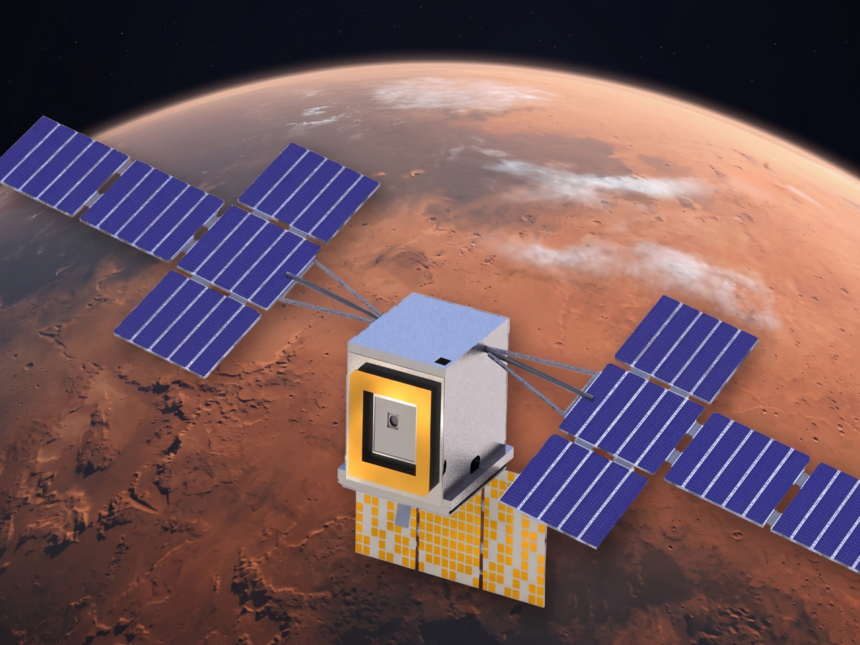
Today, NASA announces a new step that reflects profound transformations in the space industry, through a partnership between the public and private sectors with Relativity Space, which will design, build, and launch the spacecraft for the Aeolus mission, which is scheduled to be sent to Mars in 2028.

NASA Administrator Jared Isaacman said that partnerships between the public and private sectors represent a “power multiplier for science,” stressing that the combination of NASA’s advanced scientific equipment and commercial investments will accelerate scientific discoveries and reduce the time to obtain data necessary for future human missions.
“Aeolus”… the first daily observer of the Martian atmosphere
The Aeolus mission aims to provide the first integrated and comprehensive daily picture of the Martian atmosphere across the entire planet. The probe will collect continuous data about winds, temperatures, dust storms, and clouds, which are essential elements for a more accurate understanding of the Martian environment.
Through this mission, NASA seeks to develop climate models for Mars and improve the ability to predict weather conditions, especially dust storms, which represent one of the biggest challenges facing future missions.

The new data will help reduce the risks associated with entry, landing and descent operations for robotic and manned vehicles, making the mission an essential part of long-term preparations to send humans to the Red Planet.
Four devices to draw an unprecedented climate map
The Aeolus scientific system consists of 4 instruments that work together to form an integrated picture of the Martian atmosphere:
- The Doppler Wind and Temperature Meter device measures wind speeds and temperatures up to 60 kilometers above the surface.
- The thermometer provides vertical temperature profiles and monitors dust and water ice clouds.
- The “Surface Radiation Sensor Beam” device is dedicated to studying the energy balance on the surface and the properties of dust and clouds.
- A “wide-field camera” device that will capture daily images of atmospheric activity across the entire planet.
These devices will be designed and built at NASA’s Ames Research Center in California.
“Relevance Space”… a new bet in the Mars race
Reliability Space will develop the spacecraft, operate it during flight, and manage orbital operations around Mars. Although the company does not have a long history compared to the giants of the space industry, it became the focus of the sector’s attention after its development of the “Terran 1” missile, which was launched in 2023 but failed to reach orbit.
After that, the company focused its efforts on developing the larger, partially reusable rocket, “Terran R,” which is expected to carry out its first flight soon.
The company’s position was strengthened after former Google CEO Eric Schmidt joined its leadership in 2025 and invested large sums of money in developing its future projects.

The Aeolus mission builds on more than two decades of atmospheric studies of Mars carried out by missions such as MAVEN, Mars Reconnaissance Orbiter, and Mars Odyssey.
Although MAVEN’s mission recently ended after losing contact with the vehicle, it has operated for more than an additional ten years beyond its original operational life. Some Martian orbiters are still operating nearly two decades after their launch, which reflects NASA’s ability to achieve long-term scientific returns from its missions.
The agency expects to operate the Aeolus devices for a period of no less than a full Martian year, or about 687 Earth days, with the possibility of extending the mission if conditions permit.
conclusion
As humanity accelerates toward Mars, exploring the Red Planet is no longer a purely government mission, but rather an effort involving scientific institutions and private companies alike.
The Aeolus mission represents a new model for this cooperation, where scientific expertise is integrated with commercial innovation to serve a broader goal of understanding another world and preparing to visit it one day. Each new map of Mars is not just scientific data, but an additional step in man’s long journey to understand his place in the universe and expand the boundaries of knowledge.