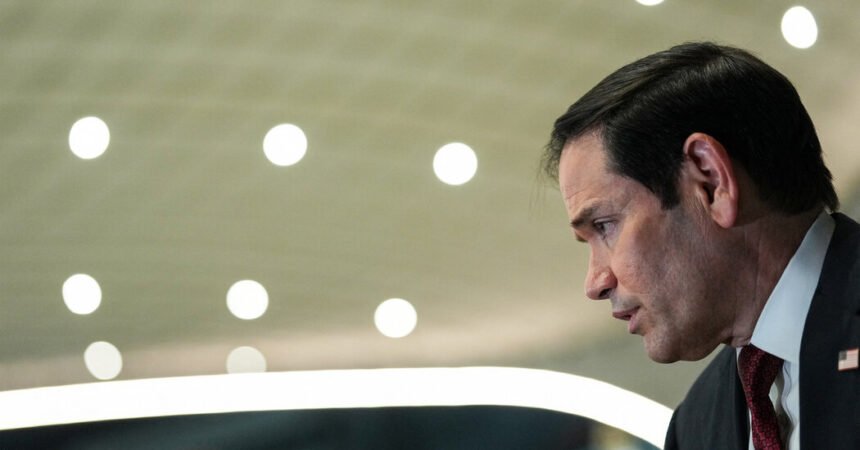
Secretary of State Marco Rubio kicked off a visit to the Middle East by saying that “no country” could charge ships for passage through the Strait of Hormuz, drawing a bright line on a key negotiating point with Iran that has major implications for global commerce.
Mr. Rubio arrived in Abu Dhabi, the capital of the United Arab Emirates, for the first of three stops in Gulf Arab capitals as leaders there and around the world try to decipher murky, often conflicting accounts of the negotiating positions Washington and Tehran have taken after a first round of peace talks in Switzerland concluded on Monday.
“No country is allowed to charge tolls or fees on an international waterway,” Mr. Rubio said. “That’s existing international law. That’s the way it is in international waterways all over the world, and that’s the way we expect it’ll be here.”
A memorandum of understanding signed last week by the United States and Iran recognizes that Iran has some form of control over the strait and says that Iran and Oman, whose lands border the waterway, would work out its administration. The memorandum also said no country would charge any toll for 60 days, but did not mandate any conditions after that.
Iran has asserted a right to charge ships for passage through the strait and has discussed the idea with the government of Oman. Iranian officials have said the levies would not be tolls, but fees for unspecified services. Shipping analysts have called that little more than semantic evasion.
President Trump, in a social media post on Saturday, ruled out any tolls on traffic through the strait “unless they are imposed by and for the United States of America.” Mr. Rubio did not specifically address Mr. Trump’s comment.
Mr. Rubio, who also serves as Mr. Trump’s national security adviser, is on his first Middle East trip since the United States and Israel launched a war on Iran almost four months ago.
Speaking to reporters minutes after landing, he also suggested that Iran was, for domestic political reasons, denying that it had agreed to allow nuclear inspections by the International Atomic Energy Agency. “We know what they agreed to,” Mr. Rubio said. “I don’t know why they have to say the things they say.”
After talks in Switzerland, Vice President JD Vance told reporters on Monday that Iran had agreed to the inspections, and Mr. Trump repeated the point on Tuesday. But Iranian officials have denied that claim.
“Whatever their internal or domestic politics is, I guess they’ll navigate it,” Mr. Rubio said. “But we know what they agreed to do, and now they’ll either do it or they won’t. And if they do, the process moves forward. And if they don’t, the president will have some decisions to make.”
Mr. Trump’s top diplomat also responded to concerns that the memorandum of understanding did not specifically address the future of well-armed Iranian-backed groups across the Middle East that have attacked American and allied military forces and assets.
Mr. Rubio said that the memorandum, which calls for “the permanent termination of the war on all fronts,” applied to those groups.
“You can’t have an end to hostilities and conflicts in a region as long as Iranian proxies are launching missiles and drones from Iraq, and are participating in terrorism, like Hamas did, and like Hezbollah did,” he said. Mr. Rubio said that the matter would be addressed “at the appropriate time in these negotiations.”
Mr. Rubio also said that Iran could draw foreign direct investment and “do incredible things” if it chose “to be a country instead of a revolutionary movement that exports terror.” Even so, he added, any investment “won’t be our government money.”
Mr. Rubio will meet with Emirati officials on Wednesday before heading to Kuwait. He will then attend a meeting of the Gulf Cooperation Council, an alliance that includes Kuwait, Oman, Qatar, Saudi Arabia, the United Arab Emirates and Bahrain, which will host the gathering.