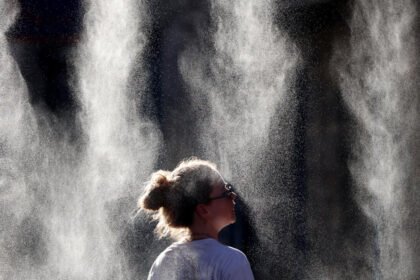

After a heat wave 23 years ago caused 70,000 deaths across this continent, European countries took steps to try to minimize the suffering next time around.
They created early warning systems, organized cooling shelters and helped hospitals get better prepared. Paris built a registry of elderly and vulnerable residents, who get check-in calls when temperatures climb.
This week, the continent is being swept by intense heat that is drawing comparisons to the disaster of 2003. And while the earlier safety measures have helped Europe avoid a cataclysmic replay, today it remains vulnerable.
In Western Europe, which is the epicenter of this week’s early season heat, air-conditioning rates remain relatively low. The European Union’s demographics add to the challenge, with the absolute number of senior citizens rising 40 percent over the past two decades, effectively swelling the population most susceptible to extremes.
And meantime, as greenhouse gas emissions rise, the pace of heat waves keeps accelerating. Of France’s 52 official heat waves since 1947, half have occurred in the past 16 years. “We have adapted, but it is far from enough for what is coming,” said Pierre Masselot, an environmental epidemiologist at the London School of Hygiene & Tropical Medicine.
The latest torrid stretch has brought Sahara-like conditions to tourist-filled capitals, with temperatures in parts of Western Europe rising 25 degrees Fahrenheit above normal. In France, several consecutive days will challenge all-time heat records. France put much of the country under red-level alert, meaning the potential of a “strong health impact.”
Britain’s Met Office issued extreme heat warnings and said June records would most likely be shattered. High temperatures at night will “make it very hard for people to recover from the daytime heat, exacerbating the heat stress,” said Mark Sidaway, the Met Office’s deputy chief forecaster.
Heat waves become deadlier as they go on, as strain builds up in bodies. Even when heat waves leave no glaring distress signals in real-time, they can levy an enormous toll. The World Health Organization says more than 200,000 people across Europe have died from heat over the past four years.
Those numbers would seemingly point to a mortality rate not so different from 2003. But Joan Ballester, a research professor at the Barcelona Institute for Global Health, said the death count from 2003 would likely be much higher if the same methodology were used as in more recent research of heat deaths. “So the magnitude in 2003 was much higher,” Dr. Ballester said.
A study published two years ago in Nature said that measures taken over the past two decades had “substantially reduced” heat-related mortality, particularly in the elderly. Heat-related deaths from 2023 would have been about 80 percent higher without the steps to adapt, the study concluded.
But that progress hasn’t prevented some withering critiques. Last month, an editorial in Le Monde, a French national newspaper, called France “unprepared,” noting that the government had relaxed rules aimed at improving buildings and homes. Paris has struggled to contend with its zinc roofs, which give the city its signature look, but direct powerful heat to apartment-dwellers below.
Then, there’s the matter of air-conditioning.
About one-quarter of French homes have the cooling units. In Italy, half are equipped. Those numbers have ticked up over the years, but they don’t approach the levels in the United States and East Asia. French policymakers have tended to encourage passive cooling for buildings, like shading and greenery, noting that air-conditioning taxes energy grids and contributes to emissions.
But it can also provide lifesaving refuge during a heat wave. A 2023 study published in The Lancet identified Paris as the city with the highest risk for heat. And overall, Northern European countries, which lack decades of practice dealing with extreme heat waves, tend to have the largest risk factors.
In France, the 2003 disaster is still invoked as the pre-eminent summer catastrophe and a moment when the dangers became apparent. That year, the heat wave hit in early August, a sacrosanct vacation period when politicians, health workers and many of the country’s young people were at the beach. But elderly and vulnerable people were stuck in Paris, roasting in hot apartments.
Eventually, the Paris morgue was overwhelmed. The city erected refrigerated tents to hold bodies.
Though France became the face of the disaster, excess mortality was comparably high in Luxembourg, Italy and Spain.
This time around, cities across France opened up cooling spaces in town halls, museums and libraries. Paris permitted swimming in the Canal Saint-Martin. Welfare coordinators did their check-ins. Hundreds of schools were closed.
Mathilde Pascal, an epidemiologist at France’s public health agency, who’d helped devise the country’s response, said the current heat wave was like the “crash test” after years of preparation. “We are better prepared,” Dr. Pascal said. She mentioned that schools had been canceled, sports events called off and many employees asked to work from home. “I hope the burden will be less than 2003, but I fear it will be high anyway,” she said. “It’s just so dangerous.”