While many big name philanthropists are backing away from climate giving, at least one megadonor is stepping up and writing major checks.
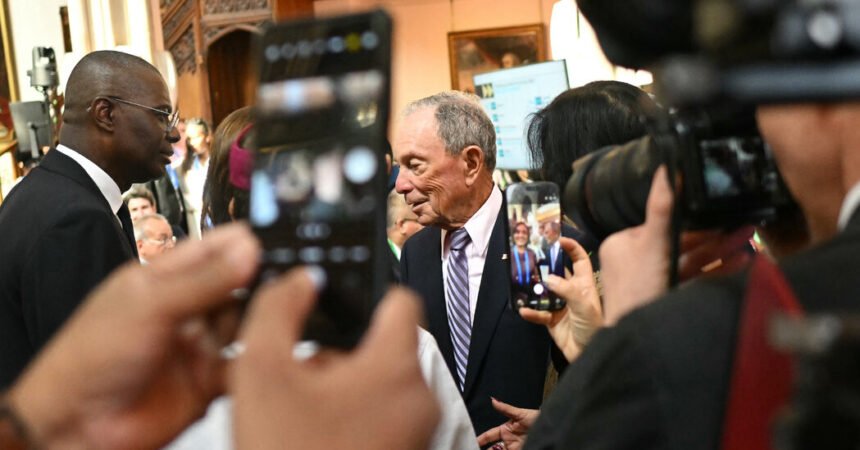
Michael Bloomberg, the former New York City mayor and founder of Bloomberg L.P., has announced $590 million in new environmental commitments in recent days.
The funds will flow from Bloomberg Philanthropies, his charitable organization, and support work on ocean conservation, energy transition and efforts to combat air pollution.
Some $285 million will go to efforts accelerating the transition away from fossil fuels and toward renewable energy at a moment when the Iran conflict is rattling energy markets.
Bloomberg Philanthropies said it would do this by supporting renewable energy industry associations, providing data and analysis on the industry and advising regulators and grid operators.
Among the groups set to receive funds are Ember, an energy research firm; Global Energy Monitor, a nonprofit group that collects energy data; the World Resources Institute, a think tank that focuses on climate and development issues; and the University of Maryland Center for Global Sustainability.
“Fossil fuels used to be viewed as reliable and secure and it was renewable energy that was viewed as volatile and intermittent,” said Antha Williams, who leads the environment program at Bloomberg Philanthropies. “That has flipped on its head. Supporting clean energy work in these emerging and developing markets feels very timely.”
An additional $260 million will be spent on efforts to protect the oceans. Grantees include the Wildlife Conservation Society, the Woods Hole Oceanographic Institution, Global Fishing Watch and Oceana.
Williams said a key focus of the oceans work would be supporting the creation of new marine protected areas in international waters. And for the first time, Bloomberg Philanthropies will be funding efforts to restore coral reefs.
A final $45 million of the Bloomberg Philanthropies funds will support programs to improve air quality in major cities around the globe.
Funding climate issues was, until recently, a popular pursuit of the billionaire class. Bill Gates, Jeff Bezos and Mark Zuckerberg were among the tech titans who made huge pledges to address global warming.
But since President Trump’s return to office, many of those efforts have gone quiet or fizzled altogether.
Early last year, Gates slashed funding to Breakthrough Energy, his main climate group. Then in October, he issued a memo warning against climate alarmism.
Bezos committed to spend $10 billion on climate issues back in 2020. But the Bezos Earth Fund, which he set up to administer his giving, is well behind its goal of spending its funds by 2030, Bloomberg News has reported.
And Zuckerberg, who once funded climate issues through his foundation, the Chan Zuckerberg Initiative, appears to have stopped his environmental giving.
Other climate funders are trying to effect change through academia and politics. Tom Steyer, the former hedge fund manager turned climate activist, spent $558 million on a failed bid to become governor of California. And the venture capitalist John Doerr donated $1.1 billion to Stanford University to fund a climate school.
Bloomberg, meanwhile, has spent much of his fortune supporting efforts to close coal plants and block the expansion of the petrochemical industry.
“Mike has been very steadfast in his commitment to global climate action,” Williams said. “We get outreach from people who are saying, ‘We want to take action to solve the urgent problem of climate change,’ or ‘We need your help to transition to less polluting sources of energy,’ Mike has told us to answer that call.”
How much hotter can Europe get?
Summer is just getting started, but Western Europe is already sweating through its second severe heat wave of the year. Greenhouse gases from burning fossil fuels are raising temperatures across the globe, and Europe is warming faster than any other continent.
That’s prompting scientists to study an urgent question: How hot can a heat wave actually get? Not in future decades, as global warming continues, but today. Maybe even this summer.
“We do know that heat waves are becoming more severe and more frequent, and they’re lasting longer,” said Rebecca Emerton, a senior scientist at the European Centre for Medium-Range Weather Forecasts in Reading, England. What’s striking now, Dr. Emerton said, is the big margins by which temperature records are being broken. — Raymond Zhong
Read more.
A climate website lives again
A group of former government workers has recreated a valuable climate-science database shuttered last year under the Trump administration.
The new site, climate.us, is an effort by former staff members at the National Oceanic and Atmospheric Administration to preserve climate science previously housed at climate.gov, including data, reports, articles and congressionally mandated national climate assessments.
The new site is effectively the “first full clone” of the original, said Rebecca Lindsey, managing director of climate.us.
“The best solutions to our climate challenges are going to come from a climate literate public,” Ms. Lindsey said. The new site became fully active on Tuesday morning. — Quinn Glabicki
Read more.