Published on 6/21/2026
Ever since the solar storm known as the Carrington Event struck Earth in 1859 and cut off telegraph networks around the world, scientists have been seeking to understand and predict the dangers of space weather.
As humanity becomes increasingly dependent on satellites, power grids, communications and navigation systems, solar storms are becoming a growing threat to modern infrastructure.
Read also
list of 2 itemsend of list
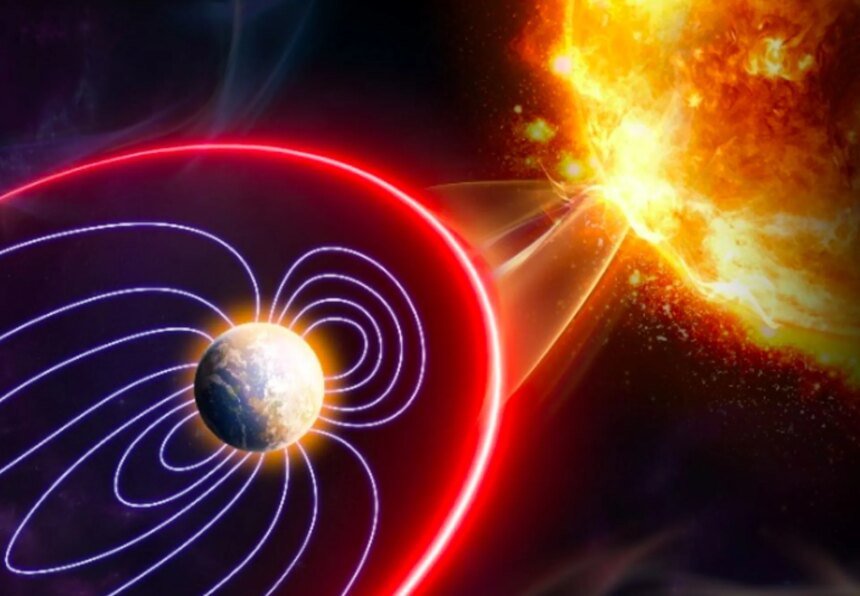
Today, a team of researchers presents an unprecedented vision that not only predicts geomagnetic storms, but also proposes direct intervention to reduce their effects through temporary modification of the space environment surrounding the Earth.
From predicting storms to trying to weaken them
The concept of the study is based on the idea that geomagnetic storms arise when the solar wind transfers huge amounts of energy to the Earth’s magnetosphere through a process known as Magnetic Reconnection.
This connection is the clash of magnetic field lines in the tail farthest from Earth, and the more efficient the connection, the greater the severity of the storm and its effects on satellites, power grids and astronauts.

The researchers propose a new technology called StormWall, which is based on increasing the physical density of plasma near the diurnal limit of the Earth’s magnetosphere.
According to physical models, increasing the density in this region reduces the efficiency of magnetic reconnection, which leads to a reduction in the amount of energy transferred from the solar wind to the space environment surrounding the Earth.
The importance of this idea comes at a time when fears are increasing of major solar storms that could cause economic losses estimated at trillions of dollars, especially if exceptional events of the magnitude of the historic Carrington accident are repeated.
How does a space storm wall work?
The study proposes deploying a group of satellites in geosynchronous orbit carrying tanks containing materials that can be converted into plasma, such as barium or lithium.
When they receive a warning of the arrival of a coronal mass ejection – which is high-energy solar plasma coming out of the sun into space – or an intense solar flare, the satellites release these materials into space. After a few minutes, it is ionized by sunlight and turns into plasma that drifts toward the outer limits of the magnetosphere.
Researchers liken this system to an airbag in cars. It remains in a constant state of readiness for many years, and is only activated when needed. Its operation does not require launching new spacecraft during an emergency, but rather issuing commands to satellites already in orbit is sufficient.
The researchers confirm that the proposed technology is based on previous scientific experiments that used the release of chemicals into space to study the behavior of plasma, which gives the idea an initial scientific and applied basis.
Computer simulation with promising results
To test the idea, scientists used the Space Weather Modeling Framework, one of the most advanced systems for simulating the Earth-space environment, and they conducted a simulation of the major magnetic storm that occurred on May 10 and 11, 2024, known as the “Gannon Storm.” The experiment included operating six virtual satellites that released material at a rate of 1.27 kilograms per second for each satellite for 14 hours.

The results showed a significant decrease in indicators of magnetic activity, as the electrical aurora index decreased by more than 84% at the peak of the storm, while the polar cap voltage decreased by 61%.
The models also showed a clear decrease in rapid changes in the Earth’s magnetic field, a phenomenon directly related to magnetically induced currents that may cause widespread malfunctions in electrical power networks.
Can the project actually be implemented?
The study indicates that the implementation of the proposed system is within the limits of current or near technical capabilities, and the total mass required for the project is estimated at approximately 436 thousand kilograms, including the materials used, satellites, and tanks.
Researchers believe that new generation rockets such as Starship may be able to transport this payload to orbit on several flights within a relatively short period. The mission can also be distributed to a larger number of small satellites and shared among multiple countries within the framework of international cooperation to protect global infrastructure from the dangers of space weather.

Despite the encouraging results, the team stresses that more studies are needed to evaluate possible side effects, such as the generation of new electromagnetic waves or unexpected plasma disturbances.
In a world that is increasingly connected to space, this study represents an important intellectual shift. Instead of simply observing and predicting the dangers of the universe, humanity begins to think of ways to interact with them and defend itself against them.
The space “storm wall” may be a first step towards a new era in which the role of science is not limited to understanding nature, but extends to engineering safer environments for humanity. Every new discovery reminds us that knowledge is not an intellectual luxury, but rather a tool for protecting civilization and expanding the limits of human possibility.