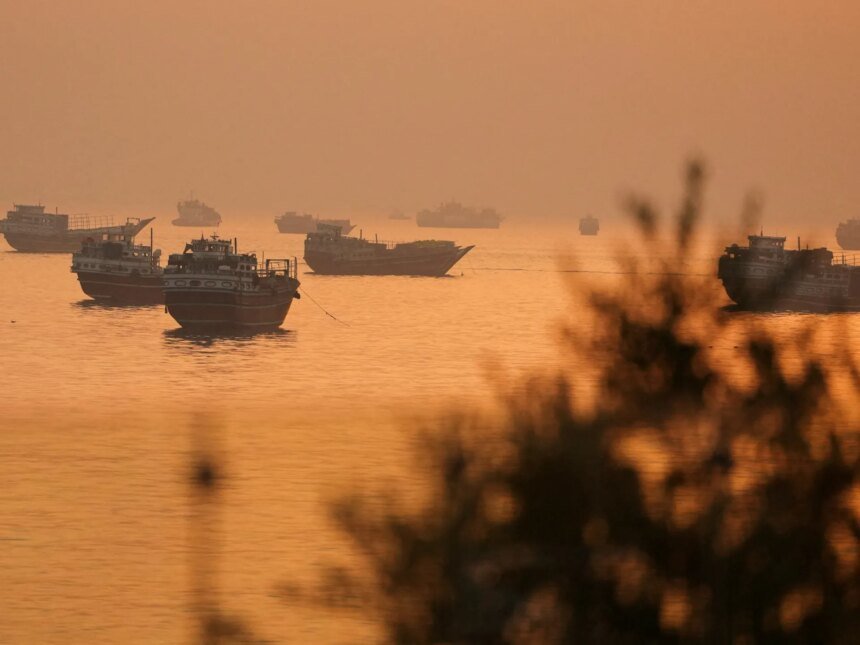
Oil markets are awaiting the state of navigation in the Strait of Hormuz after the Iranian authorities announced its closure as a result of the Israeli bombing of Lebanon, while the US military confirmed the continuation of shipping traffic in it on Saturday, with expectations that this disturbance will affect the oil markets during transactions tomorrow, Monday, with the beginning of weekly trading.
The Iranian Tasnim News Agency, citing a source close to the Iranian negotiating team, reported on Sunday that the Strait of Hormuz will not be reopened as long as the failure to respect the ceasefire in Lebanon continues.
Read also
list of 4 itemsend of list
The Iranian source added that the waterway will remain closed also until exemptions are issued allowing the sale of Iranian oil.
The memorandum of understanding between Washington and Tehran on ending the war, signed last week, calls for the reopening of the strait and the cessation of hostilities on all fronts, including Lebanon, but with no indications of an end to the fighting there, Iran announced on Saturday that the strait was closed again.
However, US officials denied closing the strait and said that 55 commercial ships crossed it on Saturday, according to what Reuters reported.
Bloomberg quoted US Central Command as saying that about 17 million barrels of oil crossed the Strait of Hormuz on Saturday, despite Iranian media reports that it was closed.
Bloomberg added that three giant oil tankers, with a total capacity of 6 million barrels, sent signals as they sailed through the strait on Saturday on a course close to the coast of Oman.

Oil price increase
The memorandum of understanding between Washington and Tehran stipulates 60 days of talks on issues such as curbing Iran’s nuclear program in exchange for lifting international sanctions. Tehran also initially received economic benefits, such as the exemption of its oil from sanctions.
Since the announcement of the agreement, crude prices have fallen to levels not seen since the start of the war, as the price of oil reached about $80 per barrel during Friday’s transactions.
But the return of the actual closure by Iran may push prices to rise again when trading in the markets resumes tomorrow, Monday.
US President Donald Trump said that he agreed to the memorandum of understanding with Tehran to avoid a global depression due to the rise in oil prices resulting from the closure of the strait.
In this context, oil expert Mamdouh Salama confirmed to Al Jazeera Net that the repeated closure of the Strait of Hormuz, and its irregular opening, creates a state of turmoil in the oil markets.
He said, “Tehran’s repeated closure of the Strait of Hormuz creates a situation that leads to a permanent increase in price as a result of what is known as the ‘traffic premium through the Strait of Hormuz.'”
The oil expert estimates this increase at between 15 and 20 dollars per barrel of Brent crude, noting that Tehran used the Strait as a tool to defend its rights in the face of the American-Israeli war on it.

Mamdouh Salama explained that this increase will become an essential part of the price of oil in the future, and will lead to a continuous rise in prices.
He said that the price of oil was between 60-65 dollars per barrel before the war, and “now it will be between 85-90 dollars, or close to 100 dollars per barrel.”
Salama added that there are other elements that contribute to the rise in oil prices in the long term, including the need for huge investments in the oil production sector estimated at billions of dollars over the next twenty years to ensure that the level of global oil production does not decline.
‘Mixed signals’ about fees
The Iranian authorities said on Friday that they would exempt ships from the fees required to cross the Strait of Hormuz during a 60-day negotiation period in accordance with the memorandum of understanding signed with Washington.
Bloomberg reported from the Iranian authorities that the insurance documents needed to cross the Strait of Hormuz are “free” at the present time, but they may include fees that ships crossing the Strait must pay in the future.
Bloomberg explained that what it described as “conflicting signals” issued by the Iranian authorities regarding the Strait of Hormuz raise concerns among those working in the shipping sector about the nature of the system that Tehran will implement after it completes negotiations with Washington, amid the possibility that this system will include requiring all ships to pay insurance fees when crossing the strait.
Economist Ziad Al-Hashimi explains to Al-Jazeera Net that the repeated closure of the Strait of Hormuz, and the constant disruption of navigation traffic in it, with the possibility of imposing fees on ships crossing it, affects global energy supply chains and leads to broad negative repercussions on energy markets.
He added that this disruption in the movement of crossing the Strait pushes shipping and insurance companies to maintain an increase in the price of shipping, known as the “risk premium,” applied to all shipments, whether oil shipments or anything else.
According to Al-Hashemi, this situation leads to a rise in oil prices for an unknown period, as long as risks in the Strait of Hormuz continue, and shipping companies continue to bear the risk premium.
He said that this situation may push buyers in Asia to shift to other oil-exporting countries that do not have risks.
Al-Hashemi also stressed the importance of alternative routes for transporting oil away from the Strait of Hormuz, such as pipelines, noting that this is what several oil-exporting countries are trying to do, including Saudi Arabia and Iraq.