Published on 6/22/2026
|
Last update: 03:13 (Mecca time)
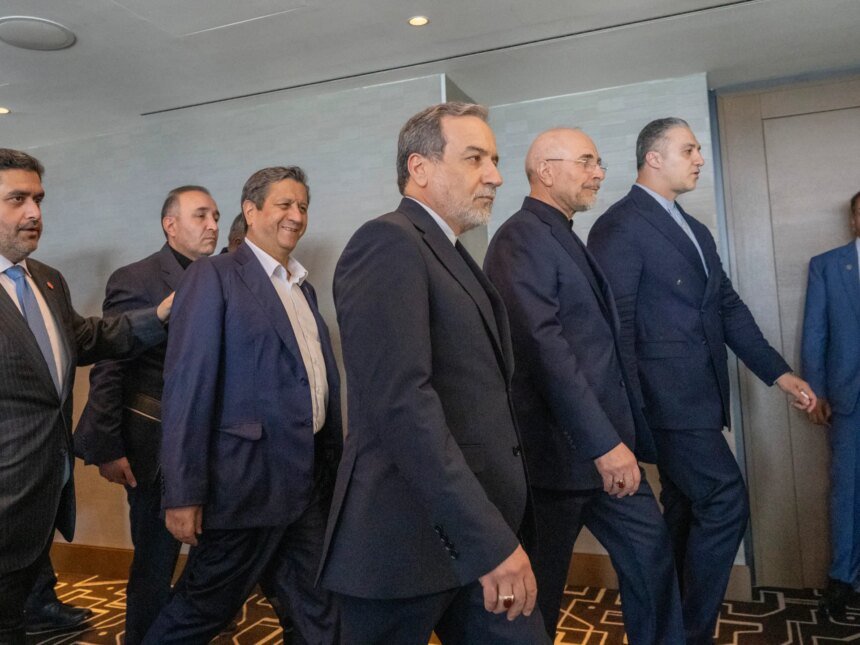
A senior American official participating in the US-Iranian talks in Switzerland said that negotiations between the two sides are still ongoing since Sunday morning, denying reports that the Iranian delegation left the talks headquarters in the Bürgenstock resort in protest against the threats of US President Donald Trump.
The official said – in a statement to Al Jazeera – that the American delegation is engaged in ongoing meetings and negotiations, stressing that – contrary to what was stated in circulating reports – the Iranian delegation is still present, and that discussions are continuing.
The official added that the American delegation expects to continue work and negotiations throughout the night, noting that the talks addressed some ambiguous Iranian messages regarding the Strait of Hormuz.
He explained that mechanisms were being worked on to prevent escalation and ensure that the Strait of Hormuz remains open, in addition to discussing ways to implement a ceasefire in southern Lebanon.
The American official also indicated that the negotiations witnessed in-depth discussions on all elements of the nuclear agreement, stressing that work will continue on these files, while using what has been achieved so far to move to technical talks.

Uninterrupted conversations
Earlier, an American diplomat confirmed to Axios that the US-Iranian talks in Switzerland began on Sunday morning and continued without interruption and in different formats.
The American diplomat said that the parties discussed several files, including the Strait of Hormuz, the nuclear agreement, mechanisms to prevent friction, and implementing a ceasefire in Lebanon.
He explained that Washington discussed with Tehran and the mediators the issue of the Strait of Hormuz and the recent Iranian statements regarding the possibility of closing it, stressing that the American side stressed the need to ensure that the Strait remains completely open.
He added that the talks had made good progress on the Strait of Hormuz issue, and that they had addressed all elements of the nuclear agreement, in addition to discussions that he described as useful regarding mechanisms for implementing the terms of the memorandum of understanding with Iran.
The diplomat indicated that the two sides discussed a plan to continue the talks, whether at the level of senior leadership or technical teams, pointing out that the Pakistani and Qatari mediators are helping the two sides to overcome differences and difficulties, and that the four parties are satisfied with the way the talks went.
He continued that the first round of talks lays the necessary foundations for building confidence in the next stage, explaining that the talks at the high political level are expected to end today, Monday, while the technical teams will continue their discussions, and are likely to remain in Switzerland to continue their work.
Getting negotiations back on track
On the other hand, the Iranian News Agency reported that the mediators are seeking to return the negotiations to their previous track, noting that the Iranian negotiating delegation is in Bürgenstock, and that consultations and discussions are still continuing.
MS Now quoted a senior Pakistani official as saying that Pakistani Interior Minister Mohsin Naqvi was meeting with the Iranian delegation, in a final attempt to keep them in the negotiations.
He added that the Iranian side has reversed its position and become more flexible, and that “the talks will continue for the time being.”
Another source told the network that the Iranians were frustrated with Trump’s statements, and that the first round ended earlier than expected as a result.
The Iranian Tasnim Agency reported – from a source close to the Iranian negotiating delegation – that the team left the headquarters of the talks in protest against the threats of President Trump, who said that Iranian negotiators “will not be able to return to their country” if Tehran closes the Strait of Hormuz.
The Iranian news agency also reported that the Iranian delegation left the negotiations headquarters, while the American CNN network quoted an informed Iranian source as saying that “the talks faltered after Trump’s threat, but they have not collapsed yet.”
The Iranian source added to the network that “background communication channels are currently working to urge the parties to return to the negotiating table.”
Trump’s threats came at the start of the US-Iranian talks, as he said – in statements to Fox News on Sunday – that he spoke with Iranian officials and warned them against closing the Strait of Hormuz.
This comes after the Iranian Revolutionary Guard announced – last Saturday – that it had closed the Strait of Hormuz to all ships, in response to the continued Israeli attacks on Lebanon, which Tehran asserts violate the memorandum of understanding signed with Washington, which stipulates stopping the war on all fronts.
On June 15, the United States and Iran announced – with the Pakistani mediator – that they had reached an agreement on a memorandum of understanding to end the war, which Washington and Tel Aviv started against Tehran on February 28.